
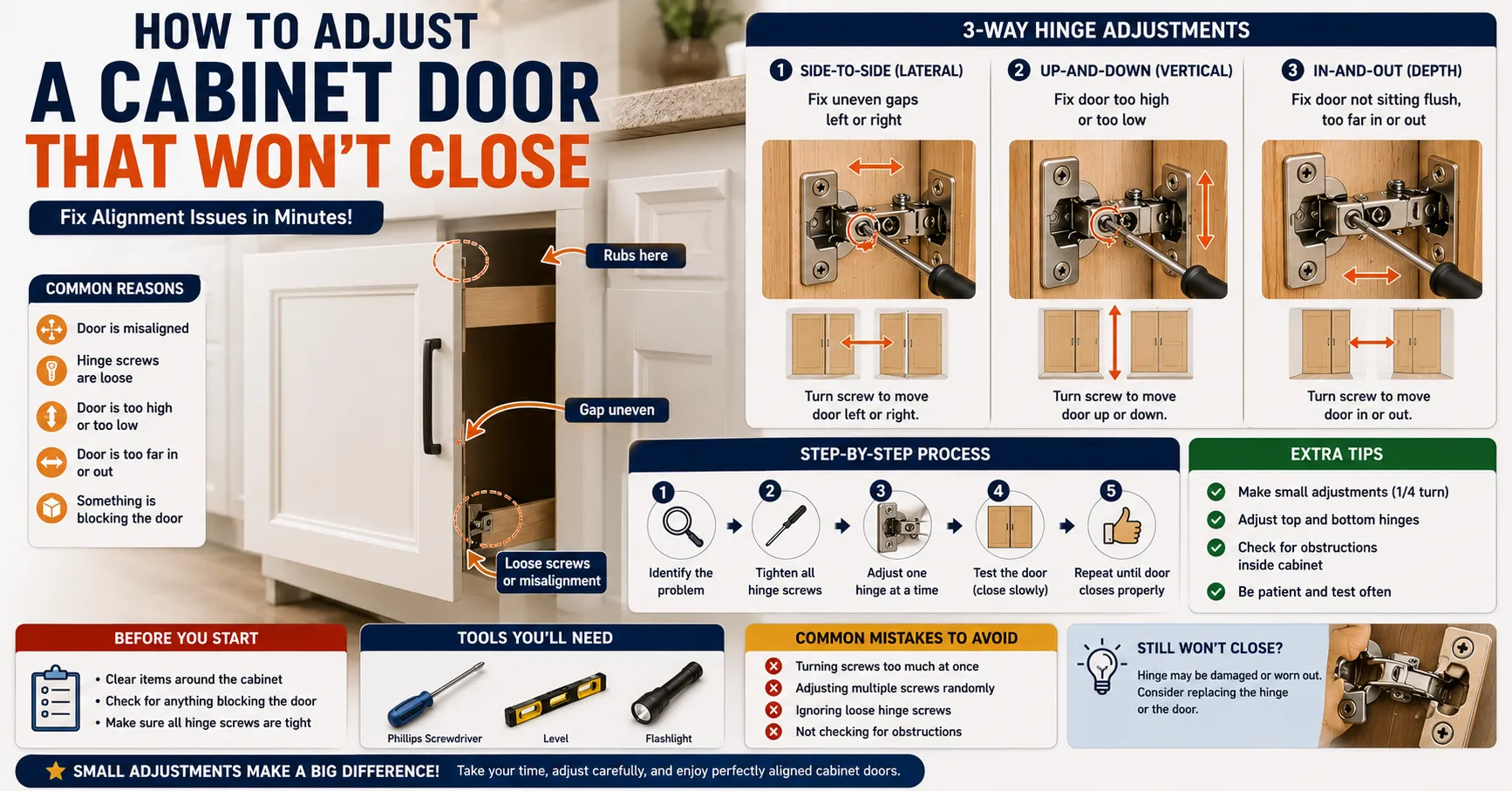
A cabinet door that won’t close is usually caused by a loose hinge, incorrect alignment, a sagging door, or damaged screw holes. Fortunately, most cabinet door problems can be fixed without replacing the entire door or hiring a professional. With a screwdriver, careful adjustments, and a few inexpensive repair supplies, you can often restore smooth and proper operation in less than an hour. This guide explains how to adjust cabinet door hinges, repair stripped mounting holes, and correct common alignment problems. Whether you have modern European hinges or older-style cabinet hinges, the steps below will help you identify the cause and make the right repair. For more detailed adjustment techniques, see our cabinet door adjustment guide.
What You Need
- Phillips screwdriver, usually
- Small level
- Measuring tape or ruler
- Cordless drill with a screwdriver bit
- Replacement cabinet screws
- Wood glue and wooden toothpicks
- Cabinet hinge repair plate
- Soft cloth
- Replacement hinge, if required
For damaged or stripped hinge holes, a can provide a stronger mounting surface. Product availability and pricing may change.
Before You Start
Open the cabinet door and inspect each hinge carefully. Check whether the door is sagging, rubbing against the frame, sitting too high or low, or stopping before it reaches the cabinet box.
Look for loose screws, bent hinge arms, cracked wood, and holes that no longer grip the screws. If the hinge is firmly attached but the door is misaligned, adjustment should solve the problem. If the screws spin without tightening, the mounting holes may be stripped.
If you are unfamiliar with hinge adjustment, review our guide on how to adjust cabinet door hinges before beginning. Keep the door supported while working, especially if it is large or heavy.
Step 1: Identify Why the Cabinet Door Won’t Close
Close the door slowly and observe where the problem occurs.
- If the door hits the cabinet frame, it needs alignment.
- If the door sags downward, the hinge screws may be loose.
- If the door closes but immediately opens again, the hinge may be under tension or misaligned.
- If the hinge pulls away from the cabinet, the screw holes may be stripped.
- If the door rubs against another door, both doors may need adjustment.
Inspect the top, middle, and bottom hinges. A tall cabinet door may have three or more hinges, and all of them should be checked.
Step 2: Tighten the Hinge Screws
Use the correct screwdriver to tighten every accessible hinge screw. Do not overtighten, because excessive force can strip the screw head or damage the cabinet wood.
Hold the door in its correct position while tightening. If the door is heavy, ask someone to support it or place a padded object underneath it temporarily.
If a screw continues spinning without becoming tight, remove it and inspect the hole. A stripped hole cannot hold the hinge securely, so simply tightening the screw will not provide a lasting repair.
For older cabinets, you may also need to follow our tutorial on how to adjust old cabinet door hinges.
Step 3: Adjust the Cabinet Door Hinges
Many concealed cabinet hinges have separate adjustment points for sideways, depth, and height movement.
Side-to-side adjustment
Turn the horizontal adjustment screw gradually to move the door left or right. This is useful when the door overlaps the frame or leaves an uneven gap.
In-and-out adjustment
Use the depth screw to move the door closer to or farther from the cabinet box. This can correct a door that sits too far forward or does not sit flush.
Up-and-down adjustment
Loosen the screws attaching the hinge mounting plate to the cabinet side. Raise or lower the door, then retighten the screws carefully. This explains how to adjust cabinet door hinges up and down.
Turn each adjustment screw only one-quarter turn at a time. Close the door after every adjustment so you can see the result.
Step 4: Repair Stripped Hinge Holes
If the hinge screws no longer grip the wood, remove the hinge from the cabinet. Apply a small amount of wood glue inside the damaged hole, then insert several wooden toothpicks or small wood slivers.
Allow the glue to dry according to the manufacturer’s instructions. Cut or snap the excess material flush with the cabinet surface. Reposition the hinge and carefully reinstall the screw.
For severely damaged wood, use a metal repair plate instead. Place the plate over the damaged hinge area and secure it with the supplied screws. Attach the original hinge to the repair plate.
may be suitable for this type of repair. Always check the product dimensions and screw spacing before purchasing.
Testing
Close the cabinet door slowly and check the gap around all four sides. The gap should be reasonably even, and the door should sit flush with neighboring doors.
Open and close the door several times. Listen for scraping, clicking, or popping sounds. Check that the hinge screws remain tight and that the door does not shift after repeated use.
If the door still will not close, return to the adjustment screws and make smaller changes. For a visual reference, see our cabinet door hinge adjustment diagram.
Common Mistakes
- Turning several adjustment screws at the same time
- Making large adjustments instead of quarter-turn adjustments
- Overtightening screws
- Ignoring a loose mounting plate
- Adjusting only the top hinge on a tall door
- Using screws that are too long
- Installing a repair plate without checking its dimensions
- Failing to support a heavy cabinet door
- Replacing the hinge before checking the cabinet alignment
When to Replace the Part
Replace the hinge if the metal is bent, cracked, badly rusted, or no longer holds the door under normal tension. A hinge with a broken spring or damaged pivot usually cannot be repaired reliably.
You should also consider replacement if the hinge style is outdated, the adjustment mechanism is damaged, or matching replacement parts are readily available. When replacing a concealed hinge, check the cup diameter, overlay measurement, screw pattern, and opening angle.
If the cabinet wood is extensively cracked or rotten, a repair plate may not be enough. In that situation, professional cabinet repair may be the safer option.
Recommended Tools and Parts
- Phillips screwdriver
- Cordless drill
- Small level
- Wood glue
- Wooden toothpicks
- Replacement cabinet screws
Some links may be affiliate links. If you purchase through them, the website may earn a commission at no additional cost to you. Check the current product details, price, and compatibility on Amazon before buying.
FAQ;
Why won’t my cabinet door close all the way?
The most common causes are loose screws, incorrect hinge alignment, a sagging door, or a damaged hinge mounting area. Adjust the hinges first, then inspect the screw holes if the door continues to move.
Which cabinet hinge adjustment screw should I turn?
The side-to-side screw moves the door left or right. The depth screw moves it in or out, while the mounting plate usually controls vertical movement. Make small adjustments and test the door after each one.
How do I fix a cabinet door that keeps sagging?
Tighten the hinge screws and check whether the mounting holes are stripped. If they are damaged, repair them with wood glue and toothpicks or install a hinge repair plate.
Can I adjust old-style cabinet door hinges?
Yes. Older hinges may use mounting screws or slotted holes rather than modern adjustment screws. Loosen the screws slightly, reposition the door, and retighten them while holding the door level.
Should I replace the hinge or the entire cabinet door?
Usually, replacing or repairing the hinge is more practical. Replace the cabinet door only when the door itself is cracked, badly warped, or structurally damaged.