
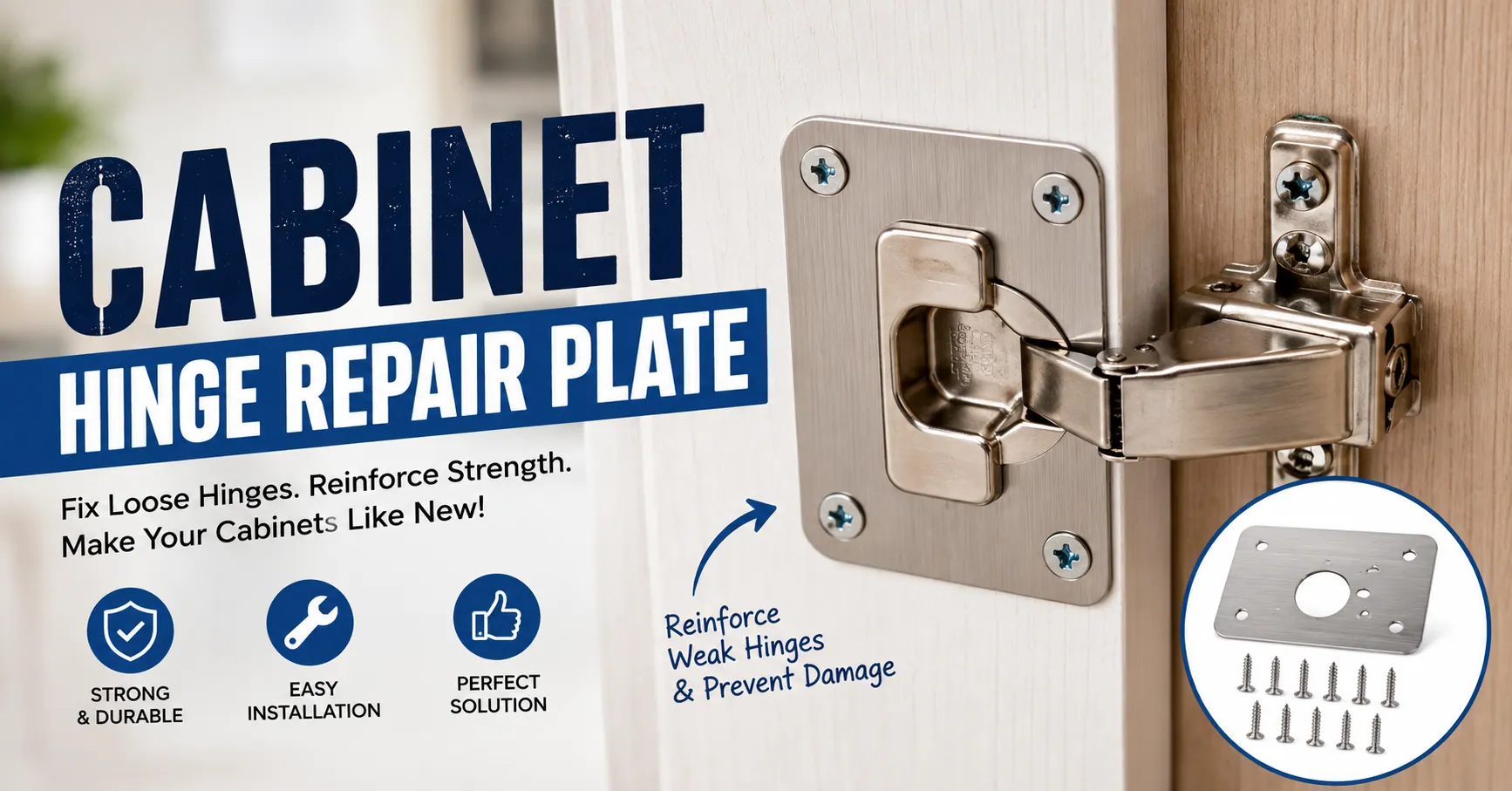
A damaged cabinet hinge can make a door sag, sit unevenly, or stop closing properly. In many cases, the hinge itself is not the real problem—the screw holes in the cabinet may have become stripped, enlarged, or damaged. A cabinet hinge repair plate can provide a stronger mounting surface and allow the existing hinge to be secured again without replacing the entire cabinet door. These small metal plates are commonly used for kitchen cabinets, cupboards, wardrobes, and furniture doors. However, choosing the correct repair plate is important because plates differ in size, hole pattern, thickness, and hinge compatibility. Before purchasing one, inspect the existing hinge and measure the damaged area carefully. This guide explains what to measure, how to identify the correct type, how to install a repair plate, and which mistakes to avoid.
What Are You Replacing?
Before buying a cabinet hinge repair plate, determine exactly what has failed.
If the cabinet hinge itself is bent, cracked, or no longer operates correctly, replacing the hinge may be the better solution. However, if the hinge is still working but the screws have pulled out of the cabinet material, a repair plate can often reinforce the mounting area.
A repair plate is a thin metal reinforcement plate installed over or around the damaged section. The plate creates a new, stronger surface for the hinge screws.
Common problems that may indicate you need a repair plate include:
- Stripped hinge screw holes
- Enlarged screw holes
- Cracked particleboard around the hinge
- A hinge that repeatedly pulls away from the cabinet
- Loose cabinet doors
- A hinge mounting area that has become weak over time
- Previous repairs that no longer hold
Do not automatically assume that every damaged hinge requires a repair plate. Examine the hinge, cabinet material, and mounting position first.
Measure the Existing Hardware
Accurate measurement is one of the most important steps when choosing a cabinet hinge repair plate.
Start by removing the cabinet hinge carefully. Keep the screws and hinge nearby so you can compare them with the replacement plate.
Measure the existing hardware and mounting area using a ruler or digital caliper.
Record:
- The overall dimensions of the existing mounting area
- The distance between screw holes
- Screw-hole diameter
- Plate thickness
- Hinge cup diameter, if applicable
- Distance from the cabinet edge to the hinge
- Cabinet door thickness
- Cabinet side-panel thickness
If your hinge is a European-style concealed hinge, check the hinge cup as well. Many concealed cabinet hinges use a 35 mm cup, but you should measure rather than assume.
A few minutes spent measuring can prevent you from ordering a repair plate that cannot line up with your existing hinge.
Important Dimensions
Not every cabinet hinge repair plate has the same dimensions.
Pay particular attention to the following specifications:
| Dimension | Why It Matters |
|---|---|
| Plate width | Must adequately cover the damaged area |
| Plate length | Determines how much reinforcement is provided |
| Plate thickness | Affects strength and screw seating |
| Hole spacing | Must match the hinge or mounting pattern |
| Screw-hole size | Must accommodate the supplied or existing screws |
| Hinge cup size | Important for concealed hinges |
| Cabinet thickness | Determines suitable screw length |
Some repair plates are designed as relatively large reinforcement plates, while others are smaller brackets intended for specific hinge mounting arrangements.
For example, current marketplace listings include repair plates in different styles and quantities, including stainless-steel plates and multi-piece repair kits.
Never choose a plate based only on its photograph. Compare the listed measurements with your cabinet hardware.
How to Identify the Type
There are several types of cabinet hinge systems, and identifying yours makes the selection process much easier.
Concealed European Hinges
These hinges are hidden when the cabinet door is closed. They commonly use a circular hinge cup installed into the back of the door.
If your cabinet has this type of hinge, look for a repair plate specifically designed for concealed hinges.
Face-Frame Cabinet Hinges
Some cabinets have a front frame around the cabinet opening. The hinge attaches partly or completely to this frame.
Repair plates for face-frame applications may have a different mounting configuration.
Frameless Cabinet Hinges
Frameless cabinets do not have a traditional front frame. The hinge generally attaches directly to the cabinet side panel.
A repair plate must provide adequate reinforcement without interfering with the hinge mechanism.
Overlay Hinges
Overlay refers to how much the cabinet door overlaps the cabinet frame or side panel. Full-overlay, half-overlay, and inset applications can require different hinge arrangements.
Therefore, identify the hinge type and door configuration before ordering.
Compatibility Checklist
Use this checklist before purchasing a cabinet hinge repair plate:
- Measure the existing hinge mounting area
- Check the screw-hole spacing
- Measure the hinge cup if using a concealed hinge
- Check cabinet door thickness
- Check cabinet side-panel thickness
- Compare plate dimensions
- Compare screw-hole positions
- Check whether screws are included
- Confirm the plate material
- Check whether the plate is designed for your hinge type
- Confirm that the plate will not interfere with hinge movement
The most important rule is simple: match the repair plate to your existing hardware, not the other way around.
Replacement Options
There are several ways to repair a damaged cabinet hinge.
1. Hinge Repair Plate
This is usually the simplest option when the existing hinge is still functional. The plate reinforces the damaged mounting area and provides fresh mounting points.
2. Hinge Repair Kit
A kit may include multiple plates and screws. This can be useful if several cabinet doors have similar damage.
3. Larger Reinforcement Plate
For severely damaged areas, a larger plate can distribute the load across a wider section of the cabinet material.
4. New Hinge
If the hinge mechanism itself is damaged, replacing the hinge may be more appropriate than installing a repair plate.
5. Wood Repair and New Mounting
If the cabinet material around the hinge is extensively broken, you may need to rebuild the damaged area before reinstalling the hinge.
Installation
Installing a cabinet hinge repair plate is generally straightforward, but accuracy matters.
Step 1: Remove the Hinge
Open the cabinet door and support its weight. Remove the hinge screws carefully.
Step 2: Inspect the Damage
Check whether the cabinet material is cracked, split, or severely deteriorated.
Remove loose pieces and clean the mounting area.
Step 3: Position the Repair Plate
Place the repair plate over the damaged area.
Make sure the plate sits flat and does not interfere with the hinge cup, cabinet door, or hinge arm.
Step 4: Mark the Holes
Use the plate’s mounting holes as a guide. Mark the positions carefully.
Avoid placing new screws too close to damaged holes because the surrounding material may still be weak.
Step 5: Pre-Drill if Necessary
If the instructions for your particular plate recommend pilot holes, drill them using the correct size bit.
Do not use an oversized drill bit.
Step 6: Install the Plate
Secure the plate using suitable screws. Tighten them firmly but avoid excessive force, especially when working with particleboard or MDF.
Step 7: Reattach the Hinge
Mount the cabinet hinge to the repair plate according to the plate’s design.
Step 8: Align the Door
Close the cabinet door and check the gaps around it.
Adjust the hinge until the door sits correctly.
Common Compatibility Mistakes
The biggest mistake is assuming that all cabinet hinge repair plates are universal.
They are not.
Here are some common errors:
Buying Without Measuring
A plate may look correct in a product photograph but have the wrong hole spacing.
Ignoring the Hinge Type
A repair plate designed for one concealed hinge configuration may not work with another.
Using Screws That Are Too Long
Long screws can penetrate too far into the cabinet material or interfere with the cabinet door.
Installing Over Severely Damaged Material
A repair plate cannot compensate for cabinet material that is completely broken or missing.
Choosing a Plate That Is Too Small
A tiny plate may not provide enough reinforcement around the damaged area.
Over-Tightening Screws
Over-tightening can strip particleboard and create another failure point.
Forgetting Door Alignment
Even when the plate is securely installed, the cabinet door may still need hinge adjustment.
Recommended Products
If you are looking for a cabinet hinge repair plate, compare the plate size, screw-hole pattern, material, and compatibility with your existing hinge before buying. Here are some useful options to check:
1. Cabinet Hinge Repair Plate
Best for: General cabinet hinge repairs and stripped screw holes.
Look for a repair plate made from stainless steel or another durable metal, with multiple mounting holes and screws included. Make sure the dimensions match your existing hinge before ordering.
2. Stainless Steel Cabinet Hinge Repair Plate
Best for: Repairing loose or pulled-out cabinet hinges.
Stainless-steel repair plates are a practical option when you need additional reinforcement around a damaged hinge mounting area. Check the plate dimensions and screw-hole spacing carefully.
👉 View cabinet hinge repair plates
3. Cabinet Hinge Repair Kit
Best for: Repairs involving multiple cabinet doors.
A repair kit can be useful if several hinges need reinforcement because kits may include multiple plates and mounting screws. Compare the number of pieces and dimensions before purchasing.
4. Concealed Hinge Repair Plate – Impact
Best for: European-style concealed cabinet hinges.
If your cabinet uses concealed hinges, pay particular attention to the hinge cup size, mounting-hole pattern, and plate dimensions. Choose a product specifically designed for your hinge configuration.
👉 Check compatible options:
5. Cabinet Door Hinge Repair Hardware – Target
Best for: Everyday kitchen and furniture cabinet repairs.
When comparing products, look for clear measurements, suitable mounting screws, and a plate large enough to cover the damaged area. Always verify the product specifications before purchasing.
👉 View available products:
6. Cabinet Hinge Reinforcement Plate – Rakuten Advertising
Best for: Reinforcing weak cabinet hinge mounting areas.
A reinforcement plate can provide a stronger mounting surface when the original screw holes have become loose or enlarged. Select a plate that matches the existing hinge and cabinet construction.
👉 See recommended options:
Quick Buying Checklist
Before purchasing any of these products, check:
- Plate length and width
- Plate thickness
- Screw-hole spacing
- Screw diameter
- Hinge type
- Hinge cup diameter, if applicable
- Cabinet door thickness
- Cabinet side-panel thickness
- Number of plates included
- Whether screws are included
FAQ
What is a cabinet hinge repair plate?
A cabinet hinge repair plate is a metal reinforcement plate used to repair damaged or stripped hinge mounting areas. It provides a stronger surface for securing the hinge.
Do cabinet hinge repair plates work?
They can work well when the surrounding cabinet material is still structurally sound and the plate is correctly matched to the hinge and mounting area.
Are cabinet hinge repair plates universal?
No. Dimensions, hole patterns, thickness, and intended hinge types vary. Always check compatibility before purchasing.
Can I use a repair plate on particleboard?
Yes, repair plates are commonly used to reinforce damaged particleboard or MDF mounting areas, but severely damaged material may require additional repair.
How do I know which size repair plate I need?
Measure the damaged area, existing hinge, screw-hole spacing, and other relevant dimensions. Compare those measurements with the manufacturer’s specifications.
Can I reuse my existing cabinet hinge?
Usually, if the hinge is still in good condition and the repair plate is designed to work with it. Check the mounting configuration before installation.
How do I prevent the repair from failing again?
Use the correct plate, suitable screws, accurate pilot holes, and avoid over-tightening. Make sure the plate is firmly supported by sound cabinet material.
Final Thoughts
A cabinet hinge repair plate can be a simple and cost-effective way to restore a loose or damaged cabinet hinge without replacing the entire cabinet door. The key is choosing the right plate for your hinge type, measuring the existing hardware carefully, and confirming the screw-hole pattern before purchasing. If the cabinet material is still reasonably strong, a properly installed repair plate can provide a solid new mounting surface and help prevent the hinge from pulling out again.
Before ordering, always compare the plate’s dimensions, thickness, hole spacing, material, and included hardware with your existing setup. When you are unsure, replacing the complete hinge or repairing the damaged cabinet material may be a better solution than forcing an incompatible plate to fit.