
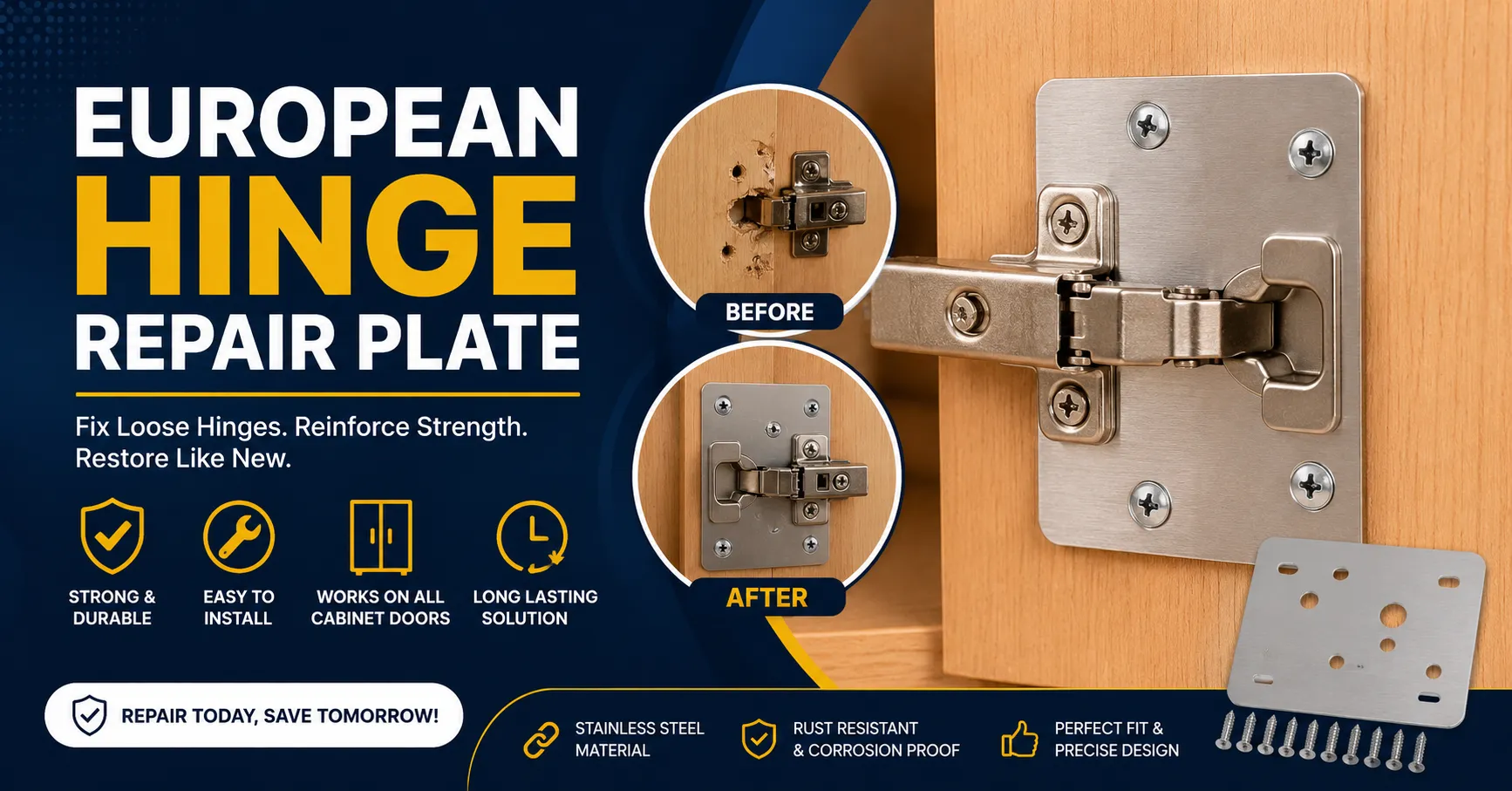
If a cabinet door suddenly becomes loose, crooked, or difficult to close, the problem may not be the hinge itself. In many cases, the screws holding a European concealed hinge have pulled out because the cabinet material around the mounting holes has become damaged. A European hinge repair plate can provide a simple way to reinforce this weak area and restore a secure mounting point. Instead of replacing the entire cabinet door or rebuilding the damaged section, a repair plate can cover the damaged area and provide fresh screw positions for the hinge.
However, choosing the correct plate requires more than simply checking its appearance. You should compare the existing hinge, mounting pattern, door configuration, dimensions, and cabinet construction before buying. This guide explains what to measure, how to identify the hinge type, and how to install a compatible repair plate.
What Are You Replacing?
A European hinge repair plate is generally used when the mounting area of a cabinet hinge has become weak or damaged. European-style concealed hinges are commonly used on modern kitchen cabinets, bathroom cabinets, wardrobes, and furniture.
You may need a repair plate when:
- Hinge screws no longer grip the cabinet material.
- The original screw holes have become enlarged.
- The cabinet material around the hinge has cracked or broken.
- A hinge has pulled away from the cabinet.
- The door has started sagging because the mounting point is no longer secure.
- You want to reinforce an older cabinet before reinstalling the hinge.
If your cabinet hinge screws are repeatedly becoming loose, it is useful to identify the underlying problem before purchasing replacement hardware. You can read this detailed guide on why cabinet hinge screws keep coming loose to understand the common causes and possible repair methods.
A repair plate does not necessarily replace the entire hinge. Instead, it can reinforce the damaged mounting area and provide a stronger surface for securing the hinge hardware.
Measure the Existing Hardware
Accurate measurement is one of the most important steps when selecting a European hinge repair plate. Do not purchase a plate simply because it looks similar to the one currently installed.
Start by opening the cabinet door and examining the hinge. If necessary, remove the hinge so you can clearly see the mounting area.
Measure:
- The overall size of the existing mounting area.
- The distance between existing screw holes.
- The available space around the damaged section.
- The hinge mounting plate dimensions.
- The position of the hinge relative to the cabinet edge.
If the original holes are damaged, measure the surrounding cabinet area instead of relying only on the old screw positions.
Taking photographs of the existing hinge before removing it can also help you compare replacement options later.
For a more detailed guide to choosing, measuring, and installing a cabinet hinge repair plate, see our cabinet hinge repair plate guide.
Important Dimensions
Several dimensions can affect whether a European hinge repair plate will work correctly.
Hinge Cup Diameter
Many European concealed cabinet hinges use a 35mm cup, but you should verify the actual hinge rather than assuming every European hinge has the same dimensions.
Mounting-Hole Spacing
The screw-hole pattern is particularly important. A repair plate needs to provide suitable mounting positions for the hinge or existing hardware.
Plate Length and Width
The repair plate must cover enough of the damaged area while still fitting inside the available cabinet space.
Screw-Hole Position
Check where the new screw holes will sit in relation to the damaged material. A plate may be the correct size but still fail if its holes line up with the old stripped holes.
Door Thickness and Overlay
Door thickness and overlay can affect hinge selection and door positioning. A repair plate should work with the existing hinge configuration rather than changing the intended geometry of the door.
How to Identify the Type
Before ordering a European hinge repair plate, identify what type of cabinet and hinge you have.
European or Concealed Hinge
A European concealed hinge is mounted inside the cabinet and is largely hidden when the cabinet door is closed. These hinges commonly use a cup installed into the back of the cabinet door.
Full-Overlay Hinge
With a full-overlay configuration, the cabinet door covers most or all of the cabinet side or frame when closed.
Half-Overlay Hinge
A half-overlay arrangement allows two doors to share a cabinet partition or leaves part of the cabinet structure visible between doors.
Inset Hinge
An inset door sits inside the cabinet opening rather than covering the front of the cabinet.
Face-Frame Cabinet
A face-frame cabinet has a visible frame around the front opening. The hinge and mounting arrangement can differ from a frameless cabinet.
Frameless Cabinet
A frameless cabinet does not have the traditional front frame. European concealed hinges are particularly common in this style of cabinet.
Identifying the cabinet construction helps you avoid buying a repair plate that works with a different mounting arrangement.
Compatibility Checklist
Before buying a European hinge repair plate, compare the following:
- Existing hinge style
- Hinge cup diameter
- Mounting-hole pattern
- Screw-hole spacing
- Repair plate dimensions
- Cabinet material
- Door thickness
- Door overlay or inset configuration
- Face-frame or frameless cabinet construction
- Available space around the damaged area
- Screw length and diameter
- Position of the hinge relative to the cabinet edge
Most importantly, do not assume that every European hinge repair plate is universal. Different hinges and mounting systems can use different hole patterns and dimensions.
If possible, compare the manufacturer’s measurements with your existing hardware before placing an order.
Replacement Options
You have several options when repairing a damaged cabinet hinge mounting area.
European Hinge Repair Plate
This is a practical option when the hinge is still functional but the cabinet material around its mounting screws has become weak or damaged.
Larger Repair Plate
A larger reinforcement plate may provide additional coverage when the damaged area extends beyond the original mounting point.
Replacement Mounting Plate
If the existing mounting plate itself is damaged or incompatible, replacing it may solve the problem without replacing the entire hinge assembly.
New Concealed Hinge
If the hinge mechanism is damaged, replacing the hinge may be more appropriate than repairing only the mounting surface.
Wood-Hole Repair and Hinge Relocation
For severely damaged cabinets, you may need to repair the cabinet material first and install the hinge in a slightly different position. This approach requires careful measurement to maintain proper door alignment.
Installation
Installing a European hinge repair plate is usually straightforward, but accurate positioning is essential.
Step 1: Remove the Cabinet Door
If the hinge design allows it, remove the cabinet door to make the damaged mounting area easier to access.
Step 2: Remove the Damaged Hardware
Remove loose screws and the existing hinge or mounting plate. Keep the hardware nearby so you can compare it with the replacement.
Step 3: Clean and Inspect the Area
Remove loose wood particles, dust, and damaged material. Check whether the surrounding cabinet structure is strong enough to support the repair.
Step 4: Position the Repair Plate
Place the repair plate over the damaged area. Make sure it sits flat and does not interfere with the cabinet edge, shelf, or door.
Step 5: Mark the Screw Holes
Use the repair plate as a guide and mark the locations of the new mounting holes. Whenever possible, position the holes in solid, undamaged cabinet material.
Step 6: Drill Pilot Holes
If required, drill appropriately sized pilot holes. Avoid making them unnecessarily large because the screws need sufficient material to grip.
Step 7: Install the Repair Plate
Secure the plate using suitable screws. Tighten them firmly, but avoid excessive force that could damage particleboard, MDF, or other cabinet materials.
Step 8: Reattach the Hinge
Attach the existing or replacement European hinge to the repair plate according to its mounting design.
Step 9: Reinstall the Door
Put the cabinet door back into position and secure the hinge.
Step 10: Adjust and Test
Open and close the door several times. Check for rubbing, uneven gaps, sagging, or excessive movement. Make the necessary hinge adjustments before considering the repair complete.
For additional guidance on the repair-plate installation process, see our detailed cabinet hinge repair plate guide.
Common Compatibility Mistakes
One of the biggest mistakes is buying a repair plate based only on its appearance. Two plates can look almost identical while using different mounting-hole patterns.
Other common mistakes include:
- Ignoring screw-hole spacing.
- Confusing a European concealed hinge with another hinge style.
- Forgetting to check whether the cabinet is face-frame or frameless.
- Ignoring door overlay or inset configuration.
- Assuming every 35mm hinge uses the same mounting system.
- Using screws that are too long for the cabinet material.
- Installing new screws directly into severely damaged holes without reinforcement.
- Failing to check whether the repair plate sits completely flat.
- Overtightening screws and damaging the cabinet material.
If your screws continue coming loose after installation, don’t simply tighten them repeatedly. The underlying problem may be damaged cabinet material, an incorrect screw, a damaged hinge, or poor door alignment. Our guide on cabinet hinge screws that keep coming loose explains these problems in more detail.
Recommended Products
For a successful cabinet hinge repair, you may want to compare several related products rather than purchasing only the repair plate.
Consider looking for:
- European hinge repair plate – for reinforcing damaged hinge mounting areas.
- Concealed cabinet hinge repair plate – another useful search term when comparing products.
- European hinge mounting plate – useful when the existing mounting plate needs replacement.
- Replacement European cabinet hinge – appropriate when the hinge mechanism itself is damaged.
- Cabinet repair screws – useful when the original screws are stripped, missing, or unsuitable.
For Amazon shoppers, you can compare currently available European hinge repair plates, mounting plates, and related cabinet hardware here:
Amazon: https://www.amazon.com/s?k=european+hinge+repair+plate
Before buying, compare the product’s dimensions, mounting-hole pattern, screw requirements, material, and compatibility information with your existing cabinet hardware. If you participate in the Amazon Associates program, use your own properly tagged affiliate URL for the product or search page.
FAQ
What is a European hinge repair plate?
It is a metal reinforcement plate generally used to strengthen a damaged cabinet hinge mounting area.
Can a hinge repair plate fix stripped cabinet hinge holes?
It can help when the surrounding cabinet material remains strong enough for the new mounting points. Severely damaged material may require additional repair.
Are European hinge repair plates universal?
No. Mounting patterns, dimensions, and hinge configurations can vary, so always check compatibility.
What size hinge is commonly used with European cabinet hinges?
A 35mm concealed hinge cup is common, but you should measure your existing hinge rather than assuming its size.
Can I install a European hinge repair plate myself?
Yes. Many basic repairs are suitable for DIY installation if you can accurately measure, position, and securely fasten the plate.
How do I know which repair plate fits my cabinet?
Compare the hinge type, mounting-hole spacing, plate dimensions, cabinet construction, door configuration, and screw requirements.
Is it better to repair the hinge or replace it?
If the hinge mechanism works correctly, repairing the mounting area may be sufficient. If the hinge itself is bent, broken, or worn, replacement may be better.
Conclusion
A European hinge repair plate can be an effective solution when cabinet hinge mounting holes become loose or damaged. The key is choosing a plate that matches your existing hinge and cabinet configuration.
Measure the hardware, check the mounting pattern, identify the door style, and confirm the plate’s dimensions before ordering. With the right repair plate and careful installation, you can restore a loose cabinet door without unnecessarily replacing the entire cabinet door or cabinet structure.