
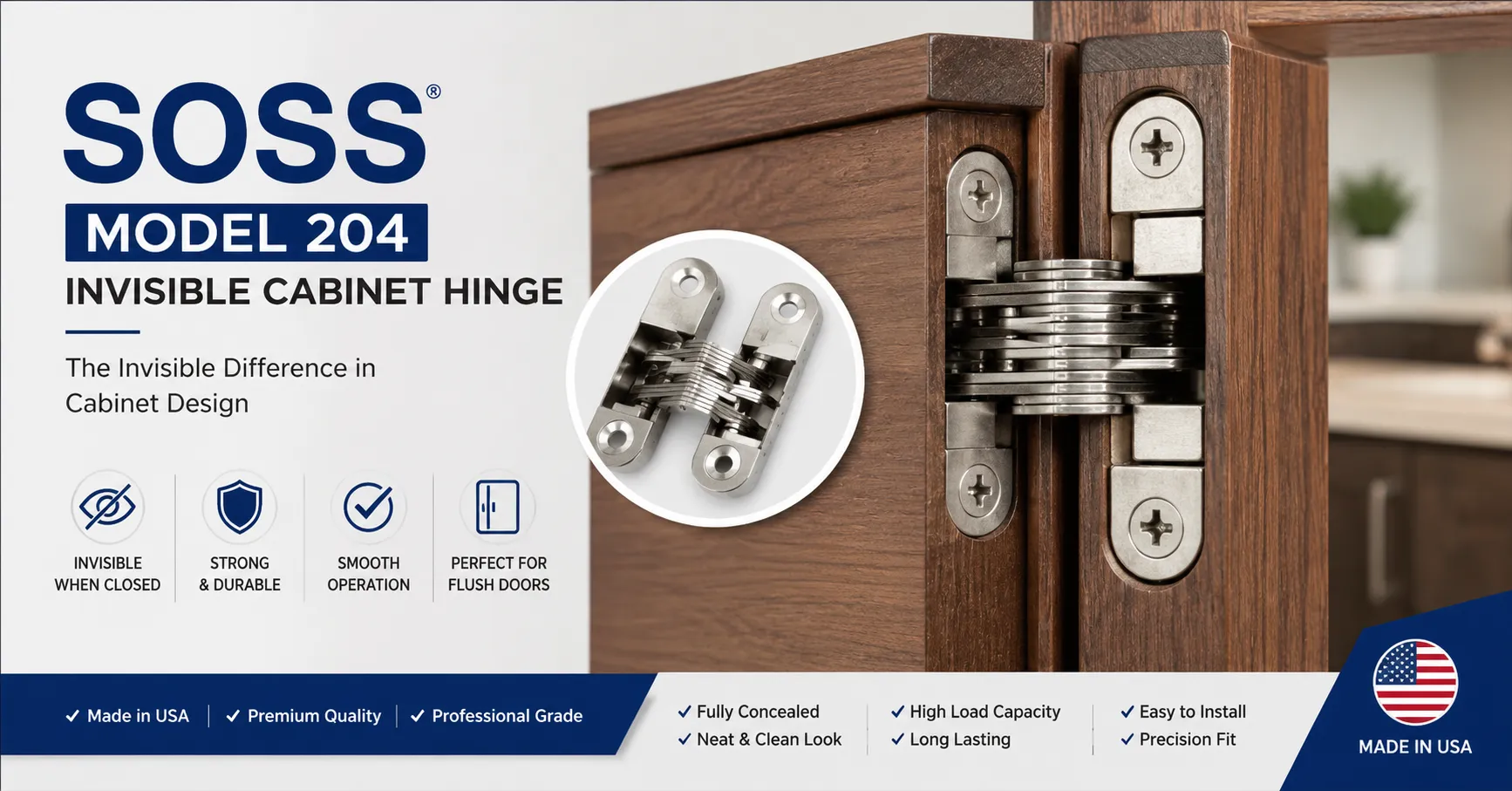
If you want a clean cabinet design without visible hinge hardware, the SOSS Model 204 invisible cabinet hinge is a strong option. It is designed for wood or metal applications with material thicknesses from 3/4 inch to 1 inch and allows the door to open a full 180 degrees. The standard Model 204 uses zinc and steel components with nylon links for strength and durability.
Because the hinge is installed inside the cabinet door and frame, accurate routing and positioning are important. A poorly sized mortise, stripped screw hole, incorrect material thickness, or misalignment can cause the door to sag, rub, or become difficult to operate. This guide explains the most common SOSS 204 problems and practical ways to fix them.
Problem
A SOSS Model 204 invisible cabinet hinge may stop working correctly when:
- The mounting screws become loose.
- The screw holes become stripped.
- The routed hinge pocket is incorrectly sized.
- The hinge is installed at the wrong depth.
- The cabinet material is too thin.
- The door is misaligned.
- The hinge or surrounding wood is damaged.
Unlike a conventional surface-mounted hinge, the SOSS 204 depends on a correctly prepared mortise. Therefore, simply tightening the screws may not fix an installation problem.
If your cabinet hinge repeatedly becomes loose, see our detailed guide on cabinet hinge keeps coming loose for additional repair techniques.
Quick Answer
If your SOSS Model 204 hinge is loose or the cabinet door is misaligned, first inspect the mortise, screw holes, hinge position, and material thickness.
The Model 204 is designed for 3/4-inch to 1-inch material, uses #7 × 1-1/4-inch wood screws in the standard wood application, and opens 180 degrees.
If the screw holes are damaged, repair or reinforce the mounting area instead of repeatedly tightening the same screws.
Find the Cause
1. Check Material Thickness
Start by measuring the cabinet door and frame. SOSS specifies the Model 204 for material from 3/4 inch to 1 inch thick.
If your material is thinner than recommended, there may not be enough material surrounding the hinge pocket to provide a secure installation.
2. Inspect the Mortise
The SOSS 204 is a routed invisible hinge, so the recess must be positioned and sized correctly.
Look for:
- A pocket that is too deep
- A pocket that is too shallow
- Incorrect pocket dimensions
- Cracked wood around the recess
- Hinge movement inside the pocket
An incorrectly routed mortise can make the door appear to have a hinge problem even when the hinge itself is perfectly functional.
3. Check the Screws
The standard Model 204 uses #7 × 1-1/4-inch wood screws for wood applications. SOSS also lists #8-32 × 5/8-inch machine screws for applicable installations.
If a screw spins without tightening, the surrounding wood may be stripped.
4. Check Door Alignment
Close the cabinet slowly and inspect the gaps around the door.
If you notice:
- One side sitting higher than the other
- Uneven gaps
- Door rubbing
- Door sagging
- Hinge movement
then the hinge position or mounting area should be inspected.
For general cabinet-door alignment problems, our guide on how to adjust a cabinet door hinge provides additional troubleshooting information.
Fix It
Fix #1: Tighten the Existing Screws
If the screw holes are still solid, carefully tighten the screws.
Do not overtighten them. Excessive force can damage the wood surrounding the mounting point and make the problem worse.
Fix #2: Repair Stripped Screw Holes
If the screws no longer grip the wood, remove the hinge and repair the damaged holes.
For more serious damage, a cabinet hinge repair plate can provide a stronger mounting surface. See our guide on cabinet hinge repair plates to understand when this type of reinforcement makes sense.
Fix #3: Correct the Hinge Pocket
If the hinge does not sit correctly inside the cabinet, inspect the routed pocket.
The hinge should be properly positioned rather than forced into an incorrectly sized recess. If the pocket is badly damaged, the surrounding material may need to be repaired before reinstalling the hinge.
Fix #4: Reinstall the Hinge Correctly
Remove the hinge, inspect the mounting area, repair any damaged wood, and reinstall it using the correct hardware.
Measure carefully before drilling new holes. Incorrect positioning can create additional holes and weaken the cabinet material.
If That Doesn’t Work
If tightening the screws, repairing the holes, and correcting the hinge position do not solve the problem, the mounting area may have suffered too much damage.
At that point, reinforcement may be the better solution.
Our guide to cabinet hinge reinforcement plates explains how reinforcement hardware can strengthen a damaged mounting area.
You can also compare options in our article about concealed hinge repair plates.
If the cabinet has already been repaired with a reinforcement plate, see cabinet hinge repair plate installed for additional installation guidance.
If the hinge itself is bent or damaged, replacing it with the correct SOSS model may be more appropriate than repairing it.
Recommended Hardware
When replacing a SOSS Model 204, do not choose a generic invisible hinge simply because it looks similar.
Check:
- Hinge model
- Hinge dimensions
- Material thickness
- Opening angle
- Screw specifications
- Finish
- Application
The SOSS Model 204 has a 2-3/8-inch hinge height and is designed for 3/4-inch to 1-inch material. SOSS lists #7 × 1-1/4-inch wood screws for wood installations.
Amazon Product Recommendation
For readers who want to purchase the hinge through Amazon, use the current Amazon search results for SOSS Model 204 Invisible Hinge:
Shop SOSS Model 204 Invisible Hinges on Amazon
This search URL is preferable to publishing an unverified individual listing because Amazon sellers, inventory, pricing, and product URLs can change.
Affiliate disclosure: If this page contains an Amazon Associates affiliate link, we may earn a commission from qualifying purchases at no additional cost to the customer.
For applications where corrosion resistance is important, SOSS also offers the Model 204SS, which is made from 316 stainless steel and has the same 3/4-inch-to-1-inch material range and 180-degree opening specification.
Comparison
| Feature | SOSS Model 204 | Standard Concealed Hinge |
|---|---|---|
| Hinge type | Invisible/routed | Concealed/cup-style |
| Visible hardware | Minimal/none | Minimal |
| Opening | 180° | Depends on model |
| Material thickness | 3/4″–1″ | Depends on model |
| Installation | Requires accurate routing | Usually cup drilling |
| Best use | Flush, premium cabinet designs | General cabinetry |
| Adjustment | Limited compared with European hinges | Often highly adjustable |
The biggest advantage of the SOSS 204 is its completely concealed appearance. However, that clean appearance comes with a greater need for accurate installation.
Prevention
The easiest way to avoid SOSS 204 hinge problems is to get the installation right from the beginning.
Before installation:
- Confirm the material thickness.
- Measure the hinge and mounting position carefully.
- Use the correct routing dimensions.
- Keep the mortise accurately positioned.
- Use the recommended screws.
- Avoid overtightening.
- Test the door before final tightening.
- Check for rubbing or unusual resistance.
Also avoid using harsh cleaning chemicals around SOSS hinges. SOSS states that its invisible hinges are shipped lubricated and normally require no additional care; if lubrication is needed, it recommends a spray lubricant such as WD-40 and warns against cleaning agents or solvents that can damage the finish or interfere with the hinge links.
If you are working on a different concealed cabinet configuration, our guide to behind-door storage cabinet hinge-mounted systems may also be useful.
FAQ
What is a SOSS Model 204 invisible cabinet hinge?
It is a concealed hinge designed for wood or metal applications where the material is 3/4 to 1 inch thick. It opens 180 degrees.
What screws does the SOSS 204 use?
For wood applications, SOSS specifies #7 × 1-1/4-inch wood screws.
How much does a SOSS 204 hinge open?
The Model 204 opens a full 180 degrees.
Why does my SOSS hinge keep coming loose?
Common causes include stripped screw holes, incorrect mortise dimensions, poor positioning, or damaged surrounding material.
Can I use a generic invisible hinge instead?
You can, but verify the dimensions, material thickness, opening angle, and mortise requirements before making the substitution.
Is there a stainless-steel version?
Yes. SOSS offers the Model 204SS, made from 316 stainless steel.
Should I repair or replace my SOSS 204?
If the hinge is undamaged but the mounting area is weak, repair or reinforcement may work. If the hinge itself is bent or damaged, replacement is usually the better option.