
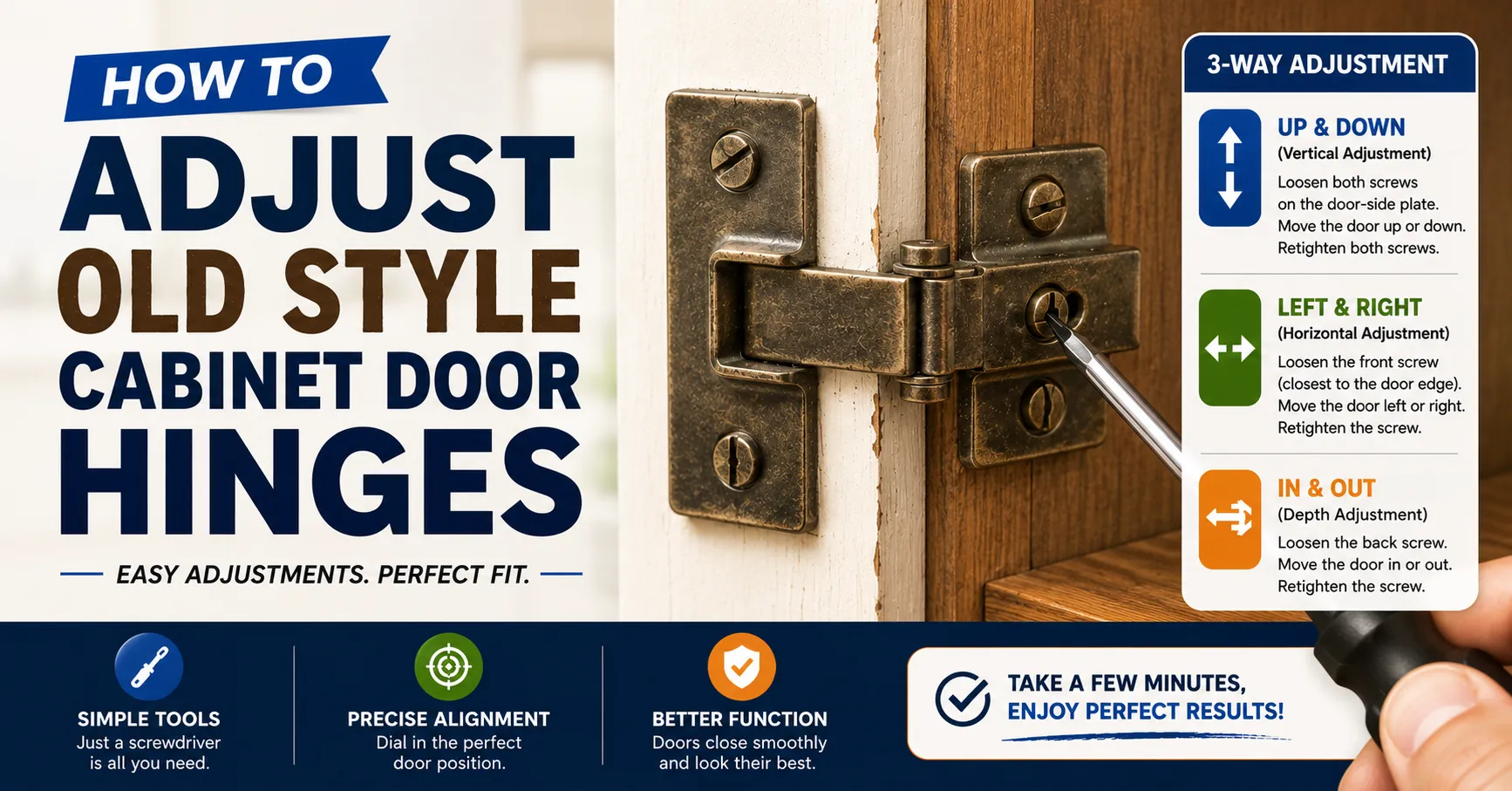
 Old cabinet doors can become crooked, sag, rub against the frame, or stop closing properly after years of use. If your cabinets have older-style hinges, you may not have the adjustment screws found on modern concealed hinges. Instead, you may need to loosen the hinge screws, reposition the door, and secure everything again.
The good news is that most minor alignment problems can be diagnosed and fixed with a screwdriver and a few careful adjustments. The key is to determine whether the problem comes from loose screws, hinge movement, poor alignment, or worn hardware before making changes.
Quick Answer: How Do You Adjust Old Style Cabinet Door Hinges?
To adjust old style cabinet door hinges, first open the door and inspect the hinge screws, hinge leaves, and mounting areas. Tighten any loose screws. If the door is still too high, too low, crooked, or rubbing, slightly loosen the screws holding the hinge to the cabinet or door. Carefully reposition the door until the gaps around it look even, then tighten the screws while holding the door in place. Make small adjustments rather than moving the hinge too far at once. Older hinges vary considerably, so not every hinge can be adjusted in the same way. If the hinge is bent, the screw holes are stripped, or the cabinet material is damaged, replacing or repairing the hardware may be necessary.
Reason #1: The Hinge Screws Have Become Loose
Loose screws are one of the most common reasons an old cabinet door becomes misaligned.
Every time you open or close a cabinet door, the hinges experience a small amount of movement. After years of use, the screws can loosen, especially when they are installed in softer wood, particleboard, or MDF.
A loose hinge can cause the door to:
- Sag downward
- Sit unevenly
- Rub against the cabinet frame
- Move sideways
- Leave an uneven gap
- Stop closing correctly
Before attempting to reposition the hinge, check whether the screws are actually tight.
If you need help understanding the different types of cabinet hardware and adjustment screws, read our guide to cabinet door adjustment screws.
Simple Test
Open the cabinet door and place your fingers near the hinge.
Gently move the door up and down.
If you can see the hinge moving against the cabinet, inspect the mounting screws. A screw that turns easily without becoming tight may indicate a damaged screw hole.
If the screws are simply loose, tightening them may immediately improve the door alignment.
Reason #2: The Cabinet Door Has Shifted Out of Alignment
Older cabinet doors can gradually move out of their original position.
The problem may not be the hinge itself. Instead, the door may have shifted because of repeated use, loose mounting screws, or changes in the cabinet material.
Typical symptoms include:
- Uneven gaps around the door
- One corner sitting higher than another
- The door rubbing against an adjacent door
- A large gap at the top or bottom
- The door appearing crooked when closed
Old-style hinges often require manual repositioning because they don’t have the independent vertical, horizontal, and depth adjustments found on many modern concealed hinges.
Simple Test
Close the cabinet door and look at the gap between the door and cabinet frame.
Compare the top, bottom, left, and right sides.
If the gaps are noticeably different, the door is probably out of alignment.
For a broader explanation of cabinet alignment problems, see our cabinet door adjustment guide.
Reason #3: The Door Needs to Be Repositioned on the Hinge
Some older hinges can be adjusted by physically repositioning the hinge rather than turning an adjustment screw.
This is particularly relevant for traditional butt hinges, surface-mounted hinges, and some semi-concealed designs.
If the door needs to move slightly upward or downward, you may be able to loosen the hinge mounting screws, move the door into the correct position, and retighten the screws.
However, don’t assume that every old hinge can be repositioned this way.
Simple Test
Look at where the hinge attaches to the cabinet and door.
If the hinge is secured with several screws but has no obvious adjustment mechanism, it may rely on physical positioning.
Compare the hinge position with another cabinet door that is correctly aligned.
If the hinges are positioned differently, that may explain the alignment problem.
If you want to understand the difference between older and newer hardware, see our guide on how to adjust cabinet door hinges.
Reason #4: The Old Hinge Is Worn or Damaged
After years of use, cabinet hinges can eventually wear out.
A hinge that has excessive movement may no longer hold the door securely, even after tightening the mounting screws.
Look for:
- Bent hinge leaves
- Loose hinge pins
- Cracked hardware
- Excessive movement
- Damaged mounting holes
- Missing screws
- Broken cabinet material around the hinge
A worn hinge can make the cabinet door appear misaligned even when the mounting screws are tight.
Simple Test
Compare the problem hinge with another hinge on the same cabinet.
Look for differences in shape, movement, and positioning.
If one hinge has noticeably more movement than another, it may be worn or damaged.
You can also open and close the door slowly while watching the hinge. If the hinge moves abnormally or does not maintain its position, replacement may be more practical than adjustment.
Simple Test for Each Reason
Before replacing anything, work through these four quick tests.
Test 1: Check the Screws
Open the cabinet door and inspect every hinge screw.
What it tells you: If the screws are loose, tighten them before making other adjustments.
Test 2: Check the Door Gaps
Close the door and examine the gaps around all four sides.
What it tells you: Uneven gaps usually indicate an alignment problem.
Test 3: Compare Hinge Position
Compare the problem hinge with a hinge on a correctly aligned cabinet door.
What it tells you: A noticeably different hinge position may indicate that the door or hinge has shifted.
Test 4: Check for Hinge Damage
Look for bent metal, loose pins, cracked mounting plates, or damaged screw holes.
What it tells you: Physical damage may require replacement instead of adjustment.
Best Solution: How to Adjust Old Style Cabinet Door Hinges
Once you’ve identified the problem, you can attempt a careful adjustment.
Step 1: Open the Cabinet Door
Open the door completely so you can access the hinge screws.
Inspect the hinge and mounting surface before loosening anything.
Step 2: Tighten Existing Screws
Start with the simplest solution.
Tighten loose screws carefully.
Don’t force a screw that keeps spinning because the hole may already be stripped.
Step 3: Support the Door
If the door is large or heavy, have someone support it while you work.
This prevents the door from dropping when the hinge screws are loosened.
Step 4: Loosen the Hinge Slightly
If tightening the screws didn’t solve the problem, slightly loosen the screws holding the hinge to the cabinet or door.
Don’t remove them completely.
The goal is to allow controlled movement.
Step 5: Reposition the Door
Move the door gradually until it reaches the desired position.
If it is sagging, move it upward.
If it sits too high, reposition it downward.
If the side gaps are uneven, adjust the door horizontally as needed.
Hold the door firmly while making the adjustment.
Step 6: Tighten the Screws
Once the door is properly positioned, tighten the hinge screws.
Tighten them securely but avoid excessive force.
Step 7: Test the Door
Close and open the door several times.
Check whether:
- The door closes completely
- The top gap is even
- The bottom gap is even
- The door doesn’t rub
- The door lines up with adjacent doors
If the alignment isn’t correct, make another small adjustment.
For a visual reference to cabinet hinge positioning, see our cabinet door hinge adjustment diagram.
Step 8: Consider Replacement Hardware
If the hinge cannot hold its position or the hardware is badly worn, replacement may be the better option.
For example, an adjustable replacement system such as the 3 piece premier adjustable cabinet door set may be worth considering when the existing hardware is no longer serviceable.
What Tools Do You Need?
For most old-style cabinet hinge adjustments, you only need a few basic tools:
- Phillips or flat-head screwdriver, depending on the screws
- Replacement screws if existing ones are damaged
- Replacement hinges if the originals are worn
- Wood repair materials if the screw holes are stripped
If you need replacement hardware, you can compare options on Amazon:
- Old Style Cabinet Hinges on Amazon
- Cabinet Hinge Repair Plates on Amazon
- Wood Screw Assortment on Amazon
- Precision Screwdriver Set on Amazon
Check the dimensions and mounting style carefully before purchasing replacement hardware.
When Professional Repair or Replacement Makes Sense
Not every old cabinet hinge problem should be solved with another adjustment.
Professional repair or replacement makes sense when:
- The cabinet material around the hinge is cracked.
- Multiple screw holes are stripped.
- The hinge is severely bent.
- The hinge pin is badly worn.
- The cabinet door is significantly warped.
- The mounting area has broken away.
- The door remains misaligned after proper adjustment.
- The cabinets are antique, custom, or particularly valuable.
If the hinge is damaged but the door itself is in good condition, replacing the hinge may be enough.
If the cabinet structure is damaged, however, simply installing a new hinge may not solve the underlying problem.
For another common cabinet problem, see our guide on how to adjust a cabinet door that won’t close.
If the specific issue is vertical alignment, our guide on how to adjust cabinet door hinges up and down provides more focused instructions.
FAQ;
How do you adjust old style cabinet door hinges?
Start by tightening loose screws. If the door remains misaligned, slightly loosen the hinge mounting screws, reposition the door, and tighten the screws again.
Can old cabinet hinges be adjusted?
Many can be repositioned manually, although adjustment depends on the hinge design. Some older hinges have limited adjustment compared with modern concealed hinges.
Why is my old cabinet door sagging?
Loose screws, worn hinge pins, damaged screw holes, or a shifted hinge can cause an old cabinet door to sag.
How do I fix a stripped cabinet hinge screw hole?
A severely stripped hole may require a suitable wood repair method or a hinge repair plate. If the surrounding cabinet material is damaged, professional repair may be appropriate.
Should I replace old cabinet hinges?
Consider replacement when the hinge is bent, excessively worn, broken, or unable to hold the door in alignment after adjustment.
Why won’t my old cabinet door close?
Check for loose hinges, uneven alignment, damaged hardware, and obstructions. If the problem remains after adjustment, the hinge or cabinet mounting area may need repair or replacement.