
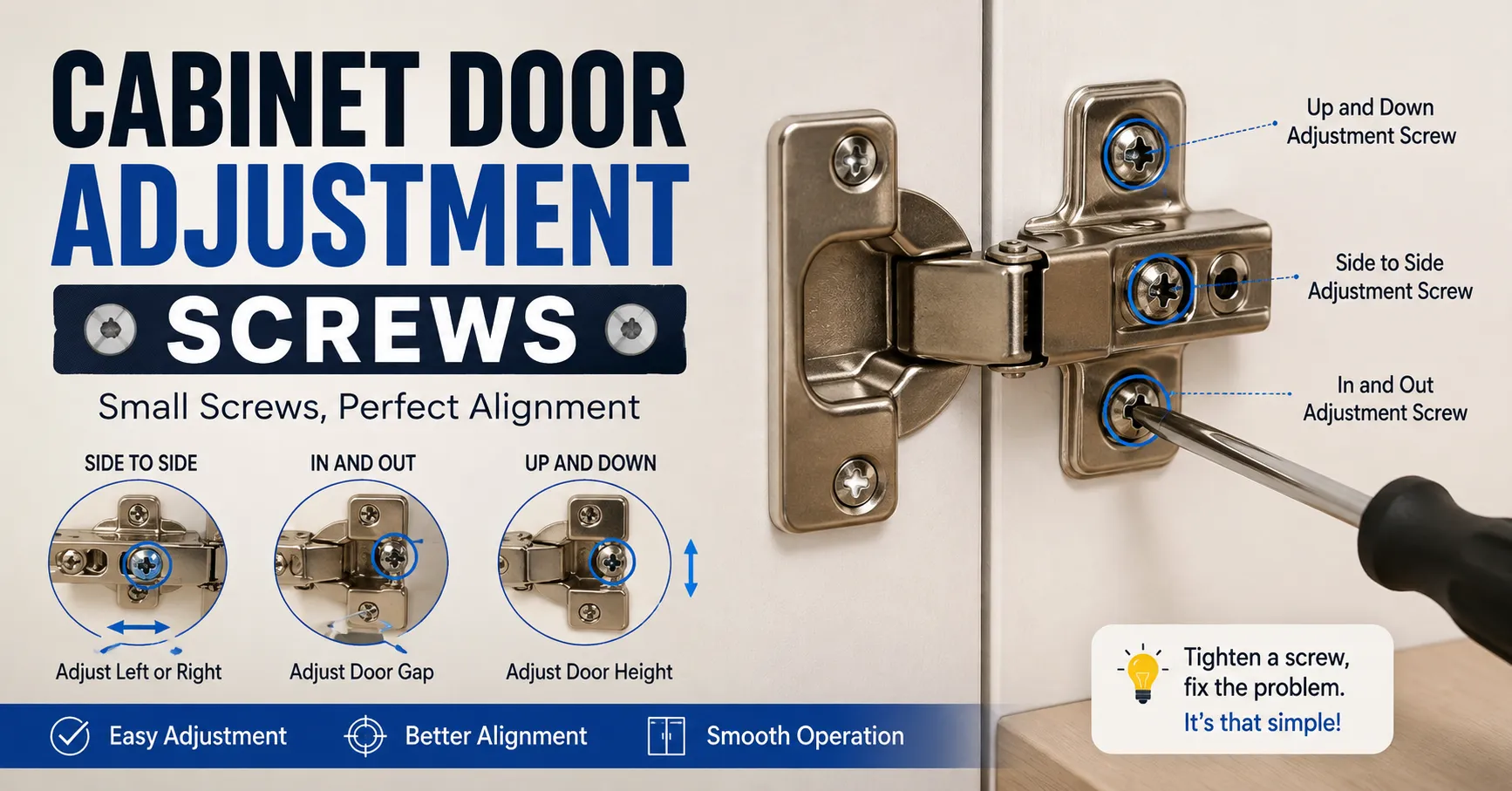
If your cabinet door is crooked, rubbing against another door, sitting too far inside or outside the cabinet, or leaving an uneven gap, the problem may be easier to fix than it looks. Cabinet door adjustment screws allow you to fine-tune many concealed cabinet hinges without removing the door.
Modern European-style hinges commonly provide adjustments in three directions: side-to-side, up-and-down, and in-and-out. However, the exact screw location and adjustment method can vary between hinge designs, so avoid assuming that every hinge uses the same screw for the same movement.
If you want a broader overview before starting, see our cabinet door adjustment guide.
What You Need
For most cabinet door adjustment jobs, you need only a few basic items:
- Phillips-head screwdriver
- Flashlight or good work light
- Small measuring tape or ruler
- A soft cloth
- Replacement hinge screws if existing screws are stripped
- Replacement hinges if the adjustment mechanism is damaged
A correctly sized Phillips screwdriver is particularly important because using the wrong driver can damage the screw head.
If you need replacement hardware, you can also check cabinet hinge adjustment screws on Amazon.
Before You Start
Before turning any cabinet door adjustment screws, close the door and look carefully at the gaps around it.
Check these four things:
- Is the door too high or too low?
- Is the gap between neighboring doors uneven?
- Does the door sit too far forward or backward?
- Are the hinge mounting screws loose?
Take a moment to identify the type of hinge installed on your cabinet. Concealed European-style hinges are usually adjustable, but older hinges may have fewer adjustment options.
If you’re unsure about the hinge itself, our guide on how to adjust cabinet door hinges explains the basic adjustment process in more detail.
Step 1: Check and Tighten the Mounting Screws
Before making fine adjustments, inspect the screws holding the hinge to the cabinet and door.
A loose mounting screw can make the door appear misaligned even when the adjustment settings are correct.
Use a Phillips screwdriver to gently tighten loose screws. Do not overtighten them, especially when the screw is installed directly into particleboard or MDF.
If the screw simply spins without tightening, the hole may be stripped. In that situation, tightening the same screw repeatedly will not solve the problem.
For severely damaged mounting holes, a hinge repair plate or replacement hardware may be more appropriate.
Step 2: Adjust the Door Side to Side
One of the most common uses for cabinet door adjustment screws is correcting the horizontal position of the door.
This adjustment changes the gap between the cabinet door and neighboring doors or the cabinet frame.
Locate the side-to-side adjustment screw on the hinge. On many concealed hinges, this is positioned toward the front or center of the hinge arm, but the exact position varies by design.
Turn the screw only a small amount—usually about a quarter turn at a time—then close the door and check the gap.
If the gap becomes worse, turn the screw in the opposite direction.
Do not make large adjustments immediately. Small changes make it much easier to identify which direction the hinge is moving.
If you’re dealing with an older hinge design, see our guide to adjusting old cabinet door hinges.
Step 3: Adjust the Door Up or Down
If the cabinet door is sitting too high or too low, you need to correct its vertical position.
Depending on the hinge design, vertical adjustment may be made by loosening the mounting screws and sliding the hinge plate up or down. Some newer hinge systems provide a dedicated adjustment mechanism instead.
Manufacturer instructions for concealed hinges commonly distinguish vertical adjustment from side-to-side and depth adjustment.
Loosen the relevant mounting screws slightly—do not remove them.
Support the door while making the adjustment. Move it gradually to the desired position, then tighten the screws securely.
After tightening, open and close the door to make sure it remains in the correct position.
If the hinge placement itself is incorrect, you may need to review cabinet door hinge placement before attempting further adjustment.
Step 4: Adjust the Door In or Out
The third major adjustment is depth.
Depth adjustment controls how far the cabinet door sits from the cabinet box. It can correct a door that looks too far forward, too far backward, or unevenly positioned relative to adjacent doors.
On many concealed hinges, a screw toward the rear of the hinge arm controls this movement, although the exact screw location depends on the hinge model.
Turn the adjustment screw gradually and check the door after every small change.
The goal is to make the front surface of the door sit consistently with neighboring doors and drawer fronts.
If you are replacing hinges rather than simply adjusting them, measuring the overlay first can prevent installation problems. See our guide on how to measure cabinet hinge overlay.
Testing
Once you’ve adjusted the cabinet door adjustment screws, test the door several times.
Open the door completely and then close it slowly.
Check:
- The door opens without rubbing.
- The door closes without hitting the neighboring door.
- The gaps are reasonably even.
- The door sits flush with surrounding cabinet fronts.
- The hinges remain firmly attached.
- The soft-close function works correctly, if equipped.
Make one final inspection with the door closed.
If you adjust multiple hinges at once, remember which screw you changed and how much you turned it. This makes troubleshooting much easier if the first adjustment does not produce the desired result.
Common Mistakes
Turning every screw at once
This makes it difficult to determine which adjustment caused the change. Adjust one direction at a time.
Making large turns
A full turn can move the door much more than expected. Start with small increments.
Overtightening screws
Overtightening can damage the screw head, hinge, or cabinet material.
Using the wrong screwdriver
A poorly fitting screwdriver can strip the adjustment screw.
Assuming every hinge adjusts the same way
This is one of the most important mistakes to avoid. Different manufacturers can position and configure their adjustment screws differently.
Ignoring the mounting screws
If the hinge is loose, fine adjustment may not hold.
Adjusting the wrong hinge
Sometimes the top hinge needs a different correction from the bottom hinge. Make small changes and observe the door after each adjustment.
When to Replace the Part
Cabinet door adjustment screws can solve many alignment problems, but adjustment is not always the answer.
Consider replacing the hinge or related hardware when:
- The adjustment screw is stripped.
- The screw will not turn.
- The hinge is bent.
- The hinge has excessive play.
- The soft-close mechanism has failed.
- The hinge mounting holes are severely damaged.
- The door cannot remain aligned after repeated adjustment.
- The hinge is badly corroded or physically broken.
If the hinge itself is worn out, installing a new adjustable hinge may be more practical than trying to repair the adjustment mechanism.
Before buying a replacement, verify the hinge type, overlay, cup size, mounting style, and opening angle.
You can also compare your existing hardware with our guide to the 3-piece premier adjustable cabinet door set.
Recommended Tools
A simple toolkit is usually enough for cabinet hinge adjustment:
| Tool | Why You Need It |
|---|---|
| Phillips screwdriver | Adjusts most common concealed hinge screws |
| Measuring tape | Helps compare door gaps |
| Flashlight | Makes hidden hinge screws easier to see |
| Soft cloth | Protects the cabinet finish |
| Replacement screws | Useful when mounting screws are stripped |
| Replacement hinges | Needed when the hinge mechanism is damaged |
For a basic screwdriver, see Phillips screwdriver options on Amazon.
For replacement hinge hardware, see cabinet hinge options on Amazon.
How Cabinet Door Adjustment Screws Work
The easiest way to understand adjustment screws is to think of them as a fine-positioning system.
One adjustment changes the door horizontally.
Another changes its depth.
Another may control vertical positioning through the mounting plate or hinge mechanism.
This three-direction approach allows you to correct many common problems without removing the entire door. Some hinge systems specifically identify separate screws for side, height, and depth adjustments.
However, the exact screw layout is not universal. Always inspect your hinge before making an adjustment.
Related Guides
If you are working on cabinet hinges, these related guides may also help:
- How to adjust cabinet door hinges
- How to adjust old cabinet door hinges
- Cabinet door adjustment guide
- Cabinet door hinge placement
- How to measure cabinet hinge overlay
- What is the overlay on a cabinet hinge?
- How to drill cabinet hinge holes
- Champagne gold cabinet hinge guide
FAQ
What are cabinet door adjustment screws?
They are screws or adjustment mechanisms built into many cabinet hinges that allow you to fine-tune the door’s position.
Which screw adjusts a cabinet door left and right?
On many concealed hinges, a side-adjustment screw controls horizontal movement. The exact location varies by hinge.
Which screw adjusts cabinet doors in and out?
A depth-adjustment screw typically moves the door closer to or farther from the cabinet box.
Can cabinet doors be adjusted without removing them?
Yes. Many concealed hinges are designed to be adjusted while the door remains installed.
Why does my cabinet door keep moving after adjustment?
Loose mounting screws, damaged hinge components, or stripped cabinet holes can prevent an adjustment from staying in place.
Should I replace the hinge or adjustment screw?
If the screw is stripped or the hinge mechanism is damaged, replacement is often more reliable than continued adjustment.
Do all cabinet hinges use the same adjustment screws?
No. Screw locations and adjustment methods vary between hinge designs and manufacturers.
How much should I turn an adjustment screw?
Start with small movements, such as a quarter turn, and check the door after each adjustment.
Final Thoughts
Cabinet door adjustment screws make it possible to correct many common cabinet-door problems without replacing the entire door. Start by checking the mounting screws, identify the adjustment direction you need, and make small changes while repeatedly testing the door.
If adjustment cannot hold or the hinge is physically damaged, replacing the hinge may be the better long-term solution.