
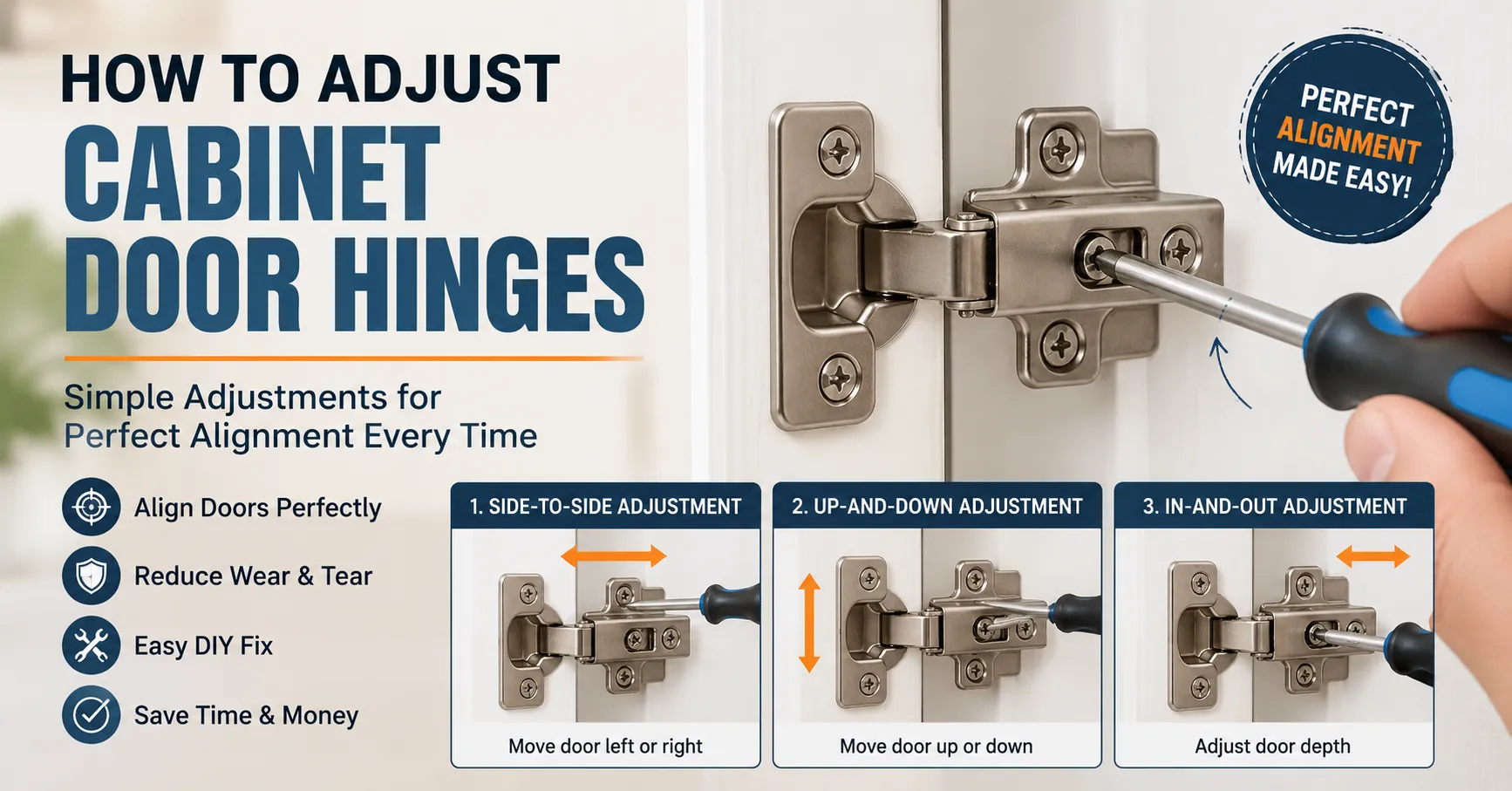
A cabinet door that sits crooked, rubs against another door, leaves an uneven gap, or refuses to close properly does not always need a new hinge. In many cases, a simple hinge adjustment can correct the problem in a few minutes. If you are wondering how to adjust cabinet door hinges, the key is to identify whether the door needs a height, side-to-side, or depth adjustment.
This guide explains how to identify the problem, adjust common concealed cabinet hinges, troubleshoot problems that adjustment cannot solve, and choose the right repair hardware when the hinge or mounting area is damaged.
Problem: Why Is My Cabinet Door Misaligned?
Cabinet doors can become misaligned for several reasons. Everyday use can gradually loosen hinge screws, while repeated opening and closing can shift the door slightly.
Common symptoms include:
- The top of the door is higher than the neighboring door.
- The bottom of the door sits too low.
- The gap between two cabinet doors is uneven.
- The door rubs against the adjacent door.
- The door sits too far inside or outside the cabinet.
- The door does not close completely.
- The hinge or mounting plate feels loose.
- The cabinet door appears tilted even though the cabinet itself is level.
Before replacing anything, inspect the hinges and mounting screws. If the hinge is structurally sound, adjustment is often enough.
Quick Answer: How to Adjust Cabinet Door Hinges
For most concealed cabinet hinges, you can correct alignment by adjusting three basic positions: height, side-to-side position, and depth. Start by checking the screws on the hinge and mounting plate. Make very small adjustments—usually about a quarter turn at a time—and close the door after each adjustment to check the result. If the door is too high or low, adjust the mounting position or height mechanism. If the gap between doors is uneven, use the side-to-side adjustment. If the door sits too far forward or backward, use the depth adjustment. Hinge designs vary, so the exact screw location can differ between models. If adjustment does not hold, inspect for loose screws, damaged hinges, stripped holes, or a damaged mounting plate.
Find the Cause Before Adjusting the Hinge
The easiest way to fix a cabinet door is to first determine what direction the door needs to move.
1. Door Is Too High or Too Low
If the entire door needs to move upward or downward, you need a height adjustment.
Look at the hinge mounting plate where it attaches to the cabinet. Some concealed hinge systems allow the hinge to move vertically after loosening the mounting screws.
If your cabinet uses a different hinge configuration, the adjustment method may vary.
2. Door Is Too Far Left or Right
If the vertical gap between two doors is uneven, you probably need a side-to-side adjustment.
This is one of the most common adjustments on concealed European-style hinges.
Turn the appropriate adjustment screw in small increments and check the gap after every change.
3. Door Sits Too Far In or Out
If the front of the cabinet door does not sit flush with the surrounding doors, you may need a depth adjustment.
Depth adjustment moves the door closer to or farther away from the cabinet box.
This is particularly useful when one door appears recessed while another sticks out.
4. Screws Are Loose
If the hinge moves when you touch it, first check the mounting screws.
Do not immediately adjust the hinge. A loose mounting screw can make a correctly adjusted hinge appear misaligned.
5. Screw Holes Are Stripped
If a screw turns but never becomes tight, the problem may be the cabinet material rather than the hinge.
This is common with particleboard or MDF cabinets where repeated screw removal can enlarge the mounting hole.
In that situation, a repair plate can provide a much stronger mounting surface. See our guide to cabinet hinge repair plates for more information.
6. The Hinge Is Damaged
If the hinge is bent, cracked, excessively worn, or no longer holds its position, adjustment may not solve the problem.
A replacement hinge may be the better option.
Fix It: Step-by-Step Cabinet Door Hinge Adjustment
Tools You May Need
Most adjustments require only a few basic tools:
- Phillips screwdriver
- Pozidriv screwdriver, depending on the hinge
- Drill/driver for repair work
- Small flashlight
- Replacement screws if necessary
- Replacement hinge or repair plate if the existing hardware is damaged
Step 1: Open the Cabinet Door
Open the door completely so you can see the hinge mechanism.
If the cabinet has two or more hinges, inspect all of them. Do not assume the upper hinge is the only one causing the problem.
Step 2: Inspect the Hinge
Look for:
- Loose screws
- Bent metal
- Cracks
- Damaged mounting plates
- Stripped screw holes
- Missing screws
If the hinge appears damaged, replacing it may be more effective than trying to adjust it.
For concealed hinges specifically, you can also compare the repair options explained in our guide to concealed hinge repair plates.
Step 3: Correct the Side-to-Side Position
If the door is too far left or right, locate the lateral adjustment screw on the hinge.
Turn it slightly and observe how the door moves.
A good technique is:
- Turn the screw about a quarter turn.
- Close the door.
- Check the gap.
- Open the door again.
- Make another small adjustment if necessary.
Avoid making large turns because a small screw movement can noticeably change the door position.
Step 4: Adjust the Door Height
If the door needs to move upward or downward, check the mounting screws and mounting plate.
Depending on the hinge design, you may need to loosen the mounting screws slightly, reposition the hinge, and then tighten the screws.
Adjust both hinges consistently when necessary.
If the hinge plate itself is damaged or the screw holes no longer hold securely, adjustment alone may not last.
Our guide on European hinge repair plates explains one option for repairing this type of mounting problem.
Step 5: Adjust the Depth
If the door sits too far inside or outside the cabinet frame, use the hinge’s depth adjustment.
Move the door gradually until its front surface sits correctly relative to the surrounding cabinet doors.
The goal is not simply to make the door close. It should also sit evenly and maintain a consistent reveal around the cabinet.
Step 6: Check the Door From Several Angles
After making adjustments, close the door and inspect:
- Top gap
- Bottom gap
- Left gap
- Right gap
- Door-to-door spacing
- Door depth
- Door closing action
Open and close the door several times to make sure the hinge remains stable.
Step 7: Tighten Everything Carefully
Once the alignment is correct, make sure the mounting screws are secure.
Do not overtighten them. Excessive force can strip the screw hole or damage the cabinet material.
What If Adjusting the Hinge Doesn’t Work?
Sometimes the adjustment itself is not the real problem.
The Screw Spins Without Tightening
A spinning screw usually indicates a damaged or enlarged screw hole.
Instead of repeatedly tightening the same screw, consider using a cabinet hinge reinforcement plate to create a stronger mounting surface.
The Cabinet Material Is Cracked
If the area around the hinge has cracked or broken, simply tightening the hinge can make the damage worse.
A suitable repair plate can distribute the load over a larger area.
The Mounting Plate Is Loose
If the hinge mounting plate moves independently of the cabinet, inspect its screws and the material underneath them.
If the holes are damaged, replacing the screws alone may not provide a permanent repair.
The Hinge Keeps Moving Out of Alignment
If you repeatedly adjust the hinge but the door returns to its original position, look for mechanical damage.
The hinge, mounting plate, or cabinet material may be worn.
If you want to see what a completed repair looks like, our cabinet hinge repair plate installed guide can help you understand the finished result.
The Door Still Does Not Align
The problem may not be the hinge.
Check whether:
- The cabinet box is square.
- The door itself is warped.
- The hinge is the correct type.
- The overlay is correct.
- The mounting plate is installed in the correct position.
Understanding what overlay means on a cabinet hinge can be particularly helpful when replacing or selecting hinges.
Recommended Hardware
For routine cabinet door adjustment, you usually do not need many tools. A quality screwdriver and the correct replacement hardware are generally enough.
For more serious repairs, useful hardware includes:
- Concealed cabinet hinges
- European-style hinges
- Cabinet hinge repair plates
- Hinge reinforcement plates
- Replacement hinge screws
- Replacement mounting plates
- Drill/driver
- Screwdriver set
Amazon Hardware Recommendations
If you are shopping for repair hardware, you can compare available options on Amazon:
Cabinet hinge repair plates:
Shop Cabinet Hinge Repair Plates on Amazon
Concealed cabinet hinges:
Shop Concealed Cabinet Hinges on Amazon
European cabinet hinges:
Shop European Cabinet Hinges on Amazon
Cabinet hinge screws:
Shop Cabinet Hinge Screws on Amazon
Disclosure: Some links on this page may be Amazon affiliate links. If you purchase through an affiliate link, we may earn a commission at no additional cost to you.
Adjustment vs. Repair vs. Replacement
| Solution | Best For | Cost Level | Difficulty | When to Use |
|---|---|---|---|---|
| Hinge adjustment | Minor alignment problems | Low | Easy | Door is crooked but hinge is healthy |
| Tightening screws | Loose hinges | Low | Easy | Screws have simply loosened |
| Repair plate | Stripped mounting holes | Low–Medium | Easy–Moderate | Screws no longer hold securely |
| Reinforcement plate | Damaged mounting area | Medium | Moderate | Cabinet material needs additional support |
| Complete hinge replacement | Bent or damaged hinge | Medium | Moderate | Existing hinge cannot be repaired |
The best solution depends on the actual cause. Replacing a perfectly good hinge will not necessarily solve a stripped mounting hole, while a repair plate will not fix a physically broken hinge.
How to Prevent Cabinet Door Alignment Problems
A little maintenance can prevent many hinge problems.
Check Screws Periodically
If a hinge begins moving, tighten the mounting screws before the holes become damaged.
Avoid Slamming Cabinet Doors
Repeated impact can gradually loosen hardware and contribute to misalignment.
Don’t Overload Cabinet Doors
Heavy items stored on or attached to a cabinet door can put additional stress on the hinge system.
Repair Loose Hinges Early
A loose hinge is easier to fix before the screw holes become enlarged.
Use the Correct Hinge
When replacing a hinge, check the hinge type, cup size, overlay, mounting style, and cabinet construction.
For unusual installations, such as hinges mounted behind a cabinet door, our guide to behind-door storage cabinet hinge mounting may also be useful.
For specialized invisible hinge installations, see our information about the SOSS Model 204 invisible cabinet hinge.
FAQ
How do I adjust cabinet door hinges?
Identify whether the door needs a height, side-to-side, or depth adjustment. Make small adjustments to the appropriate hinge screw and check the door after each change.
Which screw adjusts a cabinet door left and right?
On many concealed hinges, the lateral adjustment screw controls the door’s left-to-right position. However, screw locations differ between hinge models.
How do I fix a cabinet door that is too low?
Check the hinge mounting plate and height adjustment. Depending on the hinge design, you may need to loosen the mounting screws, reposition the hinge, and retighten it.
How do I adjust cabinet doors that rub together?
First determine where the doors are touching. Then use the side-to-side adjustment to create an even gap between them. Make small adjustments rather than turning the screw extensively at once.
Why won’t my cabinet hinge stay tight?
The screw hole may be stripped or enlarged, particularly in particleboard or MDF. A repair plate or reinforcement plate may provide a stronger mounting surface.
Can I fix a stripped cabinet hinge hole?
Yes, depending on the damage. A suitable cabinet hinge repair plate can provide a new, stronger mounting point. For severe damage, additional reinforcement or professional repair may be necessary.
How do I know what cabinet hinge I need?
Check the existing hinge type, mounting style, overlay, cup size, door construction, and opening angle. Taking measurements from the existing hinge before purchasing a replacement can help prevent compatibility problems.
What does overlay mean on a cabinet hinge?
Overlay describes how much the cabinet door overlaps the cabinet frame or opening. The correct overlay is important when selecting compatible hinges.
Can concealed hinges be adjusted?
Yes. Many concealed hinges provide multiple adjustment directions, including side-to-side, depth, and sometimes height. The exact adjustment mechanism depends on the hinge design.
When should I replace a cabinet hinge instead of adjusting it?
Replace the hinge when it is bent, cracked, severely worn, mechanically damaged, or unable to maintain the correct position after adjustment.
Final Thoughts
Learning how to adjust cabinet door hinges can save you from replacing a perfectly good hinge. Start by identifying whether the problem is height, side-to-side alignment, or depth. Make small adjustments, check the door frequently, and avoid overtightening the screws.
If the hinge keeps becoming loose, the screw holes are stripped, or the mounting area is damaged, the solution may be a repair or reinforcement plate rather than another adjustment. Taking the time to identify the actual cause will give you a more reliable and longer-lasting cabinet door repair.