
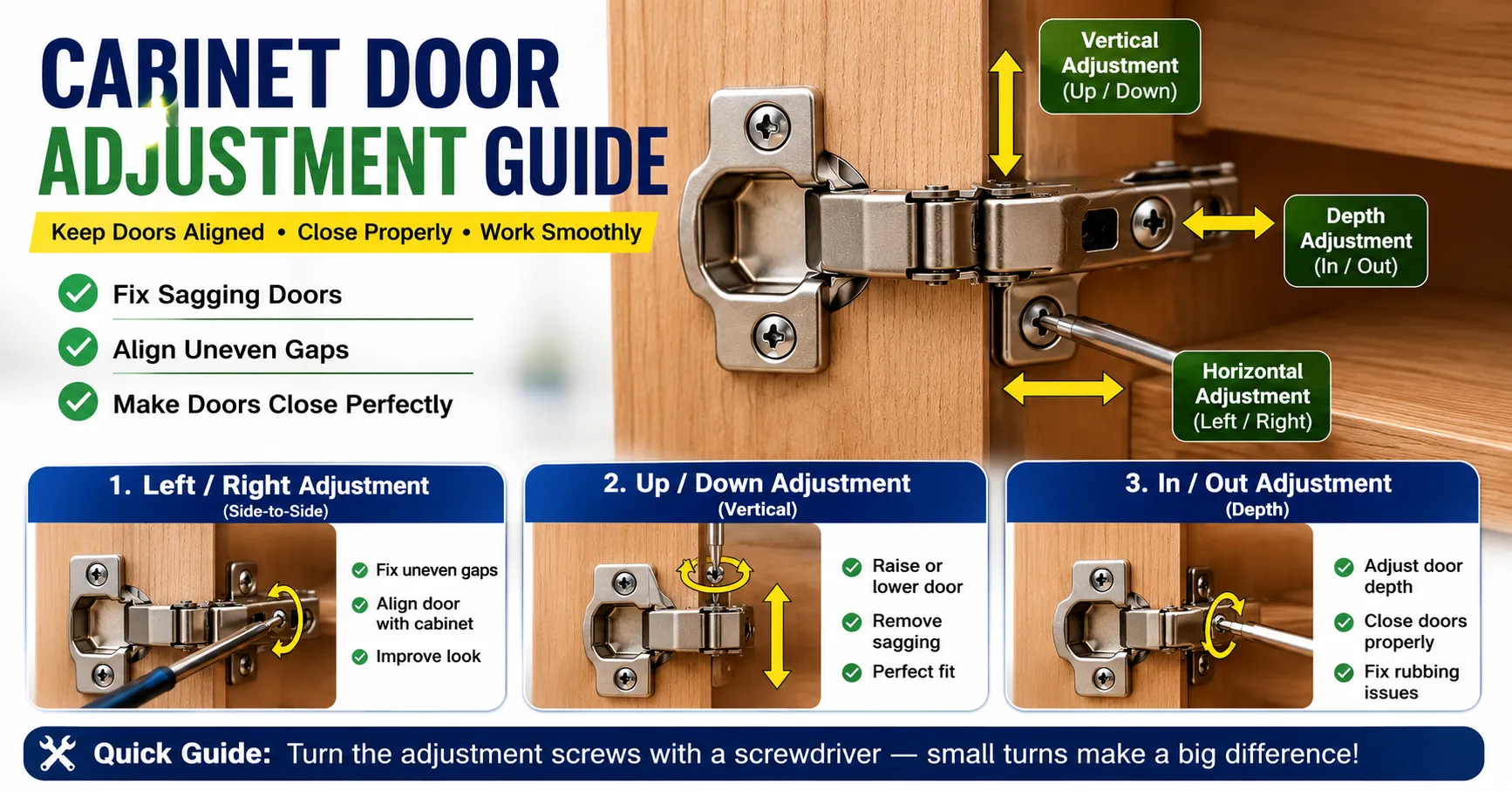
A cabinet door that sits crooked, rubs against another door, or leaves an uneven gap can make an otherwise good cabinet look poorly installed. Fortunately, many alignment problems can be corrected without replacing the entire cabinet. This cabinet door adjustment guide explains how to identify the cause of a misaligned door and make the right adjustment without randomly turning every hinge screw. Most modern concealed hinges allow some combination of side-to-side, height, and depth adjustment. However, the exact adjustment points vary by hinge design. Before making changes, inspect the hinges, mounting screws, door gaps, and overlay so you know what is actually causing the problem.
Problem
Cabinet doors can become misaligned for several reasons. A door may gradually sag because hinge screws loosen over time, or the hinge itself may become worn. Sometimes the cabinet door is perfectly straight but the hinge position or overlay is incorrect.
Common problems include:
- The door is too high or too low.
- The door leans toward one side.
- The gap between two doors is uneven.
- The door rubs against the cabinet frame.
- The door does not close completely.
- The door sits too far inside or outside the cabinet.
- The hinge screws keep becoming loose.
- A cabinet door has started sagging.
- Two neighboring doors do not have matching reveals.
Before adjusting anything, open and close the door slowly and observe exactly where the problem occurs.
Quick Answer
Most modern concealed cabinet doors can be adjusted in three directions: side-to-side, up-and-down, and in-and-out. First check for loose mounting screws, then make small hinge adjustments and close the door after each change. If adjustment cannot correct the alignment, the hinge, mounting holes, overlay, or door itself may need attention.
For a detailed walkthrough, see our guide on how to adjust cabinet door hinges.
Find the Cause
The most important part of cabinet adjustment is diagnosing the problem before making changes.
1. Check for loose screws
Open the door and inspect both the hinge and mounting plate. If a screw is visibly loose, the hinge can move when the door is opened or closed.
Tighten the screw carefully, but avoid excessive force. Over-tightening can strip the screw hole or damage particleboard.
2. Check the hinge adjustment
If the mounting screws are tight but the door still sits incorrectly, the hinge adjustment may be the problem.
A concealed hinge commonly provides adjustments that affect the door’s:
- Horizontal position
- Vertical position
- Depth
The exact screw responsible for each movement depends on the hinge design.
3. Check the overlay
Overlay describes how much the cabinet door overlaps the cabinet opening or frame. An incorrect overlay can create gaps that look like an adjustment problem.
If you are unsure about this measurement, read our guide explaining what overlay means on a cabinet hinge.
You can also learn how to measure cabinet hinge overlay before replacing or repositioning a hinge.
4. Look for damaged hinge holes
If a hinge screw turns but never becomes tight, the hole may be stripped. This is particularly common in particleboard and older cabinets.
A loose mounting hole cannot always be fixed by turning an adjustment screw. The mounting point may need reinforcement or a hinge repair solution.
5. Inspect the hinge itself
Look for bent metal, excessive movement, damaged plastic components, or a hinge that does not move smoothly.
If the hinge is physically damaged, repeated adjustment may only provide a temporary solution.
6. Check hinge placement
If a cabinet has recently been repaired or the door has been rehung, incorrect hinge placement can cause alignment problems.
Before drilling new holes or relocating a hinge, review proper cabinet door hinge placement so the replacement hardware is positioned correctly.
Fix It
Once you identify the cause, make one adjustment at a time.
Fix #1: Tighten loose mounting screws
Start with the simplest solution.
Hold the cabinet door in its normal position and gently tighten loose mounting screws. Do not immediately adjust every screw on the hinge.
After tightening, close the door and check:
- Top gap
- Bottom gap
- Gap beside the neighboring door
- Door depth
- Whether the door closes properly
If the alignment improves, no further adjustment may be necessary.
Fix #2: Correct side-to-side alignment
A door that is too close to another cabinet door may need a horizontal adjustment.
On many concealed hinges, one adjustment mechanism changes the door’s side-to-side position. Turn it in small increments rather than making a large adjustment.
After each small change:
- Close the cabinet door.
- Inspect the gap.
- Compare the top and bottom reveals.
- Repeat only if necessary.
This approach prevents you from moving the door too far in the opposite direction.
Fix #3: Adjust the door height
If the door sits too high or too low, inspect the hinge mounting plate and its height-adjustment mechanism.
Some hinge systems allow vertical movement through the mounting plate, while others use a different mechanism.
Loosen the appropriate mounting hardware slightly, reposition the door, and retighten it securely according to the hinge design.
Do not assume that every hinge uses the same adjustment method.
Fix #4: Adjust cabinet door depth
Depth adjustment changes how far the cabinet door sits toward or away from the cabinet box.
This is useful when:
- The door sticks out too far.
- The door sits too deeply.
- The door does not sit flush with neighboring doors.
- The cabinet door closes but looks uneven from the front.
Make small changes and check the closed position after each adjustment.
Fix #5: Correct uneven reveals
The reveal is the visible gap around the cabinet door.
If the top gap is narrow while the bottom gap is wide, the door may be tilted rather than simply being too high or too low.
Compare the door with adjacent cabinet doors. Adjust the hinge positions gradually until the gaps look consistent.
Fix #6: Repair stripped screw holes
If a mounting screw will not tighten, stop repeatedly turning it.
Depending on the cabinet material and damage, possible solutions include:
- Using a suitable replacement screw
- Reinforcing the mounting area
- Installing a hinge repair plate
- Relocating the hinge when appropriate
- Replacing damaged cabinet material
The correct solution depends on how badly the hole is damaged.
Fix #7: Replace a damaged hinge
If adjustment does not restore smooth movement, inspect the hinge for physical damage.
A replacement may be more practical when the hinge is:
- Bent
- Worn
- Broken
- Rusted
- Missing components
- No longer holding its adjustment
For older hardware, our guide on how to adjust old cabinet door hinges can help determine whether adjustment or replacement makes more sense.
If That Doesn’t Work
Sometimes the door remains crooked even after careful hinge adjustment. When that happens, the problem may not be the adjustment itself.
Check these possibilities:
Incorrect hinge type
A hinge designed for a different door thickness, overlay, or mounting arrangement may not position the door correctly.
Incorrect overlay
If the overlay does not match the cabinet construction, the door may never achieve the expected gap.
Incorrect hinge placement
A hinge installed too high, too low, or at the wrong distance from the cabinet edge can cause persistent alignment problems.
Damaged cabinet material
If the screws cannot hold securely because the cabinet material is damaged, the hinge will continue moving.
Warped cabinet door
A warped door may not become perfectly flush simply through hinge adjustment.
Cabinet box is out of square
If the cabinet itself is not square, the door may appear misaligned even when the hinges are correctly positioned.
If you need to install new concealed hinges, proper drilling becomes important. Our guide on how to drill cabinet hinge holes explains the process in more detail.
Recommended Hardware
You usually do not need many tools for a basic cabinet-door adjustment.
Basic tools
- #2 Phillips screwdriver
- Appropriate screwdriver for the hinge screws
- Small drill/driver
- Measuring tape
- Small level
- Replacement cabinet screws
A screwdriver is usually preferable for small adjustments because it gives you better control than a power drill.
Concealed hinge jig
If your problem requires replacing a concealed hinge and drilling a new 35mm hinge cup hole, a hinge jig can help maintain consistent positioning.
One option to consider is a 35mm concealed hinge jig:
View a 35mm Concealed Hinge Jig on Amazon
This type of tool is more relevant to hinge replacement or new installation than to a simple adjustment.
Amazon affiliate disclosure: Some links on this page may be Amazon affiliate links. If you purchase through them, we may earn a commission at no additional cost to you.
For specialty cabinet hardware, you may also encounter concealed or invisible hinge systems. For example, our article about the SOSS Model 204 invisible cabinet hinge explains a different style of hinge construction.
Comparison
| Solution | Best For | Difficulty | Cost | When to Use |
|---|---|---|---|---|
| Hinge adjustment | Minor alignment problems | Easy | Low | Door is otherwise in good condition |
| Tightening screws | Loose or sagging doors | Easy | Low | Mounting screws have loosened |
| Hinge replacement | Worn or damaged hinges | Moderate | Medium | Hinge no longer operates correctly |
| Hinge repair plate | Damaged mounting holes | Moderate | Low–Medium | Screws cannot hold securely |
| New hinge installation | Incorrect or severely damaged hardware | Moderate–High | Medium | Existing hardware is unsuitable |
The simplest solution should always be tested first. There is little reason to replace a good hinge if a small adjustment or loose mounting screw is the actual problem.
Prevention
Once you have your cabinet doors aligned, a few simple habits can reduce future problems.
Check screws periodically
Cabinet doors are opened thousands of times. Small amounts of movement can gradually loosen hardware.
Avoid overtightening
A screw that is excessively tightened can damage the cabinet material and make future repairs more difficult.
Fix sagging early
A door that is only slightly misaligned may become significantly worse if the underlying loose hinge is ignored.
Use the correct overlay
When replacing hinges, confirm the overlay before buying hardware.
Install hinges accurately
If installing a new hinge, use the correct measurements and drilling position instead of estimating the hinge location.
Replace badly damaged hardware
A damaged hinge should not be adjusted indefinitely. Once the mechanism is worn or broken, replacement is usually the more reliable solution.
You can also compare different hinge styles and finishes, such as a champagne gold cabinet hinge, when replacing visible or decorative hardware.
FAQ
How do I adjust a cabinet door that is crooked?
First check for loose mounting screws. Then determine whether the door needs side-to-side, height, or depth adjustment. Make small changes and close the door after each adjustment.
Which screw adjusts a cabinet door side to side?
On many concealed hinges, one adjustment screw controls horizontal movement, but the exact screw varies by hinge model. Inspect the hinge design before turning anything.
How do I fix a cabinet door that is too high?
Check the hinge’s vertical adjustment mechanism or mounting plate. Depending on the hinge design, you may need to loosen the mounting hardware, reposition the door, and retighten it.
How do I fix a cabinet door that sticks out?
Check the hinge’s depth adjustment. A concealed hinge may allow the door to move slightly inward or outward so it sits more flush with the cabinet.
Why won’t my cabinet door stay aligned?
Loose screws, worn hinges, damaged mounting holes, incorrect hinge placement, or a warped door can cause recurring alignment problems.
Can old cabinet hinges be adjusted?
Some older hinges have limited adjustment compared with modern concealed hinges. If adjustment is insufficient, replacement hardware may provide better alignment.
What is cabinet hinge overlay?
Overlay is the amount that a cabinet door overlaps the cabinet opening or frame. The correct overlay is important when selecting and positioning replacement hinges.
When should I replace a cabinet hinge?
Consider replacement when the hinge is bent, broken, badly worn, rusted, or unable to maintain proper alignment after reasonable adjustment.
Final Takeaway
A cabinet door usually becomes much easier to fix once you identify which direction it is misaligned. Start by checking loose screws and hinge condition, then make small side-to-side, height, or depth adjustments. If those changes do not solve the problem, investigate overlay, hinge placement, damaged mounting holes, or a warped door.
The best cabinet door adjustment guide is not about turning every hinge screw—it is about diagnosing the specific problem first and using the smallest correction necessary.