
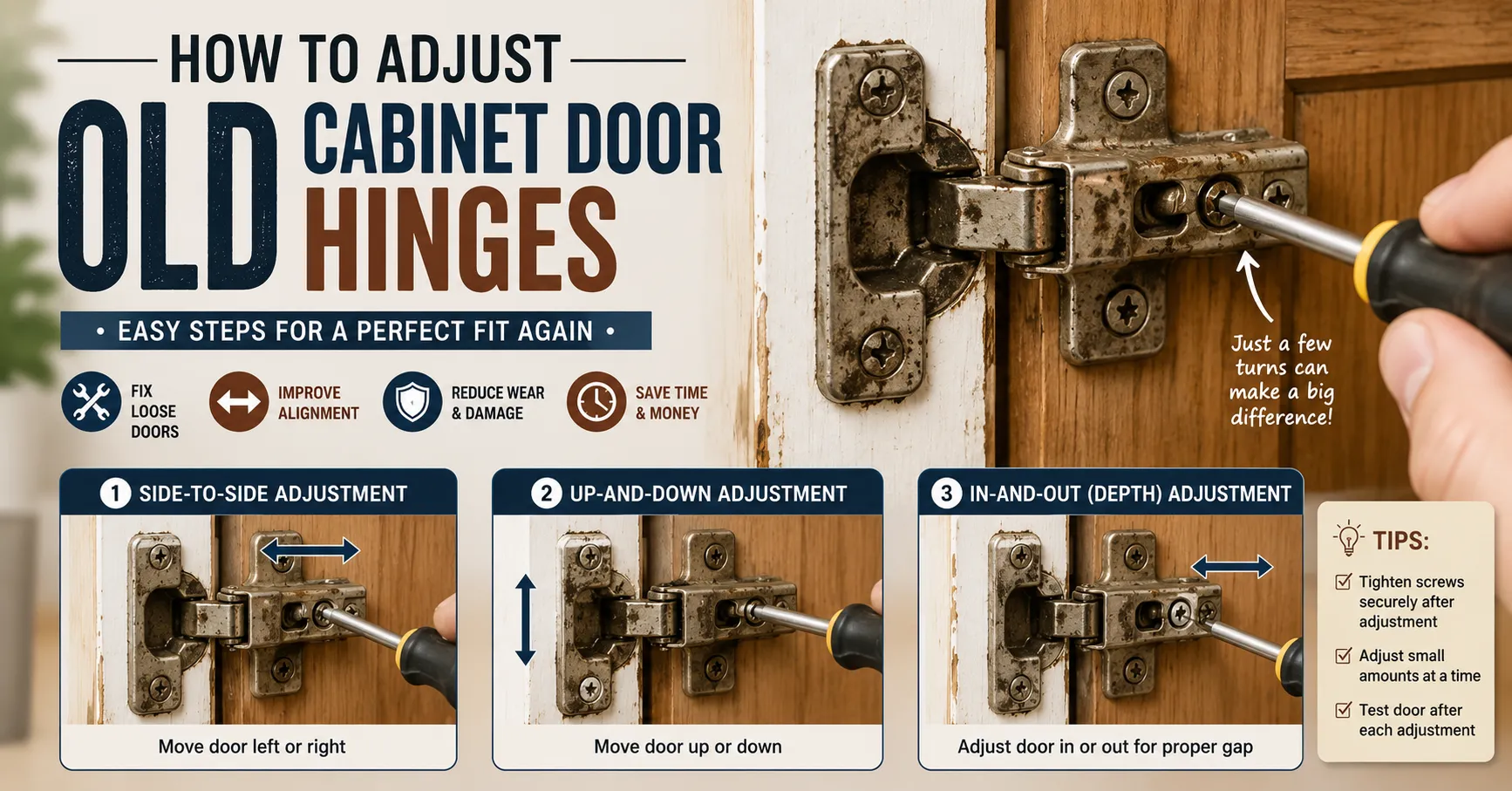
If your cabinet doors are sagging, rubbing, sitting unevenly, or refusing to close properly, the hinges are often the first place to look. Learning how to adjust old cabinet door hinges can save you from replacing an otherwise usable cabinet door or paying for a complete cabinet repair. However, old hinges can have additional problems that newer hinges do not, including loose screws, stripped mounting holes, worn adjustment mechanisms, and damaged wood around the hinge.
The good news is that most minor alignment problems can be corrected with a screwdriver and a few careful adjustments. In this guide, you will learn how to identify the cause, adjust the hinge, repair damaged mounting points, and determine when replacing the old hinge is the better option.
What Is Happening?
An old cabinet door usually becomes misaligned because the hinge or its mounting point has moved over time. Years of opening and closing can loosen screws, enlarge screw holes, or wear out the hinge mechanism. You may notice that the door sits lower on one side, rubs against another door, has an uneven gap, or does not close completely.
Before turning any adjustment screw, inspect the entire hinge system. A loose screw requires a different solution from a stripped screw hole or a bent hinge. Also remember that not every cabinet hinge adjusts in the same way. Older surface-mounted hinges, traditional butt hinges, and modern concealed hinges have different adjustment methods.
The key is to identify the problem first and make small adjustments rather than forcing the door into position.
Most Likely Causes
1. Loose hinge screws
Loose screws are one of the easiest problems to fix. Repeated movement can gradually loosen the screws holding the hinge to the cabinet or door.
If the screw can still tighten normally, this may be all you need to correct the alignment.
2. Stripped or enlarged screw holes
Old cabinet doors often have screw holes that have become enlarged after years of use. When this happens, the screw may turn without gripping the wood.
In this situation, repeatedly tightening the same screw will not provide a reliable repair.
3. Hinge adjustment has shifted
Concealed cabinet hinges commonly have adjustment mechanisms that allow the door to move horizontally, vertically, or in and out.
A small movement in one direction can make a noticeable difference in the door gap.
4. Worn or bent hinge
A hinge that is bent, cracked, heavily worn, or mechanically damaged may no longer hold its position.
If the hinge itself is defective, adjusting the screws may only provide a temporary solution.
5. Damaged cabinet material
The wood or particleboard around the hinge mounting area may have cracked or broken. When the mounting surface is damaged, the hinge cannot remain secure even if the hinge itself is perfectly good.
Quick Diagnosis
Start with the cabinet door closed.
Look at the gaps between the door and the cabinet frame. Determine whether the door needs to move left or right, up or down, or forward or backward.
Next, open the door and inspect every hinge screw.
Try gently tightening loose screws. Do not use excessive force because overtightening can damage already-weakened wood.
If the screw turns continuously without becoming tight, the mounting hole is probably stripped.
If the screws are tight but the door remains crooked, look for adjustment screws on the hinge. Concealed hinges often provide several adjustment points, while older hinges may require physical repositioning.
For a general introduction to the adjustment process, see our guide on how to adjust a cabinet door hinge.
Fix #1: Adjust the Existing Hinge
If the hinge is in good condition and the mounting screws are secure, adjusting the hinge should be your first option.
Adjust the door from side to side
Many concealed hinges have a screw that changes the horizontal position of the door.
Make a small adjustment, close the door, and inspect the gap. If the door has moved too far, turn the screw in the opposite direction.
Avoid making several large adjustments at once. Small changes give you better control over the final alignment.
Adjust the door depth
If the cabinet door sits too far inside the cabinet or protrudes too much from the cabinet frame, use the appropriate depth adjustment.
This is especially useful when the door does not sit flush with adjacent cabinet doors.
Adjust the height
Some hinge systems allow vertical adjustment through the mounting plate or hinge position.
Loosen the relevant mounting screws slightly, support the door, move it into the desired position, and retighten the screws.
After making the adjustment, open and close the door several times to make sure it remains aligned.
You can also follow our more detailed guide on how to adjust cabinet door hinges for additional adjustment techniques.
Fix #2: Repair Stripped Hinge Screw Holes
If the hinge screws will not tighten, the problem is probably not alignment alone. The mounting holes may have become too large or damaged to hold the screws.
A cabinet hinge repair plate can be an effective solution because it provides a larger metal mounting surface for the hinge.
This is particularly useful for old cabinets where the original hinge mounting area has weakened.
Basic repair process
- Remove the cabinet hinge screws.
- Hold the repair plate over the damaged hinge area.
- Position the plate so the hinge can be securely mounted.
- Mark or use the supplied mounting holes as appropriate.
- Secure the repair plate.
- Reattach the hinge.
- Adjust the cabinet door after the repair is secure.
If you want to understand how reinforcement plates work, read our guide to cabinet hinge reinforcement plates.
You can also see what a completed repair looks like in cabinet hinge repair plate installed.
Amazon hardware recommendation
For readers who need replacement hardware, you can browse Amazon cabinet hinge repair plates and select a plate that matches the hinge and cabinet construction.
Always check the dimensions and mounting configuration before purchasing.
Fix #3: Replace the Old Hinge
Sometimes the best answer is not another adjustment. If the hinge is physically damaged or its adjustment mechanism no longer works correctly, replacement is usually more practical.
Consider replacing the hinge if you notice:
- A bent hinge arm
- Cracked or broken hinge components
- Excessive movement in the hinge
- A damaged adjustment mechanism
- Severe rust or corrosion
- A door that repeatedly goes out of alignment
- A hinge that cannot hold the door securely
Before buying a replacement, identify the existing hinge type.
For concealed hinges, check the cup size, mounting style, overlay, opening angle, and door construction. Choosing a hinge that looks similar is not always enough.
If you are unsure about cabinet hinge overlay, read our explanation of what overlay means on a cabinet hinge.
For replacement hardware, you can browse Amazon 110-degree soft-close cabinet hinges.
If your project requires an invisible hinge rather than a standard concealed hinge, our guide to the SOSS Model 204 invisible cabinet hinge may also be useful.
If None Works
If the door remains crooked after adjusting or repairing the hinge, stop making random adjustments and inspect the cabinet itself.
The cabinet box may be out of square, the door may be warped, or the hinge mounting area may be severely damaged.
Remove the door if necessary and examine the wood around every hinge. Look for cracks, crushed particleboard, loose sections, or areas where the hinge is pulling away from the cabinet.
If the cabinet material is badly damaged, simply installing a larger screw may not provide a durable repair. A reinforcement plate, mounting block, or replacement section may be necessary.
Also check the cabinet door itself. A severely warped door may remain misaligned even when the hinges are correctly installed.
If the cabinet uses an unusual hinge configuration, verify that you are using the correct hinge type before replacing hardware.
Recommended Hardware
The right hardware depends on the condition of your old cabinet door.
Cabinet hinge repair plates
Best for: Stripped, enlarged, or damaged hinge mounting holes.
Browse cabinet hinge repair plates on Amazon.
Cabinet hinge screws
Best for: Missing, damaged, or worn hinge screws.
Browse cabinet hinge screws on Amazon.
Choose screws appropriate for the hinge and cabinet material rather than automatically selecting the longest available screw.
Screwdriver or hinge adjustment tool
Best for: Precise hinge adjustments and installation.
Browse cabinet hinge screwdrivers and adjustment tools on Amazon.
Using the correct screwdriver size helps reduce the risk of damaging the screw head.
Replacement cabinet hinges
Best for: Bent, broken, or severely worn hinges.
Browse replacement cabinet hinges on Amazon.
Before purchasing, compare the existing hinge’s dimensions, overlay, mounting pattern, and opening angle.
Quick Comparison
| Solution | Best For | Cost | Difficulty |
|---|---|---|---|
| Adjust existing hinge | Minor alignment problems | Low | Easy |
| Tighten screws | Loose hinges | Low | Easy |
| Repair plate | Stripped mounting holes | Low–Medium | Moderate |
| Replace hinge | Worn or damaged hinges | Medium | Moderate |
| Structural repair | Severe cabinet damage | Medium–High | Advanced |
Prevention
Once your old cabinet door is properly aligned, regular maintenance can prevent many hinge problems from returning.
Check hinge screws periodically, especially on frequently used kitchen or bathroom cabinets. Tighten loose screws before the mounting holes become damaged.
Avoid slamming cabinet doors. Repeated impact can loosen hardware and place unnecessary stress on the hinge mounting area.
Do not overtighten screws. A screw that is excessively tightened can strip or crush the surrounding wood.
Keep the door properly aligned so the hinges do not carry unnecessary stress.
If a hinge begins to move, fix the problem early rather than waiting until the mounting holes become severely damaged.
When replacing old hardware, choose a hinge designed for the cabinet’s construction and door overlay.
If appearance is also important, you can explore options such as champagne gold cabinet hinges for a decorative hardware upgrade.
For unusual cabinet installations, our article about behind-door storage cabinet hinge mounting can provide another useful reference.
FAQ
Can old cabinet hinges be adjusted?
Yes. Many old cabinet hinges can be adjusted, but the exact method depends on the hinge design. Concealed hinges generally offer more adjustment options than traditional hinges.
Why won’t my old cabinet hinge screws tighten?
The screw holes may be stripped or enlarged. If the screws continue spinning without becoming tight, consider repairing the mounting area with a cabinet hinge repair plate.
How do I fix a sagging old cabinet door?
First, check and tighten the hinge screws. Then adjust the hinge gradually. If the mounting holes are damaged, repair or reinforce the hinge mounting area.
Should I replace old cabinet hinges?
Replace a hinge when it is bent, broken, badly worn, or no longer holds its adjustment. If the hinge is mechanically sound, adjustment may be enough.
Can I use longer screws for a loose cabinet hinge?
Longer screws are not automatically better. The screw must be suitable for the cabinet material and must not penetrate too deeply or damage the cabinet.
Why does my cabinet door keep becoming crooked?
Repeated misalignment can indicate loose screws, damaged mounting holes, a worn hinge, a warped door, or a cabinet that is out of square.
How often should I check cabinet hinges?
Inspect frequently used cabinet hinges periodically. Fixing a loose screw early is usually easier than repairing a completely damaged mounting area.
Final Thoughts
Learning how to adjust old cabinet door hinges is usually a matter of identifying the actual problem before making adjustments. Start with the simplest solution: inspect the screws, check the hinge position, and make small adjustments.
If the screws will not tighten, focus on repairing the mounting area rather than repeatedly adjusting the hinge. If the hinge itself is damaged or worn out, replacement is often the most reliable long-term solution.
With the right diagnosis and hardware, many old cabinet doors can be brought back into proper alignment without replacing the entire cabinet.