
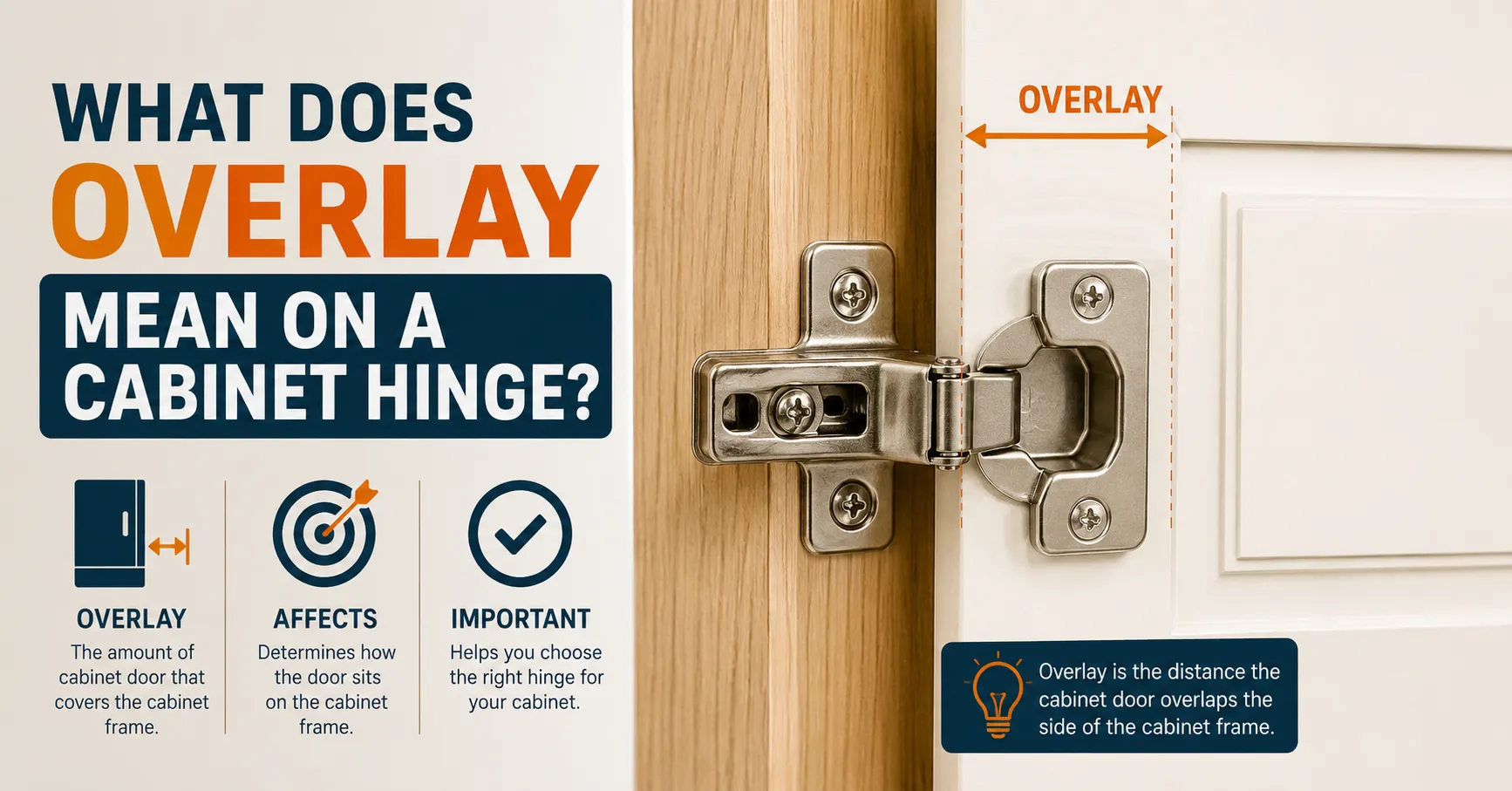
If you are shopping for replacement cabinet hinges, you may have noticed terms such as full overlay, half overlay, partial overlay, and inset. But what does overlay mean on a cabinet hinge? In simple terms, overlay describes how much the cabinet door covers the cabinet frame or cabinet box when the door is closed.
Understanding oNow write content
verlay is important because the wrong hinge can leave your cabinet door sitting too far inside, too far outside, or unevenly against the cabinet frame. The correct overlay measurement helps you choose a hinge that positions the door correctly.
Problem: Why Does Cabinet Hinge Overlay Matter?
Many homeowners replace a damaged cabinet hinge by looking only at the hinge’s shape or screw-hole pattern. However, two hinges can look almost identical while being designed for different overlay measurements.
If you install the wrong overlay hinge, the cabinet door may sit too far away from the frame, cover too much of the frame, rub against another door, or leave an uneven gap. This is especially common when replacing European or concealed hinges.
Overlay is therefore more than just a product description. It determines the position of the cabinet door when closed and helps ensure consistent spacing around the door. If your existing hinge keeps moving or coming loose, you may also want to read our guide on why cabinet hinges keep coming loose.
Quick Answer: What Does Overlay Mean on a Cabinet Hinge?
Overlay means how much the cabinet door overlaps the cabinet frame or cabinet box when the door is completely closed.
For example, if the door covers 1/2 inch of the cabinet frame on the hinge side, you have a 1/2-inch overlay. Common measurements can include 1/2 inch, 3/4 inch, 1 inch, and 1-1/4 inches, although the correct size depends on the cabinet construction and hinge system.
There are three common door configurations:
- Full overlay: The door covers most or nearly all of the cabinet frame or cabinet box edge.
- Partial/half overlay: The door covers only part of the frame.
- Inset: The door sits inside the cabinet opening instead of overlapping the front frame.
So, when a hinge listing says “1/2-inch overlay hinge,” it generally means the hinge is designed to position the door with approximately a 1/2-inch overlay.
Find the Cause: How Do You Know Your Cabinet Overlay?
Before purchasing a replacement hinge, measure the existing cabinet rather than guessing from the hinge appearance.
One simple method is to close the cabinet door and measure how far the door extends over the cabinet frame on the hinge side. For a single-door cabinet, another method is to measure the door width, measure the cabinet opening, subtract the opening width from the door width, and divide the difference by two. For example:
18.5-inch door − 17.5-inch opening = 1 inch
1 inch ÷ 2 = 0.5-inch overlay
This calculation method is also described in cabinet hinge overlay measurement guides.
Also determine whether your cabinet is face-frame or frameless. Frameless cabinets typically use hinges that mount directly to the cabinet box, while face-frame cabinets have a front frame that changes the hinge mounting arrangement.
Fix It: Choose the Correct Overlay Hinge
Once you know the overlay, select a hinge designed for that measurement and cabinet construction.
For example, a full-overlay concealed hinge is appropriate when the door is intended to cover most of the cabinet front. A partial-overlay hinge is useful when multiple doors share a cabinet frame or center stile.
European-style concealed hinges often provide additional adjustment after installation. These adjustments can help you fine-tune the door’s vertical, horizontal, and depth position.
If your cabinet door is already installed but the alignment is incorrect, our guide on how to adjust a cabinet door hinge can help you correct the position without replacing the entire hinge.
If That Doesn’t Work: Check the Hinge Mounting Area
Sometimes the overlay measurement is correct, but the door still does not align properly. In that situation, inspect the mounting screws, cabinet material, hinge plate, and mounting holes.
Loose or damaged mounting holes can prevent the hinge from holding its intended position. A repair plate can provide a stronger mounting surface when the original screw holes have become damaged.
You can learn more about this solution in our guide to a cabinet hinge repair plate and our article explaining how a European hinge repair plate can be used.
For severely damaged cabinet material, a cabinet hinge reinforcement plate may provide additional support.
Recommended Hardware
For most modern kitchen and bathroom cabinets, a concealed soft-close overlay hinge is a practical choice when the cabinet construction and overlay measurement match the hinge specification.
When shopping on Amazon, look specifically for:
- Full-overlay concealed cabinet hinges
- Partial or half-overlay cabinet hinges
- Soft-close European hinges
- Face-frame cabinet hinges
- Frameless cabinet hinges
- Cabinet hinge repair plates
Amazon product search:
Shop Full Overlay Cabinet Hinges on Amazon
Amazon concealed hinge search:
Shop Concealed Cabinet Hinges on Amazon
Amazon cabinet hinge repair plates:
Shop Cabinet Hinge Repair Plates on Amazon
For affiliate marketing, replace these search links with your Amazon Associates product links or tagged URLs for the exact products you recommend.
Comparison: Full Overlay vs Partial Overlay vs Inset
| Type | Door Position | Typical Use | Appearance |
|---|---|---|---|
| Full Overlay | Covers most of the cabinet front | Modern/frameless cabinets | Clean, continuous look |
| Partial/Half Overlay | Covers part of the frame | Cabinets with shared frame areas | More visible frame |
| Inset | Sits inside the cabinet opening | Traditional/custom cabinetry | Flush, furniture-style look |
The key difference is how the door sits in relation to the cabinet frame. Full-overlay doors cover most of the front structure, partial-overlay doors cover only part, while inset doors sit inside the opening.
If you are dealing with a concealed hinge that has damaged mounting points, you may also find our guide on a concealed hinge repair plate useful.
Prevention: Avoid Buying the Wrong Cabinet Hinge
The easiest way to prevent hinge problems is to measure before ordering.
Follow these steps:
- Close the cabinet door completely.
- Identify whether the cabinet is face-frame or frameless.
- Measure the door and cabinet opening if necessary.
- Calculate the overlay.
- Check the hinge’s specified overlay range.
- Confirm the hinge cup size and mounting pattern.
- Check whether you need full overlay, partial overlay, or inset hardware.
- Compare the replacement hinge with your existing hinge before installation.
If you have already installed a repair plate and want to understand what the finished installation should look like, see our guide on cabinet hinge repair plate installation.
For specialized concealed hardware, you can also compare the installation approach with our guide to the SOSS Model 204 invisible cabinet hinge.
FAQ
What does overlay mean on a cabinet hinge?
Overlay is the amount that the cabinet door covers the cabinet frame or cabinet box when the door is closed.
What is a full overlay cabinet hinge?
A full overlay hinge positions the door so that it covers most or nearly all of the cabinet front or frame. It is commonly associated with modern and frameless cabinet designs.
What is a half-overlay cabinet hinge?
A half-overlay or partial-overlay hinge positions the door so that it covers only part of the cabinet frame. It is commonly used where two doors share a center stile or limited frame area.
How do I measure cabinet hinge overlay?
Close the door and measure how far the door extends over the cabinet frame on the hinge side. For a single-door cabinet, you can also subtract the cabinet opening width from the door width and divide the result by two.
Is overlay the same as inset?
No. An overlay door sits over the cabinet frame or box edge, while an inset door sits inside the cabinet opening and is generally flush with the surrounding frame.
Can I adjust the overlay after installing a concealed hinge?
Many concealed European-style hinges provide adjustment that allows you to fine-tune door position. However, adjustment cannot compensate for selecting a fundamentally incompatible hinge or overlay specification.
What should I check before buying an overlay hinge?
Check the cabinet construction, overlay measurement, hinge type, mounting pattern, cup specification, door thickness, and required opening angle before purchasing.
Final Thoughts
Understanding what overlay means on a cabinet hinge makes choosing replacement hardware much easier. Overlay simply describes how much the closed cabinet door covers the frame or cabinet box. Once you know whether your door uses a full overlay, partial overlay, or inset configuration, you can narrow down the correct hinge much more confidently.
Always measure your existing cabinet before ordering. A few minutes of measuring can prevent incorrect door positioning, uneven gaps, and unnecessary hardware returns.