
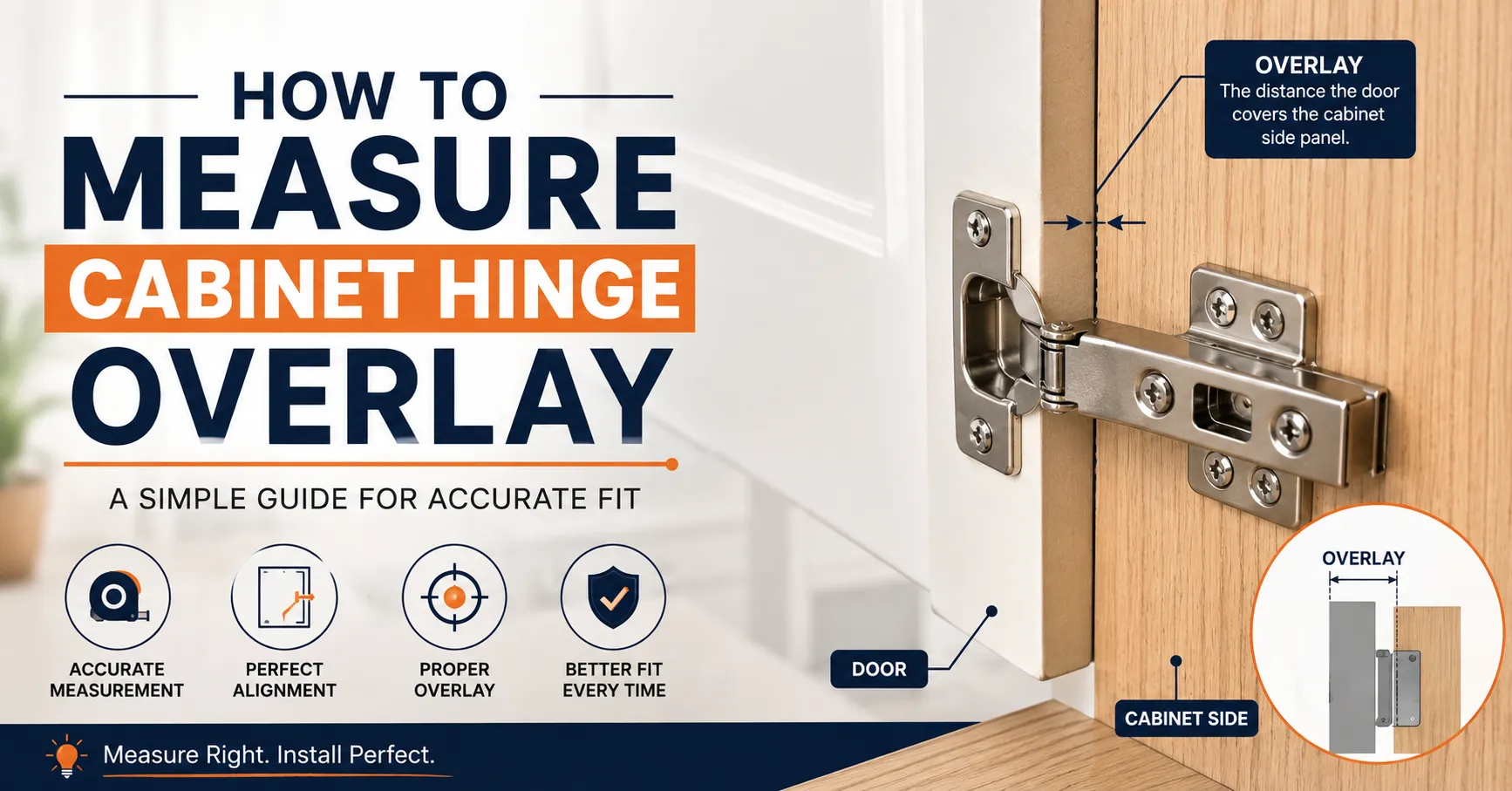
Replacing a cabinet hinge is much easier when you know the correct cabinet hinge overlay. Overlay refers to how much the cabinet door covers the cabinet opening or face frame when the door is closed. If you choose the wrong overlay, the door may sit too far inside, extend too far over the cabinet, or create uneven gaps between neighboring doors. The good news is that you can usually measure it with a tape measure and a few minutes of careful observation. In this guide, you’ll learn how to measure cabinet hinge overlay step by step, how to identify full, half, and inset configurations, and how to use your measurement when selecting replacement hinges.
What You Need
You don’t need many tools to measure cabinet hinge overlay. Gather:
- Measuring tape or precision ruler
- Pencil and paper for recording measurements
- Screwdriver
- Straightedge or combination square
- Existing cabinet hinge, if you’re replacing one
A precise ruler can be particularly useful when the overlay is close to a common hinge size.
Recommended measuring tool:
Amazon measuring tools for cabinet projects
Before You Start
Before measuring, close the cabinet door completely and inspect how it sits relative to the cabinet opening.
There are three common configurations:
- Full overlay: The door covers almost the entire cabinet opening or face frame.
- Half overlay: Two cabinet doors share part of the same center partition or frame.
- Inset: The door sits inside the cabinet opening rather than covering the front.
If you’re unfamiliar with the terminology, first read our guide explaining what overlay means on a cabinet hinge.
Also check whether your cabinet is face-frame or frameless. This can affect which hinge and mounting plate you need.
Step 1: Close the Cabinet Door and Check Its Position
Start with the cabinet door fully closed.
Look at the gap around the door. The door should sit evenly in relation to the cabinet opening.
Ask yourself:
- Does the door sit outside the cabinet opening?
- Does it partially cover the cabinet frame?
- Does it sit completely inside the opening?
- Is there another door beside it sharing the same cabinet frame?
This initial inspection helps you determine whether you’re dealing with an overlay or inset configuration.
Don’t remove the existing hinge yet. If you’re replacing the hinge, keeping it installed gives you a useful reference.
Step 2: Measure the Cabinet Opening
Next, measure the cabinet opening.
Open the door and identify the opening that the door covers when closed. Measure from the inside edge of the opening toward the corresponding outside edge of the cabinet frame.
For a face-frame cabinet, pay particular attention to the front frame because the door may cover part or all of this frame.
Write down your measurement rather than relying on memory.
For example, if the door covers approximately 1/2 inch of the cabinet frame beyond the opening, that measurement is important when determining the appropriate hinge configuration.
The goal isn’t simply to measure the door itself. You’re trying to determine how far the door extends beyond the cabinet opening.
Step 3: Measure the Overlay
Now you can measure the actual overlay.
Open the cabinet door and locate the edge of the cabinet opening. Measure from that edge to the edge of the cabinet door where the door overlaps the cabinet structure.
In simple terms:
Overlay = the amount of cabinet opening/frame covered by the door.
For example, if the cabinet door extends 1/2 inch beyond the cabinet opening on the hinge side, the overlay at that location is approximately 1/2 inch.
An Easier Method
If the hinge is already installed, you can also inspect the hinge specifications. Many concealed cabinet hinges are designed for a specific overlay range.
However, don’t assume the hinge’s appearance tells you the exact overlay. Different manufacturers use different hinge designs and mounting plates.
Measure the cabinet physically whenever possible.
Measure Both Sides When Necessary
If you’re working with a double-door cabinet, check the position of both doors. Small differences can indicate that one door has shifted or that the original installation wasn’t perfectly symmetrical.
If the cabinet doors are badly misaligned, you may also need to adjust the hinge after confirming the overlay. Our guide on how to adjust cabinet door hinges explains the adjustment process.
Step 4: Match the Measurement to the Correct Hinge
Once you know the overlay, compare it with the specifications of the replacement hinge.
Common configurations include:
Full Overlay Hinge
A full overlay hinge is designed for doors that cover most or all of the cabinet face-frame opening.
This configuration is common when individual cabinet doors sit over separate cabinet openings.
Half Overlay Hinge
A half overlay hinge is commonly used where two doors share a central partition. Each door covers part of the cabinet structure.
Inset Hinge
An inset hinge is used when the cabinet door sits inside the cabinet opening instead of covering the front of the cabinet.
Don’t select a hinge based only on the overlay measurement. Also check:
- Door thickness
- Cabinet construction
- Hinge cup size
- Mounting plate
- Opening angle
- Hinge type
- Manufacturer’s overlay specification
If your hinge is correctly selected but the door still doesn’t align, adjustment may be the solution. See our guide on how to adjust a cabinet door hinge.
If you’re installing concealed hinges from scratch, our guide on how to drill cabinet hinge holes can help with the drilling process.
Testing
Before ordering several replacement hinges, verify your measurement.
Close the cabinet door and check:
- The gap around the door.
- The amount of the frame covered by the door.
- The alignment with neighboring doors.
- The position of the hinge mounting plate.
- The manufacturer’s specified overlay.
If possible, measure the same area twice.
A measurement of approximately 1/2 inch should not automatically be rounded to another size simply because it appears close. Accurate measurement is especially important when replacing multiple hinges.
After installation, open and close the door several times. Check that it doesn’t rub against the cabinet, neighboring doors, or shelves.
Common Mistakes
1. Measuring the Door Instead of the Overlay
The door’s total width isn’t the same as its overlay. Overlay describes how much the door covers the cabinet opening.
2. Measuring Only the Door Thickness
Door thickness helps determine hinge compatibility, but it doesn’t tell you the overlay.
3. Ignoring Face-Frame Construction
A face-frame cabinet and frameless cabinet can require different hinge configurations.
4. Guessing the Overlay
Two hinges can look very similar while having different mounting requirements. Always measure instead of guessing.
5. Measuring Only One Door
With double-door cabinets, check both doors when accuracy matters.
6. Ignoring the Existing Mounting Plate
The hinge and mounting plate work together. A replacement hinge may not be compatible with the existing plate.
7. Ordering Before Checking Specifications
Your measurement is only one part of the selection process. Always compare it with the hinge manufacturer’s specifications.
If the cabinet door is already installed but sitting unevenly, don’t immediately replace the hinge. First determine whether adjustment is enough. You can also learn how to adjust old cabinet door hinges before purchasing new hardware.
When to Replace the Part
Sometimes measuring and adjusting the hinge won’t solve the problem because the hardware itself is damaged.
Consider replacing the hinge if you notice:
- Bent hinge arms
- Broken hinge springs
- Cracked hinge cups
- Severe corrosion
- Stripped mounting screws
- Damaged mounting plates
- Repeated door misalignment
- Loose hinge holes
If the hinge itself is fine but the wood around the mounting screws has become damaged, a repair or reinforcement plate may be a better solution.
You can learn more about using a cabinet hinge reinforcement plate for damaged mounting areas.
For an example of the repair process, see how a cabinet hinge repair plate is installed.
Recommended Tools
Having accurate measuring and installation tools makes cabinet hinge work much easier.
Measuring Tape
A compact measuring tape is useful for checking cabinet openings and door dimensions.
Precision Ruler
A metal or precision ruler can make small overlay measurements easier.
Cabinet Hinge Jig
If you’re installing new concealed hinges, a hinge jig can help position the hinge cup consistently.
35mm Forstner Bit
Many concealed European-style hinges use a 35mm cup, but always verify the specifications of the hinge you’re installing before drilling.
Cabinet Hinge Installation Tools
A basic installation kit can be useful when you’re replacing multiple hinges.
Amazon cabinet hinge installation tools
FAQ
Q: What is cabinet hinge overlay?
A: Cabinet hinge overlay is the amount that a cabinet door covers the cabinet opening or face frame when the door is closed.
Q: How do I measure cabinet hinge overlay?
A: Close the door, identify the cabinet opening, then measure the distance from the opening edge to the corresponding edge of the closed door.
Q: What is a standard cabinet hinge overlay?
A: There isn’t one universal overlay. Common hinges are available for full overlay, half overlay, and inset applications, with exact measurements varying by hinge design.
Q: How do I know if I need a full overlay hinge?
A: If the cabinet door covers almost the entire cabinet face around its opening, you may need a full overlay hinge. Always verify the manufacturer’s specifications.
Q: Can I measure overlay without removing the cabinet door?
A: Yes. In many cases, you can determine the overlay by examining the closed door and measuring its relationship to the cabinet opening.
Q: Is overlay the same as door thickness?
A: No. Overlay describes how far the door covers the cabinet opening. Door thickness is a separate measurement.
Q: What happens if I buy the wrong overlay hinge?
A: The door may sit too far inside or outside the cabinet, creating poor gaps or alignment problems.
Q: Can an overlay hinge be adjusted?
A: Many concealed hinges have adjustment screws that allow you to fine-tune the door position after installation.
Final Takeaway
Learning how to measure cabinet hinge overlay can save you from buying the wrong replacement hardware. Start by identifying whether your cabinet uses an overlay or inset configuration, measure the amount of the door covering the cabinet opening, and then compare that measurement with the hinge manufacturer’s specifications.
Remember that overlay is only one part of hinge selection. Door thickness, cabinet construction, mounting plates, hinge type, and cup dimensions can also affect compatibility. Taking a few extra minutes to measure everything carefully can make installation much easier and help you achieve clean, even cabinet-door gaps.