
Replacing a cabinet hinge is not as simple as choosing one that looks similar to the old hinge. Even two hinges that appear almost identical can have different cup diameters, mounting patterns, overlays, or opening angles. If the measurements do not match, the replacement may not fit the existing holes or the cabinet door may sit incorrectly.
If you are searching for how to measure a cabinet hinge, the most important thing is to identify the hinge type first and then measure the dimensions that determine compatibility. For concealed European-style hinges, this usually includes the cup diameter, cup setback, cup depth, door thickness, overlay, and mounting pattern. For traditional hinges, you may need to measure the leaf size, screw-hole spacing, and overall hinge dimensions.
Taking a few minutes to measure before buying can save you from unnecessary drilling, returns, and alignment problems.
Who Needs This?
This guide is useful for homeowners, DIYers, cabinet installers, furniture makers, and anyone replacing damaged or outdated cabinet hinges.
You should measure your cabinet hinge before purchasing a replacement when:
- The existing hinge is broken or bent.
- You want to replace standard hinges with soft-close hinges.
- The new hinge must use the existing screw holes.
- Your cabinet door is misaligned.
- You are replacing old cabinet hardware.
- You are installing hinges on a new cabinet door.
- You are unsure whether your cabinet is face-frame or frameless.
- You do not know whether your door is inset or overlay.
If your hinge is not damaged and your main problem is a crooked or uneven door, replacement may not be necessary. You may simply need to adjust it. Our guide on how to adjust a cabinet door hinge explains the basic adjustment process.
What to Check Before Buying
Before ordering a cabinet hinge, inspect both the hinge and the cabinet door.
Identify the Existing Hinge
First determine whether you have a:
- Concealed European hinge
- Face-frame hinge
- Frameless hinge
- Overlay hinge
- Inset hinge
- Half-overlay hinge
- Butt hinge
- Soft-close hinge
- Invisible hinge
The measurements you need depend heavily on the hinge type.
Check the Cabinet Construction
Look at the front of the cabinet box.
If there is a wooden frame around the front opening, it is generally a face-frame cabinet. If there is no front frame and the cabinet box itself forms the front edge, it is generally frameless.
This matters because the mounting arrangement can be different.
Check the Door Position
Close the cabinet door and look at how it sits relative to the cabinet.
Does the door cover the cabinet frame? That indicates an overlay configuration.
Does the door sit inside the cabinet opening? That indicates an inset configuration.
For a detailed explanation, read our guide on what does overlay mean on a cabinet hinge.
Look for Manufacturer Markings
Check the hinge for:
- Brand name
- Model number
- Numbers stamped into the metal
- Logo
- Hinge series
If you can identify the exact model, finding a matching replacement can be much easier.
Important Measurements
Once you identify the hinge, take the measurements that determine whether a replacement will fit.
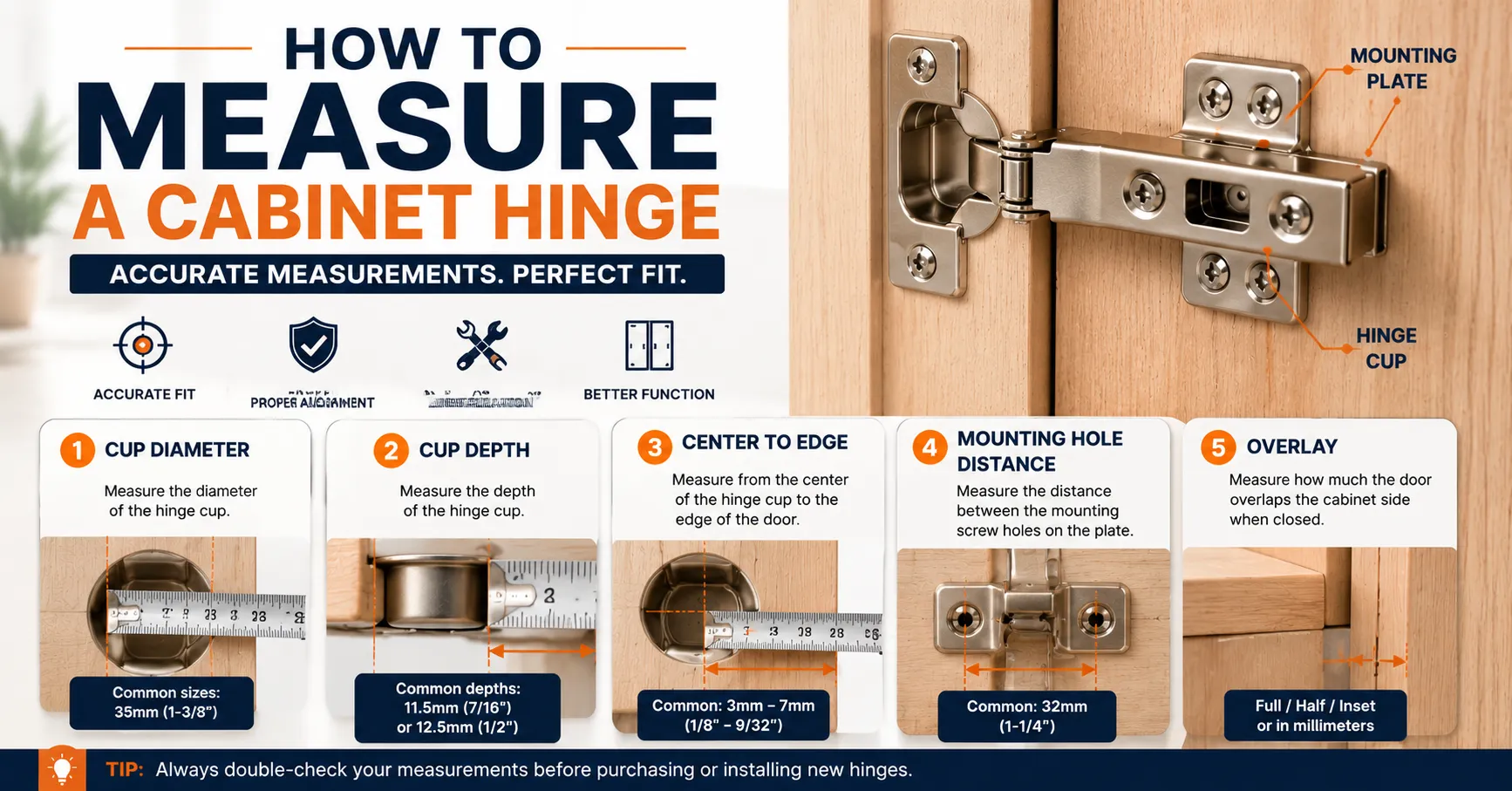
1. Measure the Hinge Cup Diameter
If you have a concealed European-style hinge, start by measuring the circular cup installed into the back of the cabinet door.
A 35 mm cup is very common on full-size European-style concealed hinges.
However, do not automatically assume yours is 35 mm. Measure it.
Place a ruler or caliper across the widest part of the circular opening.
If you are installing a new concealed hinge and need to create the cup hole, a 35 mm Forstner bit is commonly used for hinges designed around the 35 mm cup standard.
Amazon: 35 mm Forstner Bit
2. Measure Cup Setback
Cup setback is the distance between the edge of the cabinet door and the location of the hinge cup.
This is particularly important if you are drilling a new hinge cup hole.
A small difference in cup position can affect how the door sits on the cabinet.
Measure from the appropriate reference edge of the door to the hinge-cup location according to the hinge manufacturer’s installation dimensions.
Do not confuse cup setback with overlay. They are separate measurements.
3. Measure Cup Depth
If the hinge is concealed, measure the depth of the circular cup hole.
This tells you how deep the hinge cup is installed into the door.
A common concealed-hinge cup depth is around 11–13 mm, but you should always check the requirements of the specific hinge you intend to purchase.
Drilling too deeply can damage the cabinet door.
If you are creating new holes, use a depth stop or suitable drilling guide whenever possible.
4. Measure Cabinet Door Thickness
Use a ruler or digital caliper to measure the thickness of the cabinet door.
Do not estimate this measurement.
Door thickness can affect:
- Hinge compatibility
- Cup drilling depth
- Screw selection
- Hinge clearance
- Door positioning
A digital caliper is particularly useful because cabinet hardware measurements often require greater precision than a standard tape measure provides.
Amazon: Digital Caliper
5. Measure the Overlay
Overlay is one of the most important measurements when replacing a cabinet hinge.
Close the cabinet door and determine how much the door extends over the cabinet frame or opening.
Depending on the cabinet design, you may have:
- Full overlay
- Partial overlay
- Half overlay
- Inset
The correct overlay hinge must match the way your cabinet door is positioned.
For a detailed measurement method, see our guide on how to measure cabinet hinge overlay.
6. Measure Screw-Hole Spacing
If you want to reuse existing screw holes, measure the distance between the mounting holes.
For a concealed hinge, inspect both the hinge cup mounting area and the mounting plate.
Measure from the center of one hole to the center of the other whenever possible.
This can help you determine whether the new hinge will fit without drilling additional holes.
7. Check the Mounting Plate
Many concealed cabinet hinges use a separate mounting plate.
Measure and identify:
- Plate type
- Plate height
- Screw-hole pattern
- Mounting position
- Face-frame or frameless configuration
A replacement hinge may have the correct cup diameter but still be incompatible with your existing mounting plate.
8. Check the Opening Angle
Look at how far the cabinet door opens.
Concealed hinges are available with different opening angles, depending on the design and application.
Before buying, check whether the replacement hinge provides the opening range you need.
This is especially important for corner cabinets, adjacent doors, and cabinets positioned next to walls or appliances.
Types
Concealed European Hinges
Concealed hinges are widely used on modern kitchen and bathroom cabinets.
The hinge cup is installed into a circular hole on the back of the door, while the hinge connects to a mounting plate on the cabinet.
One major advantage is adjustability.
Face-Frame Hinges
Face-frame hinges are designed for cabinets with a front frame.
The hinge mounting arrangement is designed around the wooden frame surrounding the cabinet opening.
Frameless Hinges
Frameless hinges attach to cabinets without a traditional front frame.
The mounting plate attaches directly to the cabinet box.
Overlay Hinges
Overlay hinges are designed for cabinet doors that sit over the cabinet frame or opening.
The amount of overlay must be considered when selecting the hinge.
Inset Hinges
Inset hinges are used when the cabinet door sits inside the cabinet opening rather than covering it.
Butt Hinges
Butt hinges have two leaves connected by a central pin and are commonly associated with traditional cabinet and furniture construction.
Invisible Hinges
Invisible hinges are designed to remain hidden when the cabinet door is closed.
For a specialized example, see our article about the SOSS Model 204 invisible cabinet hinge.
Which Type Fits Which Problem?
| Cabinet Situation | Suitable Hinge Type |
|---|---|
| Modern kitchen cabinet | Concealed European hinge |
| Door covers the cabinet frame | Overlay hinge |
| Door sits inside the opening | Inset hinge |
| Cabinet has a face frame | Face-frame hinge |
| Cabinet has no face frame | Frameless hinge |
| Door needs controlled closing | Soft-close hinge |
| Traditional visible hinge required | Butt hinge |
| Hardware needs to remain hidden | Invisible hinge |
If your existing hinge is still mechanically sound but the door has uneven gaps, first try adjustment.
Our cabinet door adjustment guide covers common problems such as uneven gaps, crooked doors, and alignment issues.
Top Recommended Options
1. Digital Caliper
A digital caliper is one of the most useful tools for measuring cabinet hardware.
It can help you measure:
- Door thickness
- Hinge cup diameter
- Mounting plate dimensions
- Screw-hole spacing
- Small hardware components
Amazon: Digital Calipers
2. 35 mm Forstner Bit
If your replacement concealed hinge requires a 35 mm cup hole, a suitable Forstner bit can create the circular opening.
Make sure the bit diameter matches the hinge manufacturer’s specifications before drilling.
Amazon: 35 mm Forstner Bits
3. Concealed Hinge Drilling Jig
A hinge drilling jig can help position and drill concealed hinge cup holes more consistently.
This is particularly useful when installing multiple hinges or replacing hinges where new holes are required.
Amazon: 35 mm Cabinet Hinge Jigs
4. Replacement Concealed Cabinet Hinges
If your existing concealed hinge is damaged, you can search for replacement hinges that match your measurements.
Do not select a hinge based only on its appearance.
Check the cup size, overlay, mounting style, door thickness, mounting pattern, and cabinet construction.
Amazon: 35 mm Soft-Close Cabinet Hinges
Comparison Table
| Measurement | What You Measure | Why It Matters |
| Cup diameter | Diameter of circular cup hole | Determines hinge compatibility |
| Cup setback | Door edge to cup position | Controls hinge placement |
| Cup depth | Depth of cup hole | Prevents improper drilling |
| Door thickness | Thickness of cabinet door | Determines compatible hardware |
| Overlay | Door overlap over cabinet | Determines hinge configuration |
| Screw spacing | Distance between mounting holes | Helps match existing holes |
| Mounting plate | Plate dimensions and pattern | Determines cabinet compatibility |
| Opening angle | Maximum door opening | Determines door clearance |
Pros / Cons
Measuring Before Buying
Pros:
- Reduces the chance of buying the wrong hinge.
- Helps match existing mounting holes.
- Makes installation easier.
- Helps achieve the correct door overlay.
- Reduces alignment problems.
Cons:
- Requires several measurements.
- Some older hinges are difficult to identify.
- Manufacturer dimensions can vary.
- You may need a digital caliper for precise measurements.
Buying Based Only on Appearance
Pros:
- Quick.
- Convenient when you already know the exact model.
Cons:
- Similar hinges can have different dimensions.
- The mounting holes may not match.
- The overlay may be wrong.
- The hinge cup may be incompatible.
- The door may not align correctly.
Buying Mistakes
Assuming Every Concealed Hinge Uses a 35 mm Cup
Although 35 mm is common, it is not universal. Measure your existing cup before buying.
Measuring Only the Hinge
The hinge is only one part of the installation. Door thickness, overlay, mounting plate, and cabinet construction also matter.
Confusing Overlay With Cup Setback
Overlay describes how much the cabinet door covers the cabinet frame or opening. Cup setback describes the position of the hinge cup in the door.
They are not interchangeable measurements.
Ignoring Door Thickness
A replacement hinge can have the correct cup diameter and still be unsuitable for your cabinet door.
Ignoring Face-Frame vs. Frameless Construction
Always identify the cabinet construction before selecting a replacement hinge.
Buying by Appearance
Two hinges may look almost identical but have different mounting plates, cup positions, or adjustment mechanisms.
Replacing a Hinge That Only Needs Adjustment
If the hinge is not damaged, replacement may be unnecessary.
For older hardware, read our guide on how to adjust old cabinet door hinges.
Drilling Without a Measurement Plan
If new holes are required, measure the door carefully before drilling.
Our guide on how to drill cabinet hinge holes provides additional information about positioning and drilling.
FAQ
Q: How do I measure a cabinet hinge?
A: Identify the hinge type first. For concealed hinges, measure the cup diameter, cup setback, cup depth, door thickness, overlay, mounting-hole spacing, and mounting plate.
Q: What is the most common concealed cabinet hinge size?
A: Many European-style concealed hinges use a 35 mm cup, but you should measure your existing hinge rather than assuming.
Q: How do I measure cabinet hinge overlay?
A: Close the cabinet door and measure how far it extends over the cabinet frame or opening. The measurement helps determine the correct overlay hinge.
Q: Are all 35 mm cabinet hinges interchangeable?
A: No. The 35 mm measurement refers primarily to the cup diameter. Other dimensions and specifications can differ.
Q: Do I need to replace the mounting plate?
A: Not necessarily. Some replacement hinges may work with an existing compatible mounting plate. Always verify compatibility first.
Q: What is the best tool for measuring a cabinet hinge?
A: A ruler can handle basic measurements, but a digital caliper provides greater precision for small hardware dimensions.
Q: Should I remove the hinge before measuring?
A: Not always. You can often identify and measure important dimensions while the hinge is installed. Remove it if you need access to hidden dimensions.
Final Thought
Knowing how to measure a cabinet hinge correctly makes replacement much easier. Do not rely on appearance or a single measurement. Instead, identify the hinge type and check the cup diameter, cup setback, cup depth, door thickness, overlay, mounting-hole spacing, mounting plate, and opening angle.
For concealed European hinges, 35 mm is a common cup diameter, but the complete hinge configuration must still match your cabinet.
If your existing hinge is not damaged, check whether adjustment can solve the problem before buying a replacement. When replacement is necessary, measure first, compare the specifications carefully, and then purchase the closest matching hinge.