
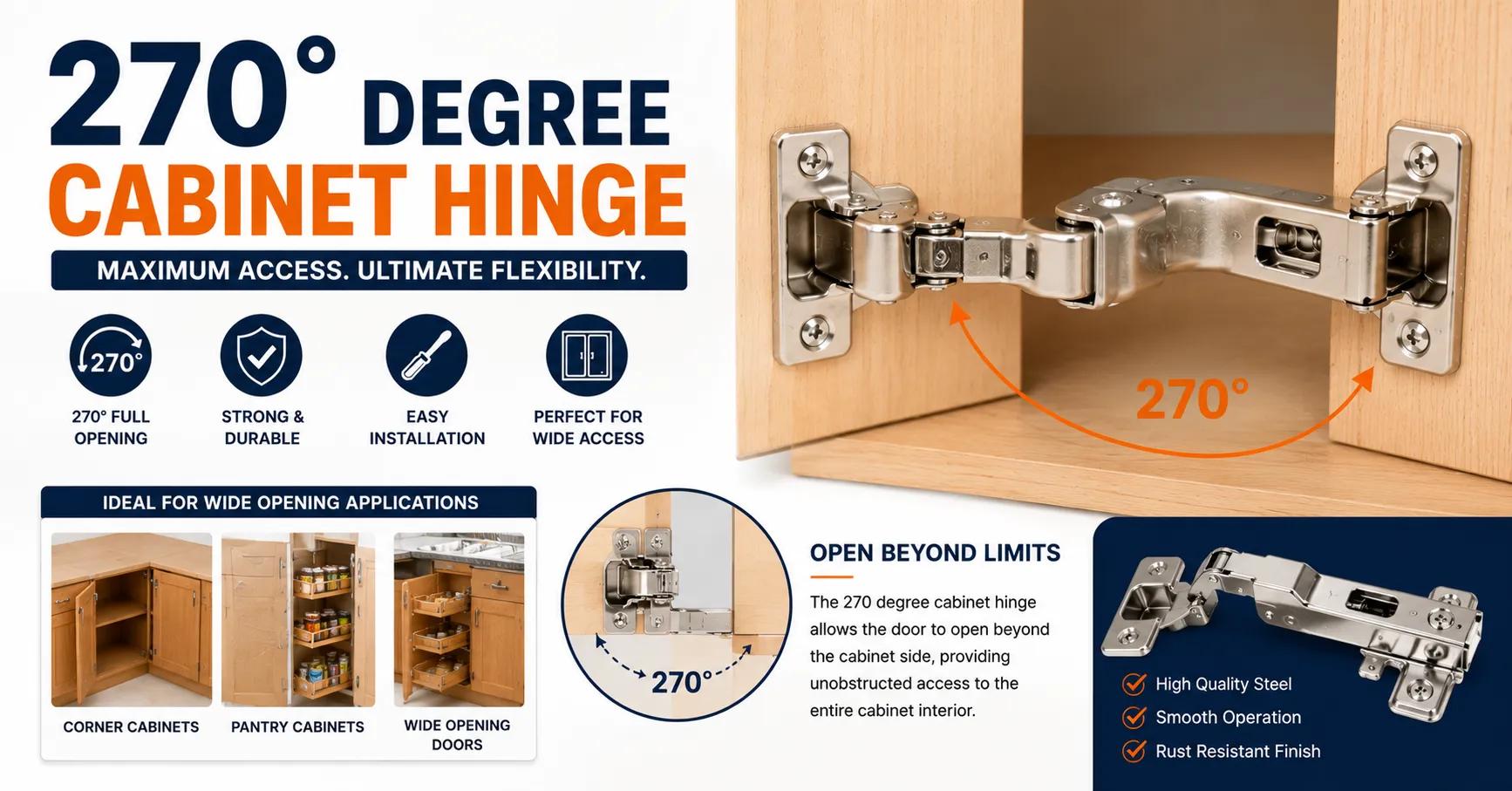
A 270 degree cabinet hinge is designed for cabinet doors that need an exceptionally wide opening. Unlike conventional cabinet hinges that may provide a more limited opening range, a 270-degree hinge can allow a compatible door to swing back much farther, providing easier access to the cabinet interior. This can be useful for furniture, storage cabinets, specialty cabinets, and other applications where a wide door swing is desirable.
However, choosing the correct 270° hinge is not simply a matter of matching the opening angle. Door thickness, overlay, mounting style, hole pattern, cabinet construction, and available clearance all affect compatibility. Before ordering a replacement, carefully measure your existing hardware and compare those measurements with the manufacturer’s specifications.
If you’re unfamiliar with hinge measurements, start with our guide on how to measure a cabinet hinge before purchasing.
What are you replacing?
Before replacing a cabinet hinge, identify exactly what is currently installed. Take a photo of the hinge while the cabinet door is still attached, then inspect the hardware after removing one hinge.
Determine whether the existing hardware is:
- Concealed or visible
- Overlay or inset
- Full-overlay or partial-overlay
- Surface-mounted or cup-style
- Adjustable or fixed
- Designed for a particular opening angle
- Attached to a face frame or frameless cabinet
If your existing hinge is damaged, compare its shape, mounting plate, screw locations, and overall dimensions with the replacement.
Don’t throw away the old hinge until the new one has been tested. It can serve as a useful reference if you discover a measurement or compatibility problem.
Measure the existing hardware
Accurate measurement is one of the most important steps when replacing a 270 degree cabinet hinge.
Measure both the hinge and the cabinet rather than relying on appearance alone.
Record the following information:
- Cabinet door thickness
- Door width and height
- Overlay
- Hinge cup diameter, if applicable
- Hinge cup depth
- Mounting-hole spacing
- Mounting-plate dimensions
- Screw-hole position
- Distance from the door edge
- Distance between hinges
- Cabinet side or frame thickness
- Approximate opening angle
You can also use our guide on how to measure cabinet hinge overlay to determine how much the door overlaps the cabinet.
This is especially important because two hinges can both be advertised as 270° hinges while having completely different mounting requirements.
Important dimensions
Door Thickness
Measure the cabinet door at an area that has not been damaged or modified. Use a ruler for basic measurements or a digital caliper when greater accuracy is necessary.
Never assume that a replacement hinge will work simply because the door looks similar to the manufacturer’s example.
Overlay
Overlay describes how much the cabinet door overlaps the cabinet opening or frame when closed.
Correct overlay is critical because an incorrect overlay can cause:
- Uneven gaps
- Doors sitting too far inward or outward
- Difficulty closing
- Misaligned cabinet fronts
- Interference with adjacent doors
If you’re unsure about this measurement, read what is the overlay on a cabinet hinge before ordering.
Hinge Cup Size
Some concealed cabinet hinges use a cup drilled into the back of the door. If your replacement uses a cup system, check the cup diameter, depth, location, and mounting pattern.
Do not assume that every concealed cabinet hinge uses exactly the same cup dimensions.
Mounting Hole Pattern
Measure the distance between mounting holes and compare the pattern with the replacement hinge.
A hinge can have the correct opening angle and still be unsuitable because the mounting holes don’t line up.
Clearance
A 270-degree opening requires adequate space around the hinge and cabinet.
Check for possible interference from:
- Adjacent cabinets
- Walls
- Handles
- Shelves
- Cabinet frames
- Appliances
- Decorative trim
How to identify the type
Not every 270° hinge has the same construction.
Concealed 270° Hinge
A concealed hinge is largely hidden when the cabinet door is closed. Some designs use a cup installed into the back of the door and a mounting plate attached to the cabinet.
This can provide a clean appearance, but replacement requires close attention to cup and mounting dimensions.
270° Overlay Hinge
An overlay hinge is designed for a door that sits over the cabinet opening or frame.
Some wide-opening overlay hinges require particular positioning near the cabinet corner to achieve their maximum opening range.
Surface-Mount Hinge
Surface-mounted hinges attach directly to the door and cabinet rather than using a concealed cup.
They can be easier to install when the cabinet wasn’t originally drilled for concealed hinges.
Mortise Hinge
A mortise hinge requires a recess to be created in the door, frame, or both.
This can provide a neat installation but requires more precise preparation.
If your installation requires new cup holes, see our guide on how to drill cabinet hinge holes.
Compatibility checklist
Before purchasing a 270 degree cabinet hinge, verify every important specification.
- Opening angle is approximately 270°
- Door thickness is within the manufacturer’s range
- Overlay is compatible
- Hinge type matches the cabinet
- Cup diameter matches, if applicable
- Cup depth matches, if applicable
- Mounting-hole pattern matches
- Mounting plate is compatible
- Cabinet frame or side-wall construction is suitable
- Hinge orientation is correct
- Door weight is supported
- Enough clearance exists for the full swing
- Required screws and hardware are included or available
For correct positioning of multiple hinges, see our guide to cabinet door hinge placement.
Replacement options
Option 1: 270° Concealed Hinge
A concealed 270-degree hinge is a good option when the existing cabinet already uses a compatible concealed hinge system.
Best for: Furniture and cabinets where a cleaner appearance is important.
Advantages:
- Less visible when the door is closed
- Clean appearance
- Some models provide adjustment
- Suitable for compatible modern furniture
Potential drawback: Installation can be more complicated if the cabinet doesn’t already have the required cup holes.
Option 2: 270° Overlay Hinge
A 270-degree overlay hinge may be more appropriate for cabinets using an overlay door.
Best for: Cabinets and furniture requiring a very wide opening.
Before ordering, confirm the required door thickness and overlay specification.
Option 3: Heavy-Duty 270° Hinge
For larger or heavier cabinet doors, consider a hinge specifically designed for the door’s weight and construction.
Don’t choose a hinge simply because it looks heavy-duty. The mounting system and manufacturer’s load specifications still need to match your application.
Installation
Once you’ve confirmed compatibility, install the replacement hinge carefully.
Step 1: Remove the Old Hinge
Support the cabinet door before removing the screws. For larger doors, having another person hold the door can make the process safer and easier.
Keep the old hinge nearby for comparison.
Step 2: Check the Mounting Location
Compare the new hinge with the old hinge and verify that the mounting location is appropriate.
If you’re changing the hinge design, follow the manufacturer’s installation dimensions instead of simply copying the old screw positions.
Step 3: Attach the Hinge to the Door
Install the hinge to the door according to the manufacturer’s instructions.
Make sure the hinge is sitting flat and the screws are properly aligned. Avoid overtightening screws because excessive force can damage cabinet material.
Step 4: Attach the Cabinet Side
Secure the other side of the hinge to the cabinet frame or cabinet side.
Check that the hinge is square and firmly attached.
Step 5: Test the Door
Slowly open the door and watch the hinge movement.
Check whether the door:
- Opens smoothly
- Reaches the intended opening range
- Contacts another cabinet
- Hits the wall
- Rubs against the frame
- Creates unusual stress on the hinge
Never force the door to reach 270°.
Step 6: Adjust the Door
Once the hinge is installed, correct the door alignment if necessary.
Our how to adjust cabinet door hinges guide explains the common adjustments used to correct cabinet gaps and alignment.
For older hardware, you can also read how to adjust old cabinet door hinges.
Common compatibility mistakes
Choosing by Opening Angle Only
“270°” describes the intended opening capability. It doesn’t mean the hinge will fit every cabinet.
Always check the complete specification.
Ignoring Door Thickness
A hinge designed for one door-thickness range may not work correctly on a substantially thicker or thinner door.
Forgetting Overlay
Incorrect overlay can make the door sit incorrectly even when the hinge physically fits.
Assuming Hole Patterns Are Universal
Mounting holes vary between hinge systems. Measure before drilling new holes.
Installing Without Checking Clearance
A cabinet door may be capable of opening 270° mechanically but may not have enough room to do so in your actual kitchen or furniture layout.
Installing the Hinge in the Wrong Position
The hinge’s position can affect the achievable opening angle. Follow the manufacturer’s mounting instructions carefully.
Reusing Damaged Screws
Stripped or damaged screws can prevent the hinge from being securely attached.
Buying an Incompatible Replacement Set
If several hinges are being replaced, make sure the entire set uses the same compatible system. Mixing unrelated hinge designs can produce inconsistent door alignment.
Recommended products
If you’re shopping online, Amazon is a convenient place to compare different hinge designs and specifications.
Amazon search: 270 Degree Cabinet Hinge
You can also try more specific searches:
- 270 Degree Overlay Cabinet Hinge on Amazon
- 270 Degree Concealed Cabinet Hinge on Amazon
- 270 Degree Furniture Hinge on Amazon
When comparing products, look at these specifications first:
- Opening angle
- Door thickness
- Overlay
- Hinge type
- Cup dimensions
- Mounting-hole pattern
- Material
- Door-weight capacity
- Included screws and mounting plates
- Customer reviews for similar cabinet applications
Avoid publishing a specific Amazon product as a “recommended” replacement unless its current specifications have been verified against your cabinet measurements.
If you’re considering a different opening angle, compare it with our guide to 90 degree cabinet hinges.
FAQ
Q: What is a 270 degree cabinet hinge?
A: A 270 degree cabinet hinge is designed to allow a compatible cabinet door to open to approximately 270 degrees, providing a much wider swing than many conventional hinges.
Q: Is a 270° hinge suitable for every cabinet?
A: No. Door thickness, overlay, mounting pattern, cabinet construction, clearance, and hinge design must all be compatible.
Q: Can I replace a 90° hinge with a 270° hinge?
A: Possibly, but it isn’t always a direct replacement. You may need different mounting hardware or holes, and the cabinet must have enough clearance for the wider door movement.
Q: How do I measure a cabinet hinge?
A: Measure the hinge type, door thickness, overlay, mounting-hole positions, cup dimensions, and mounting plate. Our cabinet hinge measurement guide provides additional guidance.
Q: Do 270° hinges need special installation?
A: Some do. Their mounting position and surrounding clearance can be particularly important because the hinge is designed for an unusually wide opening.
Q: Can I install a 270° hinge myself?
A: Yes, if you have the correct tools and the replacement matches your cabinet. Follow the manufacturer’s instructions and avoid forcing the door beyond its designed movement.
Q: Why won’t my 270° hinge open fully?
A: Check the mounting position, hinge orientation, overlay, cabinet clearance, door interference, and whether the particular hinge actually provides a full 270° movement in your installation.
Final Recommendation
A 270 degree cabinet hinge can be an excellent replacement when you need maximum cabinet-door access, but the opening angle should never be the only selection criterion. Start by identifying your existing hinge, then measure the door thickness, overlay, mounting pattern, cup dimensions, and available clearance.
For the best result, choose a replacement whose complete specifications match your cabinet rather than choosing based only on appearance or the “270°” label. After installation, test the door slowly and adjust the alignment before putting the cabinet back into normal use.
If your existing hinge is causing alignment problems rather than being physically damaged, check our cabinet door adjustment guide before replacing the hardware.