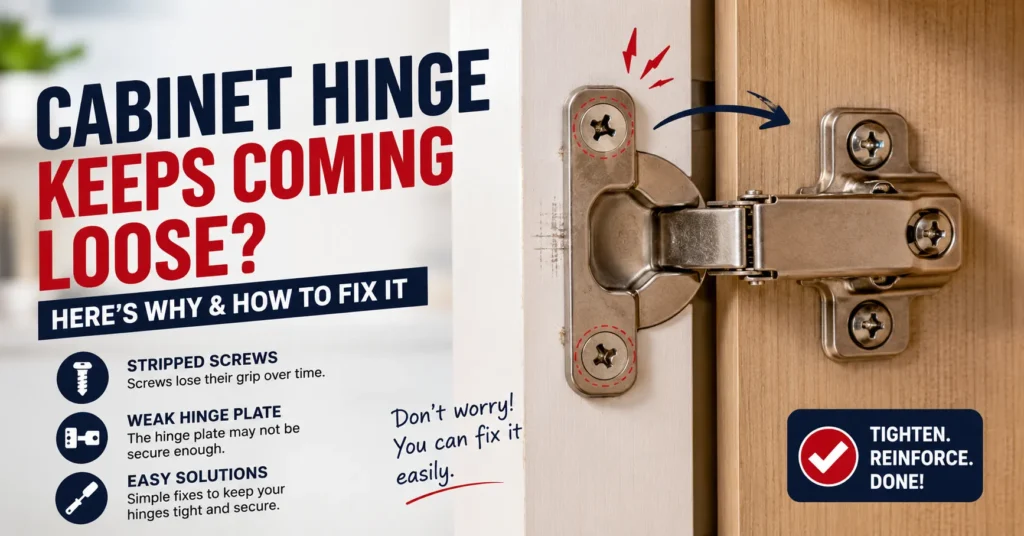
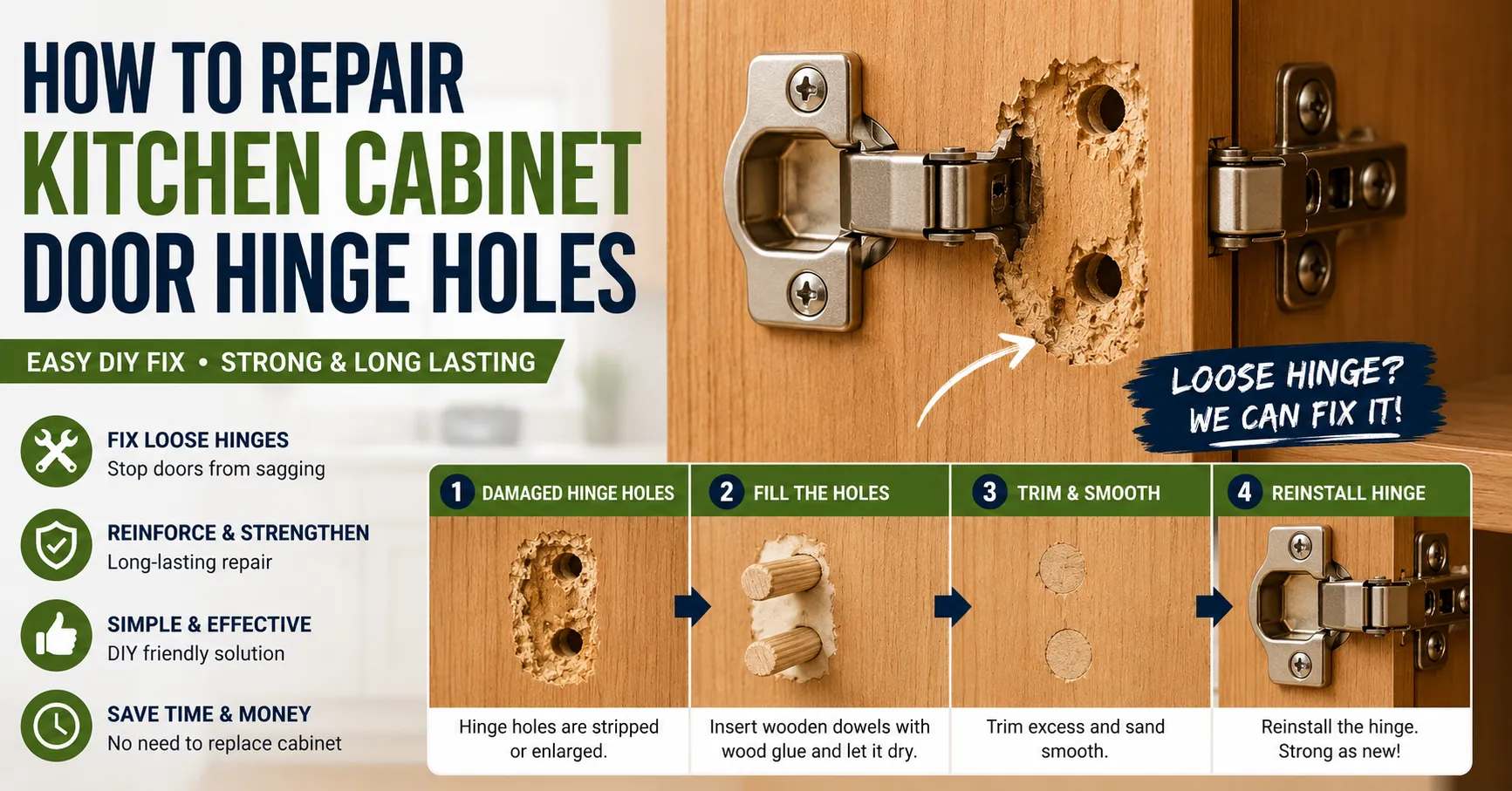
 When a cabinet door hinge pulls out because the screw holes are stripped or damaged, you generally have two choices: repair the existing mounting area or replace the hinge. The right option depends on whether the hinge itself is still functional and how much damage has occurred around the mounting holes.
A repair plate is designed to create a stronger mounting surface when the original cabinet material can no longer hold the hinge screws reliably. A replacement hinge, on the other hand, makes more sense when the hinge mechanism is bent, broken, worn, or otherwise defective. This comparison focuses on the practical differences between the two approaches, including installation, strength, durability, ease of use, value, and when each solution makes the most sense.
Quick Verdict
Choose a cabinet hinge repair plate when the hinge is still good but the mounting holes are stripped, enlarged, or damaged. Choose a replacement hinge when the hinge mechanism itself is broken, bent, worn, or incompatible with the cabinet.
If the mounting area is severely damaged, simply installing a new hinge may not solve the problem because the replacement hinge still needs a secure surface to attach to. For a deeper look at repair hardware, see our guide to the cabinet hinge repair plate.
Product/Solution A: Cabinet Hinge Repair Plate
A cabinet hinge repair plate is a metal plate that reinforces or bridges the damaged mounting area. Instead of relying exclusively on the original stripped holes, the plate provides additional mounting points.
This makes it particularly useful when the cabinet material around the original screws has become weak.
Best Features
- Repairs damaged hinge mounting areas
- Provides additional screw-mounting points
- Useful for stripped holes
- Can be suitable for particle board and MDF repairs when properly matched
- Allows you to keep a functional existing hinge
For readers specifically dealing with European-style concealed hinges, our European hinge repair plate guide provides more detail.
Amazon Option
You can compare current cabinet hinge repair plates and kits on Amazon:
Check Cabinet Hinge Repair Plates on Amazon
Product availability, specifications, prices, and sellers can change, so verify the dimensions and included hardware before purchasing.
Product/Solution B: Replacement Cabinet Hinge
A replacement hinge removes the old hinge and installs a new one. This is the better solution when the hinge itself is damaged rather than just the mounting holes. For example, replacement makes sense when:
- The hinge is bent
- The hinge mechanism is broken
- The hinge no longer closes correctly
- The soft-close mechanism has failed
- The existing hinge is badly worn
- You want to upgrade to a different compatible hinge
However, a new hinge does not automatically repair stripped cabinet material. If the original mounting holes are badly damaged, the new hinge still needs a secure mounting surface.
When replacing a hinge, check the hinge type, overlay, mounting pattern, cup dimensions, and cabinet construction before ordering. Many concealed hinges use a 35 mm cup, but compatibility should never be assumed solely from that measurement.
Amazon Option
Check Replacement Cabinet Hinges on Amazon
For soft-close replacements:
Check Soft-Close Cabinet Hinges on Amazon
Key Differences
| Feature | Cabinet Hinge Repair Plate | Replacement Hinge |
|---|---|---|
| Main purpose | Repairs damaged mounting area | Replaces damaged hinge |
| Best for | Stripped/loose hinge holes | Broken or worn hinge |
| Keeps existing hinge | Yes | No |
| Fixes damaged cabinet material | Yes, depending on damage and installation | No |
| Installation | Usually moderate | Usually easy–moderate |
| Requires hinge compatibility | Yes | Yes |
| Structural reinforcement | Yes | Not necessarily |
| Good for repeated hole failure | Yes | No, by itself |
| Upgrade opportunity | Limited | Yes |
| Best value | When hinge is still good | When hinge itself is defective |
Installation
Installing a Repair Plate
The general process is:
- Remove the cabinet door or hinge as necessary.
- Remove loose screws and damaged debris.
- Position the repair plate over the damaged area.
- Mark the appropriate mounting points.
- Pre-drill where required.
- Secure the plate using suitable screws.
- Reattach the hinge.
- Reinstall and align the cabinet door.
Always follow the specific installation instructions supplied with the repair plate.
Some repair kits include multiple plates and screws. One currently indexed example describes an 8-piece kit with 48 screws and a screwdriver, illustrating why kit contents should be checked before purchase. For visual guidance on the process, see our article on cabinet hinge repair plate installed.
Installing a Replacement Hinge
Replacement is generally straightforward when the existing mounting holes remain usable:
- Remove the old hinge.
- Compare the replacement hinge with the original.
- Confirm dimensions and mounting configuration.
- Attach the new hinge.
- Reinstall the door.
- Adjust the hinge for correct alignment.
The replacement hinge must match the cabinet and door configuration. Manufacturer installation documentation commonly emphasizes checking dimensions and using the supplied screws.
Strength and Durability
Repair Plate
A properly installed repair plate can be the stronger choice when the problem is damaged cabinet material.
Instead of depending entirely on a failed original screw location, the plate can distribute the mounting load across additional material.
This is especially relevant when particle board or another composite material has deteriorated around the hinge.
A stainless-steel repair plate can also provide a rigid reinforcement surface. Current repair-plate products commonly advertise stainless-steel construction, although actual quality varies by manufacturer and model.
Replacement Hinge
A quality replacement hinge can be more durable than an old, damaged hinge—but only if the cabinet mounting area remains structurally sound.
If the screw holes are stripped, replacing the hinge alone may simply reproduce the same problem.
Winner for damaged mounting material: Repair plate.
Winner when the hinge itself is defective: Replacement hinge.
Ease of Use
Repair Plate
A repair plate requires more planning because you need to position the plate correctly and make sure the new mounting points work with the existing hinge.
However, once the correct plate is selected, the actual repair can be relatively straightforward.
Difficulty: Easy to Moderate.
Replacement Hinge
Replacing a hinge is often easier when the existing mounting holes are still usable.
You remove the old hardware, install the replacement, and adjust the door.
Difficulty: Easy to Moderate.
Winner for simplicity: Replacement hinge—provided the cabinet mounting holes are still strong.
Best For
Choose a Cabinet Hinge Repair Plate If:
- The hinge itself is still functional
- Screw holes are stripped
- Particle board has crumbled around the hinge
- The hinge has repeatedly pulled out
- You want to reinforce a weak mounting area
- You don’t want to replace a perfectly good hinge
You can also compare a cabinet hinge reinforcement plate if your main concern is strengthening the surrounding mounting area.
Choose a Replacement Hinge If:
- The hinge is broken
- The hinge is bent
- The soft-close mechanism has failed
- The hinge is severely worn
- You want to upgrade the cabinet hardware
- The existing mounting holes are still structurally sound
Not Ideal For
Repair Plate Is Not Ideal For:
- A completely deteriorated cabinet structure
- A hinge that is mechanically broken
- Applications where there isn’t enough surrounding material for secure mounting
- Situations where the plate dimensions don’t match the hinge
Replacement Hinge Is Not Ideal For:
- Severely stripped screw holes
- Crumbling particle board
- A hinge mounting area that has already pulled away from the cabinet
- Situations where the real problem is structural rather than mechanical
If you’re specifically dealing with concealed hinges, compare the options in our guide to concealed hinge repair plates before choosing replacement hardware.
Price and Value
The cheapest option is not always the best value.
If your existing hinge works perfectly and only the mounting holes are damaged, buying an entirely new hinge may waste money while failing to solve the structural problem.
A repair plate can provide better value because it addresses the actual failure point.
On the other hand, if the hinge is broken, paying for a repair plate while keeping a defective hinge makes little sense.
Repair-plate kits are often sold in multi-piece packages with screws, which can be useful when repairing several cabinet doors. Current marketplace listings show examples of multi-piece repair kits, but prices and availability change frequently.
Best value for stripped holes: Repair plate.
Best value for a broken hinge: Replacement hinge.
Best value for an upgrade: Replacement hinge.
Final Recommendation
For the keyword “repair cabinet door hinge holes,” the most important question is not simply whether a repair plate or replacement hinge is cheaper.
Ask: What actually failed?
If the hinge is good but the cabinet mounting holes are damaged, choose a cabinet hinge repair plate or reinforcement plate.
If the hinge itself is broken or worn while the mounting area remains strong, choose a replacement hinge.
If both the hinge and cabinet material are damaged, you may need both a replacement hinge and a structural repair.
Before buying, measure the hinge, mounting-hole spacing, cabinet thickness, and available installation area. This small amount of preparation can prevent buying hardware that doesn’t fit.
For more repair options, see our cabinet hinge repair plate guide and compare it with the European hinge repair plate and concealed hinge repair plate options.
FAQs
Q: Can a repair plate fix stripped cabinet hinge holes?
A: Yes. A repair plate can provide a new mounting surface when the original screw holes are too damaged to hold the hinge securely.
Q:Should I replace the hinge or repair the holes?
A: Repair the holes when the hinge is still functional. Replace the hinge when the hinge itself is damaged or worn.
Q: Is a hinge repair plate stronger than a new screw?
A: For severely damaged mounting areas, a properly installed repair plate can provide additional mounting support instead of relying on the same failed hole.
Q: Can I use a repair plate on particle board?
A. suitable plate can be useful for damaged particle board, but the surrounding material must still be strong enough to accept the new mounting screws.
Q: Will a new hinge fix stripped screw holes?
A: Not necessarily. A new hinge still requires a secure mounting surface. Severely damaged holes may need structural repair first.
Q: What should I measure before buying?
A: Check hinge type, screw-hole spacing, cabinet thickness, damaged-area size, and the available mounting space.
Final Thought
The best solution depends on where the failure occurred. A repair plate is usually the smarter choice when the cabinet material has failed but the hinge remains usable. A replacement hinge is the better choice when the hinge itself has failed. Don’t replace good hardware unnecessarily—and don’t install a new hinge into a mounting area that cannot hold it.