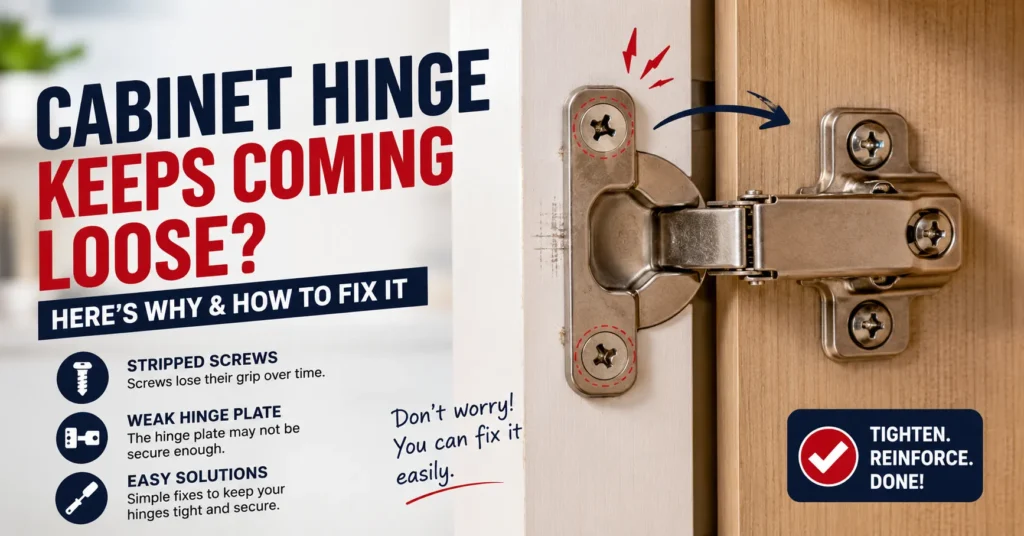
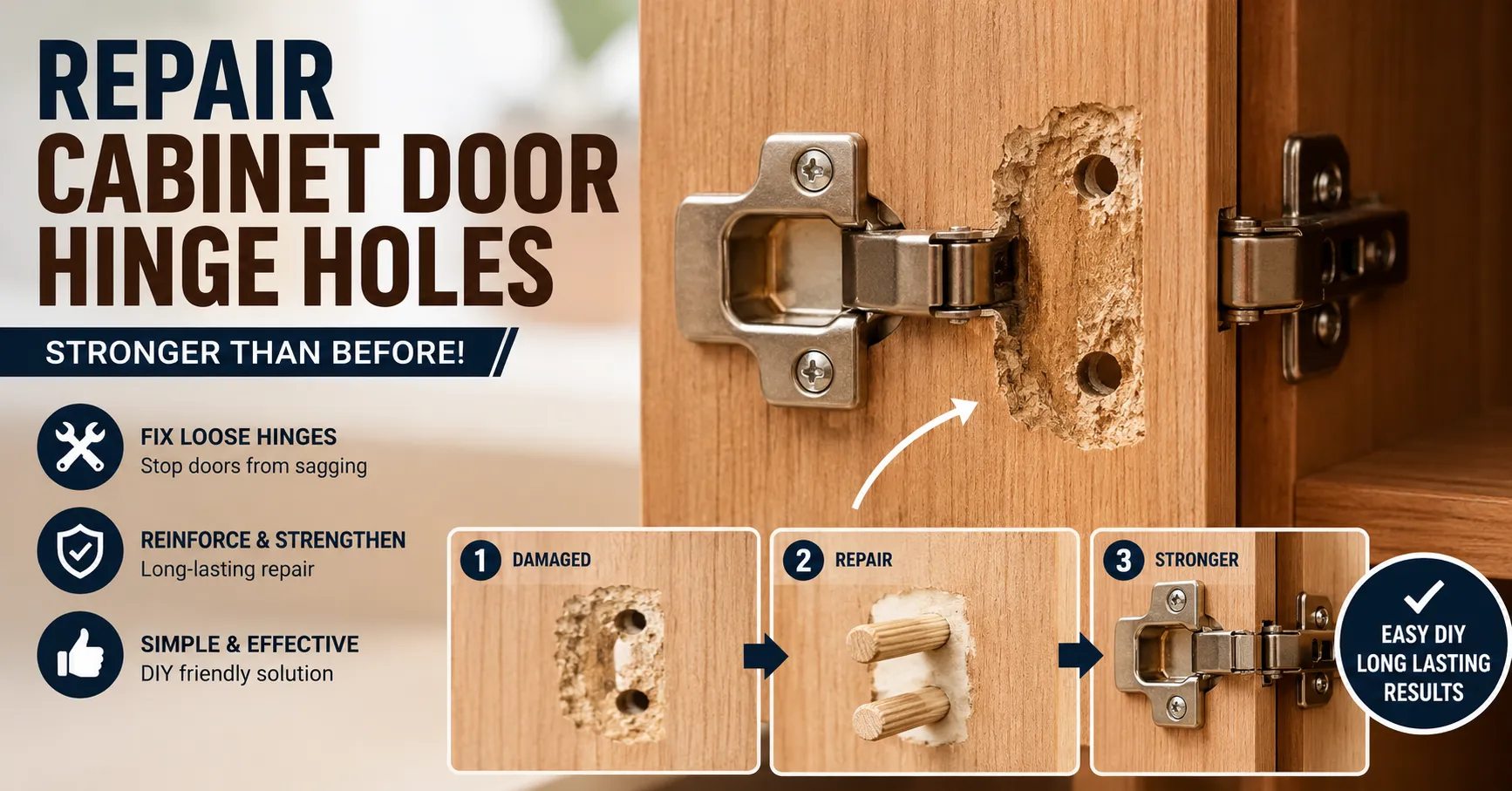
If a cabinet door keeps falling out of alignment, the hinge screws spin without tightening, or the hinge pulls away from the cabinet, damaged hinge holes may be the problem. This is especially common with older cabinets, particle board, MDF, and doors that have been opened and closed thousands of times.
Fortunately, you usually don’t need to replace the entire cabinet door. Depending on the damage, you can repair cabinet door hinge holes using a hinge repair plate, reinforcement plate, wood-repair method, or suitable replacement screws.
The important part is choosing a repair method that matches the cabinet material, hinge type, hole spacing, and severity of the damage. This guide explains what to check before buying, which repair option fits different problems, and the common mistakes to avoid.
Who Needs This?
This guide is useful if:
- Cabinet hinge screws keep coming loose
- Screws spin without gripping
- A hinge has pulled away from the cabinet
- The original screw holes have become enlarged
- Particle board around the hinge has crumbled
- MDF has become damaged around the mounting screws
- A previously repaired hinge has become loose again
- Your cabinet door is repeatedly going out of alignment
Before buying repair hardware, determine whether the problem is actually the hinge holes. If the hinge itself is bent or worn, replacing the hinge may be more appropriate.
If your hinge holes are still intact but the door is crooked, read our guide on how to adjust cabinet door hinges before purchasing repair hardware.
What to Check Before Buying
Not every cabinet hinge repair plate fits every cabinet. Check these factors first.
Cabinet Material
Identify whether your cabinet is made from:
- Solid wood
- Plywood
- MDF
- Particle board
- Composite or laminate material
This matters because different materials have different screw-holding characteristics.
Hinge Type
Determine whether you’re working with:
- European concealed hinges
- Concealed cabinet hinges
- Face-frame hinges
- Frameless cabinet hinges
- Surface-mounted hinges
A repair plate designed for one hinge configuration may not work correctly with another.
Damage Level
Inspect the damaged hole carefully.
If the screw hole is only slightly enlarged, a minor repair may be enough. If the surrounding material has broken away, a reinforcement or repair plate is generally more appropriate.
Plate Dimensions
Check the overall dimensions of the repair plate and compare them with the available space around the hinge.
A plate that is too large may interfere with the cabinet door or nearby hardware.
Important Measurements
Before ordering a cabinet hinge repair product, measure:
- Screw-hole spacing — Measure from the center of one mounting hole to the other.
- Cabinet material thickness — This helps determine suitable screw length.
- Existing screw diameter — Avoid choosing screws purely by appearance.
- Existing screw length — Check how much material is available behind the mounting point.
- Damaged-area dimensions — Measure how much material has been lost.
- Hinge cup and mounting configuration — Especially important for concealed European hinges.
Accurate measurements can prevent one of the most common cabinet repair mistakes: buying a plate that technically looks similar but does not line up with the existing hinge.
Types of Cabinet Door Hinge Hole Repair
There are several ways to repair damaged cabinet hinge holes.
1. Cabinet Hinge Repair Plate
A cabinet hinge repair plate covers the damaged mounting area and provides a new surface for securing the hinge.
This is one of the most practical options when the original screw holes are badly stripped.
For a dedicated guide, see our cabinet hinge repair plate.
Best for: Severely stripped or enlarged hinge mounting holes.
2. European Hinge Repair Plate
European-style concealed hinges are widely used in modern kitchen cabinets. A European hinge repair plate is designed around the mounting requirements of these hinge systems.
Best for: Cabinets using European-style concealed hinges.
If you’re using this type of hinge, see our detailed guide to European hinge repair plates.
3. Concealed Hinge Repair Plate
A concealed hinge repair plate is designed for damaged mounting areas around concealed cabinet hinges.
Best for: Concealed hinge mounting damage where the original screw holes no longer provide sufficient grip.
Read our guide on concealed hinge repair plates for additional information.
4. Cabinet Hinge Reinforcement Plate
A reinforcement plate distributes the mounting load across a larger area instead of depending entirely on the damaged original holes.
Best for: Weak cabinet material, repeated hinge failure, and areas where additional structural support is needed.
See our guide to cabinet hinge reinforcement plates for a more detailed comparison.
5. Wood Repair Method
For smaller holes in suitable wood-based cabinets, you may be able to rebuild the damaged area and create a new pilot hole.
This method is less attractive when a large amount of particle board or MDF has already crumbled away.
6. Replacement Screws
If the mounting material is still strong and the original screw is damaged, replacing the screw may solve the problem.
However, simply installing a much larger screw isn’t necessarily a proper repair.
Which Type Fits Which Problem?
| Cabinet Hinge Problem | Best Repair Option | Why |
|---|---|---|
| Slightly loose screw | Appropriate replacement screw | Existing material may still hold securely |
| Small damaged hole | Wood repair method | Can rebuild limited damage |
| Severely stripped hole | Hinge repair plate | Provides a fresh mounting surface |
| Crumbling particle board | Reinforcement/repair plate | Spreads the mounting load |
| Damaged concealed hinge area | Concealed hinge repair plate | Designed for concealed-hinge applications |
| European hinge mounting damage | European hinge repair plate | Better suited to European hinge configurations |
| Repeated hinge failure | Reinforcement plate | Provides additional structural support |
| Bent or broken hinge | Replace hinge | Hole repair won’t fix the hinge itself |
Top Recommended Options
1. Cabinet Hinge Repair Plate
Best for: Severely damaged cabinet hinge holes.
A repair plate is a strong option when the original mounting holes have become too damaged for normal screws to hold securely.
Pros:
- Creates a new mounting surface
- Can cover damaged material
- Useful for many hinge repair situations
- Usually straightforward for DIY installation
Cons:
- Must match the hinge and mounting configuration
- Requires accurate positioning
- Not appropriate for every type of cabinet damage
Amazon: Check cabinet hinge repair plates on Amazon
2. European Hinge Repair Plate
Best for: European concealed cabinet hinges.
This category is worth considering when the damaged hinge uses a European-style mounting configuration.
Pros:
- Designed around European hinge applications
- Can restore a damaged mounting area
- Useful for older concealed-hinge cabinets
Cons:
- Compatibility must be checked carefully
- Not a universal solution for every hinge
Amazon: Check European hinge repair plates on Amazon
3. Concealed Hinge Repair Plate
Best for: Concealed hinge mounting damage.
This option is particularly relevant when the hinge is hidden inside the cabinet and the mounting screws have lost their grip.
Pros:
- Suitable for concealed-hinge repairs
- Can provide additional mounting support
- Useful when original holes are damaged
Cons:
- Dimensions vary
- Installation position matters
Amazon: Check concealed hinge repair plates on Amazon
4. Cabinet Hinge Reinforcement Plate
Best for: Weak or repeatedly damaged mounting areas.
A reinforcement plate is useful when you want to spread the load over a larger section of cabinet material.
Pros:
- Adds structural support
- Can distribute hinge load
- Useful for repeated hinge-hole failures
Cons:
- Requires enough surrounding cabinet material
- May not be suitable for very limited installation space
Amazon: Check cabinet hinge reinforcement plates on Amazon
Comparison Table
| Repair Option | Best For | Difficulty | Main Benefit | Main Limitation |
|---|---|---|---|---|
| Cabinet hinge repair plate | Stripped holes | Easy–Moderate | Creates new mounting surface | Must fit hinge |
| European hinge repair plate | European hinges | Moderate | Designed for European applications | Compatibility varies |
| Concealed hinge repair plate | Concealed hinges | Easy–Moderate | Supports damaged mounting area | Requires correct positioning |
| Reinforcement plate | Weak material | Moderate | Distributes load | Needs surrounding space |
| Wood repair | Minor damage | Moderate | Preserves existing hardware | Not ideal for severe damage |
| Replacement screw | Minor loosening | Easy | Fast and inexpensive | Won’t fix badly damaged material |
Pros and Cons of Repairing Cabinet Hinge Holes
Pros
- Less expensive than replacing an entire cabinet door
- Can preserve the existing hinge
- Suitable for many DIY repairs
- Repair plates can strengthen weak mounting areas
- Can extend the useful life of older cabinets
Cons
- Severely damaged material may require more extensive repair
- Incorrect measurements can lead to poor alignment
- Some repair plates are hinge-specific
- A damaged hinge may still need replacement
- Particle board and MDF require careful handling
How to Repair Cabinet Door Hinge Holes
Step 1: Remove the Cabinet Door
Carefully remove the door and place it on a stable surface.
Step 2: Remove the Hinge
Remove the hinge from the damaged mounting area.
Step 3: Inspect the Damage
Look for stripped holes, cracks, crumbling particle board, or broken material.
Step 4: Measure the Hinge
Measure screw spacing, cabinet thickness, damaged area, and hinge configuration.
Step 5: Choose the Repair Method
For minor damage, consider an appropriate wood-repair method or replacement screw.
For severe damage, consider a dedicated hinge repair or reinforcement plate.
Step 6: Install the Repair Hardware
Follow the manufacturer’s installation instructions and make sure the plate is correctly positioned before tightening the screws.
Step 7: Reinstall the Door
Attach the hinge and reinstall the cabinet door.
Step 8: Adjust the Door
Check the door gap and alignment. If necessary, adjust the hinge.
For additional installation guidance, see our article on cabinet hinge repair plate installed.
When Should You Use a Repair Plate?
A repair plate makes the most sense when the original mounting material can no longer provide reliable screw grip.
For example, if a particle board cabinet has been repaired several times and the area around the hinge screws has crumbled, simply inserting another screw may not provide a durable solution.
A repair plate can spread the load over a larger section of material.
This is particularly useful when:
- The same hinge has repeatedly pulled out
- The screw hole is substantially enlarged
- The surrounding material is damaged
- The cabinet door is relatively heavy
- The original mounting point has lost structural strength
If your cabinet uses an older hinge system, you can also compare your options with our guide to cabinet hinge repair plates.
Buying Mistakes to Avoid
1. Buying Without Measuring
Never assume that every repair plate is universal.
Measure the hinge and mounting area first.
2. Choosing Only by Price
The cheapest repair plate may not have the correct dimensions or mounting configuration.
3. Ignoring Cabinet Material
A solution suitable for solid wood may not perform the same way in damaged particle board.
4. Using an Extremely Long Screw
A longer screw isn’t automatically stronger. It must be appropriate for the cabinet thickness and available space.
5. Buying the Wrong Hinge Repair Plate
European, concealed, and other hinge configurations may require different repair hardware.
6. Replacing the Hinge When Only the Hole Is Damaged
If the hinge is still mechanically sound, replacing the entire hinge may not address the actual problem.
7. Repairing the Hole but Ignoring Alignment
After repairing the mounting area, the cabinet door may still need hinge adjustment.
FAQs
Q: Can I repair cabinet door hinge holes?
A: Yes. The appropriate method depends on the cabinet material and damage. Options include repair plates, reinforcement plates, wood repair, and replacement screws.
Q: What is the best repair for stripped cabinet hinge holes?
A: For severely damaged mounting holes, a cabinet hinge repair or reinforcement plate can provide a new, stronger mounting surface.
Q: Can I repair cabinet hinge holes in particle board?
A: Yes. However, severely crumbled particle board may not provide enough material for a simple screw repair. A suitable repair plate can be a better option.
Q: Are hinge repair plates universal?
A: No. Always check the hinge type, plate dimensions, screw spacing, and available mounting area.
Should I use a bigger screw for a stripped hinge hole?
Not automatically. A larger screw can further damage weak material. Choose a repair method based on the actual condition of the mounting area.
When should I replace the cabinet hinge?
Replace the hinge if it is bent, broken, excessively worn, or mechanically defective. If the hinge is functional but the mounting holes are damaged, repairing the mounting area may be sufficient.
Final Thought
When you need to repair cabinet door hinge holes, don’t automatically replace the entire cabinet door. Start by identifying the cabinet material, hinge type, screw-hole condition, and extent of the damage. For minor damage, a suitable screw or wood-repair method may be enough. For severely stripped holes, a cabinet hinge repair plate, European hinge repair plate, concealed hinge repair plate, or reinforcement plate can provide a more practical solution. The most important step is measuring before buying. A repair product is only useful if its dimensions and mounting configuration match your cabinet. If you’re dealing with particle board or repeated hinge failure, start by comparing dedicated repair plates and reinforcement options rather than repeatedly installing larger screws.