If you’re wondering “what cabinet hinge adjuster or tool should I get?”, you may not actually need a specialized tool. Many common cabinet hinges can be adjusted with a standard Phillips screwdriver. The important thing is identifying the type of hinge and the specific problem before buying anything.
A cabinet door that sits crooked may simply need a small hinge adjustment. However, if the screws won’t tighten, the hinge keeps moving, or the cabinet material around the screws is damaged, an adjustment tool won’t fix the underlying problem.
This guide takes you from the simplest fix to more advanced troubleshooting. You’ll learn what tool to try first, how to determine whether the adjustment worked, when a repair plate is more appropriate, and when replacing the hinge is the better option.
Who Needs This?
This guide is useful if:
- Your cabinet door is crooked
- The door sits too high or too low
- Two cabinet doors rub against each other
- The door won’t close properly
- The gap around the door is uneven
- Your concealed hinge needs adjustment
- You aren’t sure which cabinet hinge tool to buy
- You frequently adjust kitchen cabinet doors
If the hinge mounting holes themselves are damaged, start with our guide on repair cabinet door hinge holes rather than buying an adjustment tool immediately.
Quick Fix
Start With a Phillips Screwdriver
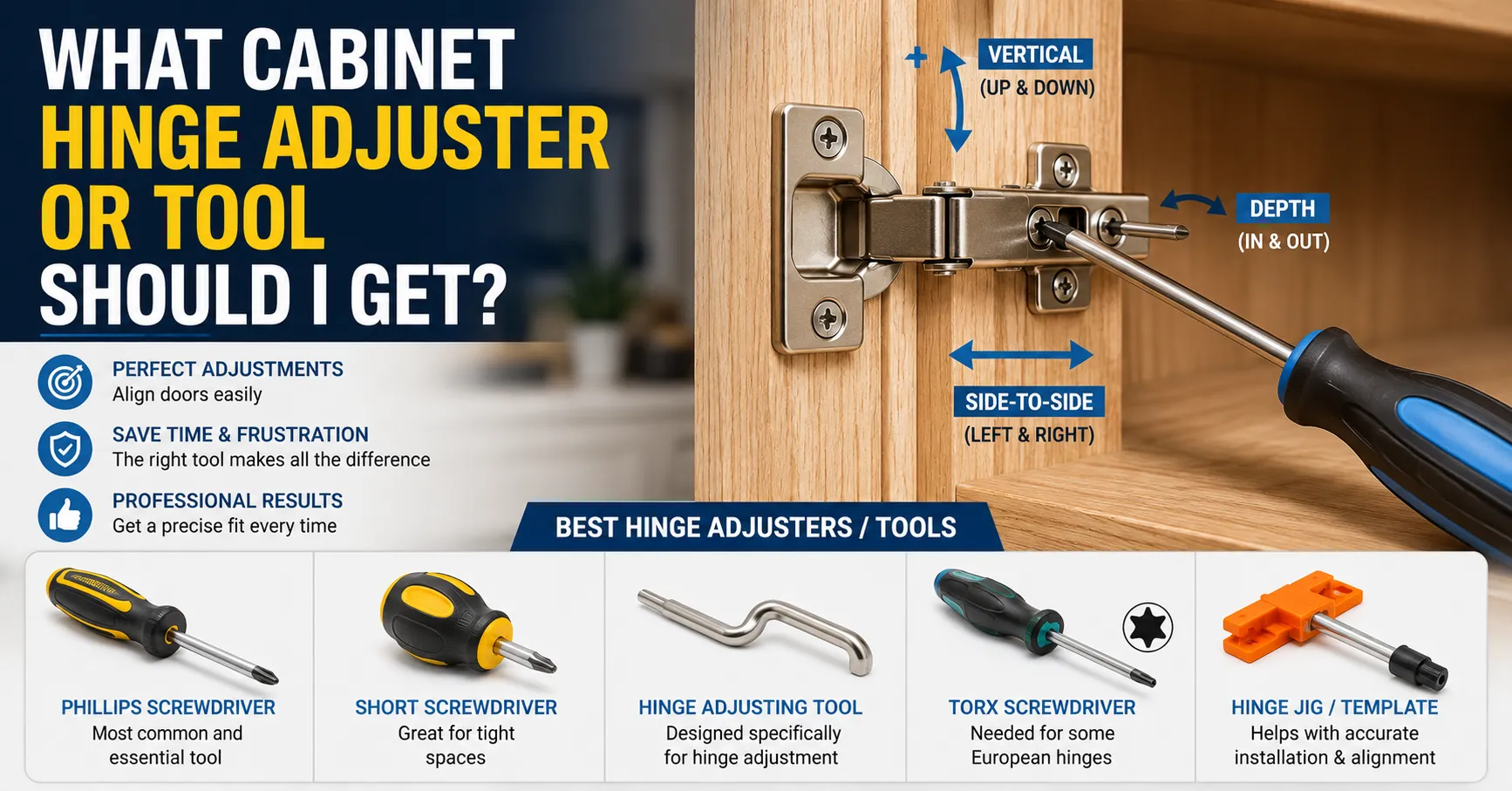
For many concealed and European-style cabinet hinges, the first tool to try is a good Phillips screwdriver.
Look at the hinge and identify its adjustment screws. Depending on the hinge design, these screws can control:
- Side-to-side movement
- Forward/backward depth
- Door alignment
- Closing position
Make small adjustments, usually around a quarter turn at a time. Close the door after each adjustment and check the alignment.
Avoid turning multiple screws randomly. If you change several adjustments at once, it becomes difficult to determine which adjustment caused the improvement.
Check the Door Gap
Before adjusting, look at the gap between the cabinet door and the neighboring door or cabinet frame.
Your goal is generally to create a consistent gap while ensuring that the door opens and closes without rubbing.
Amazon Option
If you need a basic screwdriver:
Browse Phillips screwdrivers on Amazon
If you want a dedicated adjustment tool:
Browse cabinet hinge adjustment tools on Amazon
Did It Work?
After making a small adjustment, close the cabinet door and check four things:
- Is the door level?
- Is the gap consistent?
- Does the door close completely?
- Does it rub against another cabinet or the frame?
If YES → Done
If the door is aligned, closes properly, and stays in position, you probably don’t need a specialized cabinet hinge adjuster.
Don’t continue adjusting the hinge after the problem is solved. Excessive adjustment can create new alignment problems.
If NO → Check #2: Inspect the Hinge
If adjusting the hinge didn’t solve the problem, inspect the hinge itself.
Look for:
- Loose mounting screws
- Bent hinge arms
- Cracked components
- Damaged adjustment screws
- Excessive wear
- A failed soft-close mechanism
- A hinge that doesn’t sit correctly
Check the Mounting Screws
Try gently tightening the mounting screws.
If the screw becomes tight and the hinge stays in position, readjust the door and test it again.
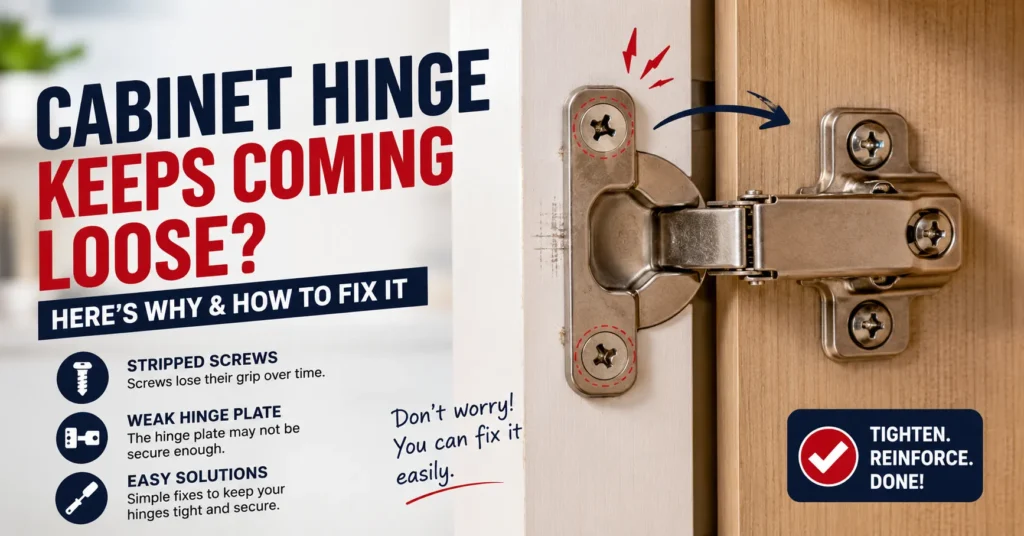
If the screw simply spins without tightening, don’t keep turning it. You may have a stripped mounting hole.
That’s a different problem from hinge adjustment.
Our guide to the cabinet hinge repair plate explains how a repair plate can create a new mounting surface for damaged hinge areas.
If Still NO Check 3: Inspect the Cabinet and Door
If the hinge appears to be functioning correctly, inspect the cabinet and door itself.
Check the Cabinet Frame
A cabinet frame that has shifted, loosened, or become damaged can make a properly functioning hinge appear misaligned.
Look for:
- Loose cabinet joints
- Uneven frame surfaces
- Damage around the hinge
- Gaps that change when pressure is applied
Check for Door Warping
A warped cabinet door may not align correctly even when the hinges are adjusted properly.
Look along the door edge and compare it with the cabinet frame.
If the door is visibly warped, repeatedly adjusting the hinge may not provide a permanent solution.
Check the Catch or Latch
If the door aligns correctly but won’t stay closed, the problem may not be the hinge.
Inspect the:
- Magnetic catch
- Roller catch
- Push latch
- Cabinet frame
- Door alignment
A hinge adjustment tool cannot fix a defective catch.
Advanced Repair
If the basic adjustments don’t work, determine whether you’re dealing with a mounting problem, hinge problem, or cabinet problem.
Stripped Hinge Holes
If the hinge screws no longer grip the cabinet material, you may need to repair the mounting holes.
This is especially common with older particle board and MDF cabinets.
Instead of repeatedly tightening the same screw, consider a suitable repair method.
See our detailed guide on how to repair kitchen cabinet door hinge holes for a step-by-step approach.
Reinforce the Mounting Area
If the cabinet material around the hinge is weak or damaged, a reinforcement plate can spread the load over a larger area.
See our guide to the cabinet hinge reinforcement plate for another repair option.
European Hinge Problems
If you have a European-style concealed hinge, confirm that the hinge mounting configuration matches the repair hardware you’re considering.
For damaged European hinge mounting areas, see our European hinge repair plate guide.
Concealed Hinge Damage
If a concealed hinge has pulled away from the cabinet, an adjustment tool won’t solve the structural problem.
A suitable concealed hinge repair plate may be more appropriate.
For installation examples, see cabinet hinge repair plate installed.
When the Hardware Must Be Replaced
A cabinet hinge adjuster is useful only when the hinge is still mechanically functional.
Consider replacing the hinge when:
- The hinge is bent
- The hinge arm is cracked
- The adjustment mechanism is damaged
- The hinge no longer holds its position
- The soft-close mechanism has failed
- The hinge has excessive play
- The hinge is badly worn
- The hinge doesn’t open or close correctly
However, don’t replace a good hinge just because the mounting holes are damaged.
If the hinge works properly and only the cabinet material has failed, repair the mounting area instead.
Recommended Replacement
If you determine that the hinge itself needs replacement, match the new hinge to the existing cabinet configuration.
Check:
- Hinge type
- Overlay
- Mounting style
- Door thickness
- Hinge cup size for concealed hinges
- Mounting-hole pattern
- Opening angle
- Soft-close requirements
Replacement Cabinet Hinges
Browse replacement cabinet hinges on Amazon
Soft-Close Cabinet Hinges
For a cabinet upgrade:
Browse soft-close cabinet hinges on Amazon
Cabinet Hinge Adjustment Tools
If your hinges are in good condition and you simply want a dedicated tool for future adjustments:
Browse cabinet hinge adjustment tools on Amazon
Always verify the current product dimensions, compatibility, included accessories, and seller information before purchasing.
Which Tool Should You Get?
| Problem | Recommended Tool/Solution |
|---|---|
| Minor door misalignment | Phillips screwdriver |
| Difficult hinge access | Suitable hinge adjustment tool |
| Frequent cabinet adjustments | Dedicated hinge adjustment tool |
| Loose screw | Screwdriver + suitable screw |
| Stripped screw hole | Cabinet hinge repair plate |
| Weak mounting area | Hinge reinforcement plate |
| European hinge damage | European hinge repair plate |
| Concealed hinge mounting damage | Concealed hinge repair plate |
| Broken hinge | Replacement hinge |
| Warped door | Door/cabinet repair |
The Simple Rule
Adjustment problem → screwdriver or hinge adjuster.
Stripped mounting hole → repair plate.
Weak mounting area → reinforcement plate.
Broken hinge → replacement hinge.
Warped cabinet door → structural/door repair.
FAQ
Q: What cabinet hinge adjuster or tool should I get?
A: For many common concealed hinges, start with a Phillips screwdriver. A dedicated hinge adjustment tool is useful when access is difficult or you frequently adjust multiple cabinet doors.
Q: Do I need a special tool to adjust cabinet hinges?
A: Usually not. Many hinges can be adjusted with a standard screwdriver, but the required tool depends on the screw head and hinge design.
Q: Why won’t my cabinet door stay adjusted?
A: Loose screws, stripped mounting holes, damaged hinges, warped doors, or cabinet-frame problems can cause repeated misalignment.
Q: Can an adjustment tool fix stripped hinge holes?
A: No. An adjustment tool changes hinge positioning but doesn’t restore damaged cabinet material. A suitable repair plate or other mounting repair may be necessary.
Q: Should I replace my cabinet hinge?
A: Replace it if the hinge is broken, bent, excessively worn, or mechanically defective. If only the mounting holes are damaged, repair the mounting area instead.
Q: What is the best tool for European cabinet hinges?
A: Many European concealed hinges can be adjusted with a screwdriver, but the correct tool depends on the specific hinge design. Check the hinge before purchasing a dedicated adjuster.
Final Thought
The answer to “what cabinet hinge adjuster or tool should I get?” is usually simpler than it first appears.Start with a quality screwdriver and make small adjustments. If that doesn’t work, inspect the hinge, mounting screws, cabinet frame, door, and catch before buying additional hardware. If the hinge screws won’t tighten, stop adjusting and investigate the mounting holes. A cabinet hinge repair plate or cabinet hinge reinforcement plate may solve the actual problem. If the hinge itself is damaged, replace it rather than trying to compensate with an adjustment tool. The best cabinet hinge tool is the one that matches the actual problem—not simply the most specialized tool available.