
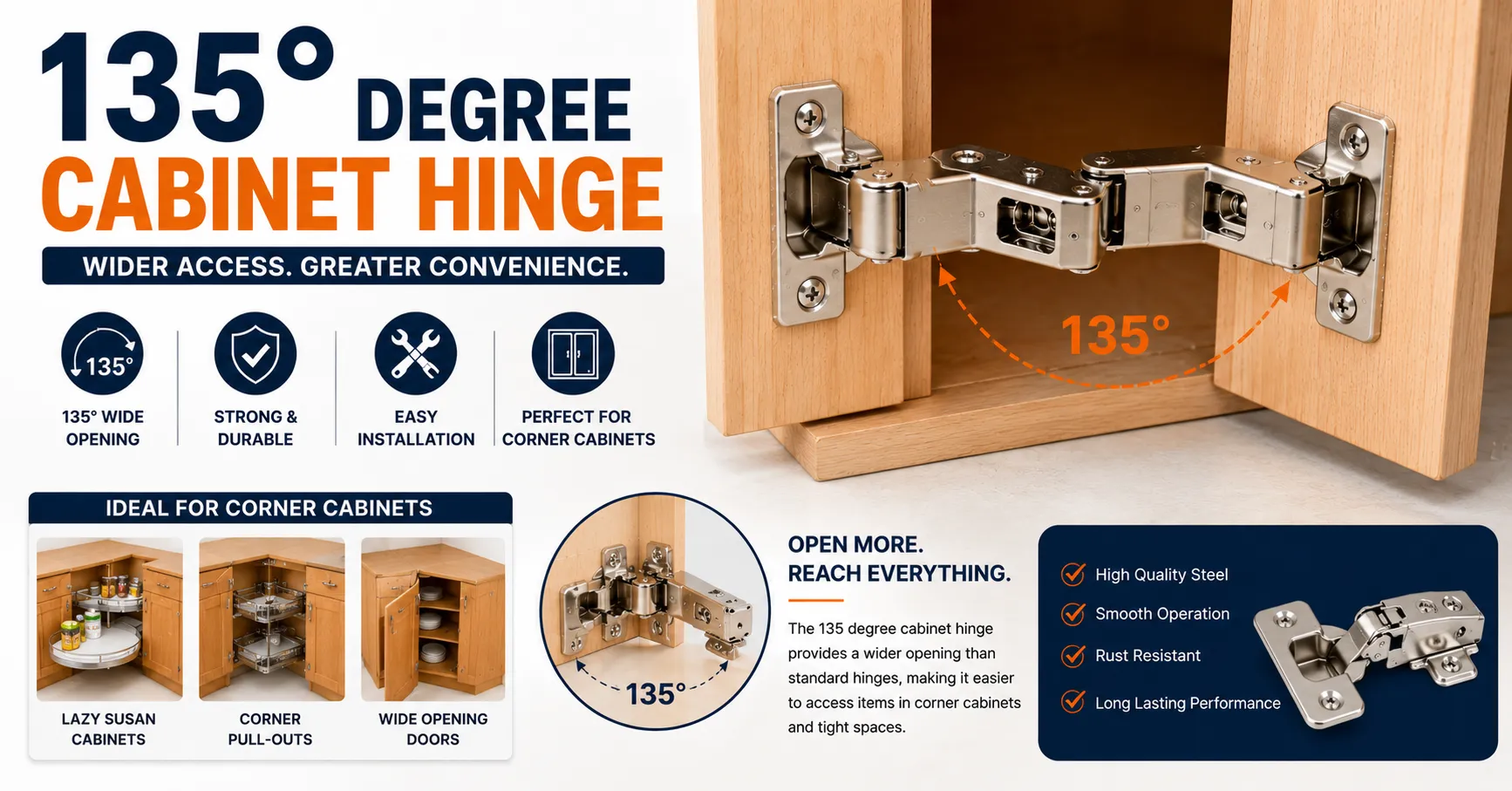
A 135 degree cabinet hinge is a practical choice when a cabinet door needs to open wider than a standard hinge allows. It is commonly used on kitchen cabinets, corner cabinets, storage units, and other furniture where wider access to the cabinet interior is useful. However, selecting the correct hinge involves more than checking the opening angle. Door overlay, hinge cup dimensions, mounting plate, screw-hole pattern, door thickness, and cabinet construction all affect compatibility.
If your cabinet door does not open far enough, the problem may be caused by incorrect hinge selection, poor adjustment, loose screws, or physical obstruction. Before purchasing a replacement, inspect and measure the existing hardware carefully. This guide explains how to diagnose common problems, choose the right 135 degree cabinet hinge, install it correctly, and avoid compatibility mistakes.
What Is Happening?
If your cabinet door stops before reaching the opening angle you expect, the hinge may not be designed for the required movement. A 135 degree cabinet hinge is designed to provide a wider opening range, which can make it particularly useful for corner and wide-access cabinet applications.
However, limited movement does not always mean that the hinge needs replacement. A loose mounting screw, incorrect overlay, poor adjustment, damaged hinge arm, or nearby cabinet can restrict the door.
Before buying new hardware, inspect the complete hinge system. If you need help identifying your current hinge, start with our guide on how to measure a cabinet hinge.
Most Likely Causes
1. Wrong hinge angle
Your existing hinge may simply have a smaller opening angle than your cabinet requires. Replacing it with a 135-degree model can provide greater access, provided the cabinet is compatible.
2. Incorrect door overlay
Overlay describes how much the cabinet door covers the cabinet frame or opening. The wrong overlay specification can cause poor alignment and prevent the door from operating correctly.
Before purchasing, learn how to measure cabinet hinge overlay and understand what the overlay on a cabinet hinge is.
3. Loose screws
Loose hinge screws can cause the door to sag or shift. This can create rubbing, uneven gaps, and restricted movement.
4. Incorrect hinge adjustment
Concealed cabinet hinges usually have adjustment screws for positioning the door. Incorrect adjustment can make the cabinet appear to have a hinge problem when the hardware itself is still usable.
5. Damaged hinge
A bent hinge arm, worn mechanism, cracked mounting plate, or stripped screw hole can prevent smooth operation.
6. Physical obstruction
The door may be hitting an adjacent cabinet, wall, handle, shelf, or cabinet panel. In that situation, changing the hinge alone may not solve the problem.
Quick Diagnosis
Use this simple inspection before ordering a replacement:
- Open the cabinet door as far as possible.
- Check whether another cabinet or object is blocking it.
- Inspect the hinge for visible damage.
- Tighten loose mounting screws.
- Check whether the door is sagging.
- Identify the hinge type and mounting style.
- Measure the hinge and door.
- Determine the door overlay.
- Check the hinge cup and mounting-hole dimensions.
- Compare your measurements with the replacement hinge specifications.
If the door is simply uneven or has inconsistent gaps, adjustment may be enough. Follow our cabinet door adjustment guide before replacing functional hardware.
Fix #1: Adjust the Existing Hinge
The easiest solution is often to adjust the existing hinge.
Many concealed hinges allow side-to-side, vertical, and front-to-back adjustment. Make small turns to the appropriate adjustment screw, then close and reopen the door to evaluate the result.
Avoid making large adjustments at once. Small changes are easier to control and help you identify which adjustment is affecting the door.
For detailed instructions, read how to adjust cabinet door hinges.
If you have older cabinet hardware, our guide on how to adjust old cabinet door hinges may be more relevant.
Fix #2: Install a 135 Degree Cabinet Hinge
If your existing hinge cannot provide the opening range you need, replacing it with a 135 degree cabinet hinge may be the correct solution.
Before ordering, compare these specifications:
- Opening angle
- Overlay
- Hinge cup diameter
- Hinge cup depth
- Door thickness
- Mounting plate type
- Screw-hole spacing
- Cabinet construction
- Soft-close mechanism
- Hinge orientation
Do not assume that every 135-degree hinge is a universal replacement.
If the cabinet door does not already have the correct hinge cup holes, you may need to create or modify them. Read how to drill cabinet hinge holes before drilling into the door.
Fix #3: Check the Mounting Plate and Hinge Position
A cabinet hinge can work poorly if its mounting plate is loose, damaged, or incorrectly positioned.
Remove the hinge carefully and inspect the mounting area. Look for stripped screws, damaged cabinet material, cracks, or incorrect mounting-hole positions.
Multiple hinges should also be positioned consistently. Correct placement helps distribute the door’s weight and maintain alignment.
For more information, see our guide to cabinet door hinge placement.
If you need multiple matching hinges, a complete adjustable cabinet door set may be more convenient than mixing different hinge models. You can compare this with our 3-piece Premier adjustable cabinet door set.
If None Works
If adjustment and hinge replacement do not solve the problem, investigate the cabinet structure.
Check the door edge, cabinet side panel, neighboring doors, handles, shelves, and wall clearance. A cabinet may physically prevent the door from reaching its theoretical maximum opening angle.
Also make sure you selected the correct hinge type. A 135 degree cabinet hinge is different from a 90-degree or 270-degree hinge.
For comparison, read our guides to 90 degree cabinet hinges and 270 degree cabinet hinges.
If the cabinet requires a specific hinge geometry, choosing a hinge solely because it has a higher opening angle can create new alignment or clearance problems.
Recommended Hardware
When shopping for a 135 degree cabinet hinge, prioritize compatibility over price.
Look for:
- Correct 135-degree opening specification
- Matching overlay
- Compatible mounting plate
- Correct hinge cup size
- Suitable cup depth
- Appropriate door thickness range
- Strong metal construction
- Matching screw pattern
- Soft-close function if required
- Corrosion-resistant finish for kitchen use
You can search Amazon for 135 degree cabinet hinges and compare the specifications of individual products.
If you use Amazon Associates, replace the standard search URL with your properly tagged affiliate link after selecting a product that matches your readers’ needs.
For readers interested in cabinet appearance as well as functionality, you can also naturally recommend champagne gold cabinet hinges where the finish is relevant.
Prevention
Correct measurement is the best way to prevent cabinet hinge problems.
Before ordering a replacement, record the existing hinge type, opening angle, overlay, cup dimensions, mounting plate, screw-hole pattern, and door thickness. Also check whether the cabinet is face-frame or frameless.
Do not force a cabinet door beyond its natural stopping point. Excessive force can bend the hinge or damage the mounting area.
After installation, open and close the door several times. Check for rubbing, uneven gaps, loose screws, unusual resistance, or excessive movement.
Periodically inspect the screws and hinge mechanism. Tightening loose hardware early can prevent more expensive cabinet repairs later.
FAQ
Q: What is a 135 degree cabinet hinge?
A: A 135 degree cabinet hinge is designed to allow a cabinet door to open to a wider angle than many standard cabinet hinges. It can be useful for corner cabinets and applications requiring improved interior access.
Q: Is a 135 degree hinge better than a 90 degree hinge?
A: Not necessarily. A 135-degree hinge is better when a wider opening is required. A 90-degree hinge may be more appropriate for cabinets with limited clearance.
Q: Can I replace my existing hinge with a 135 degree hinge?
A: Possibly, but you must check the overlay, hinge cup dimensions, mounting plate, screw pattern, door thickness, and cabinet clearance before replacing it.
Q: How do I measure a cabinet hinge?
A: Measure the existing hinge and identify its type, cup dimensions, mounting configuration, overlay, and opening angle. Our how to measure a cabinet hinge guide provides a useful starting point.
Q: Are 135 degree cabinet hinges available with soft-close?
A: Yes, some 135-degree cabinet hinges are available with soft-close mechanisms. Always verify the manufacturer’s specifications before purchasing.
Q: Why won’t my 135 degree hinge open fully?
A: The hinge may be incorrectly adjusted, incorrectly installed, damaged, or blocked by the cabinet structure, adjacent door, wall, or hardware.
Should I replace one hinge or all hinges?
If only one hinge is damaged, an individual replacement may work. However, replacing all hinges with matching hardware can provide more consistent movement and alignment, especially when the existing hinges are old.