
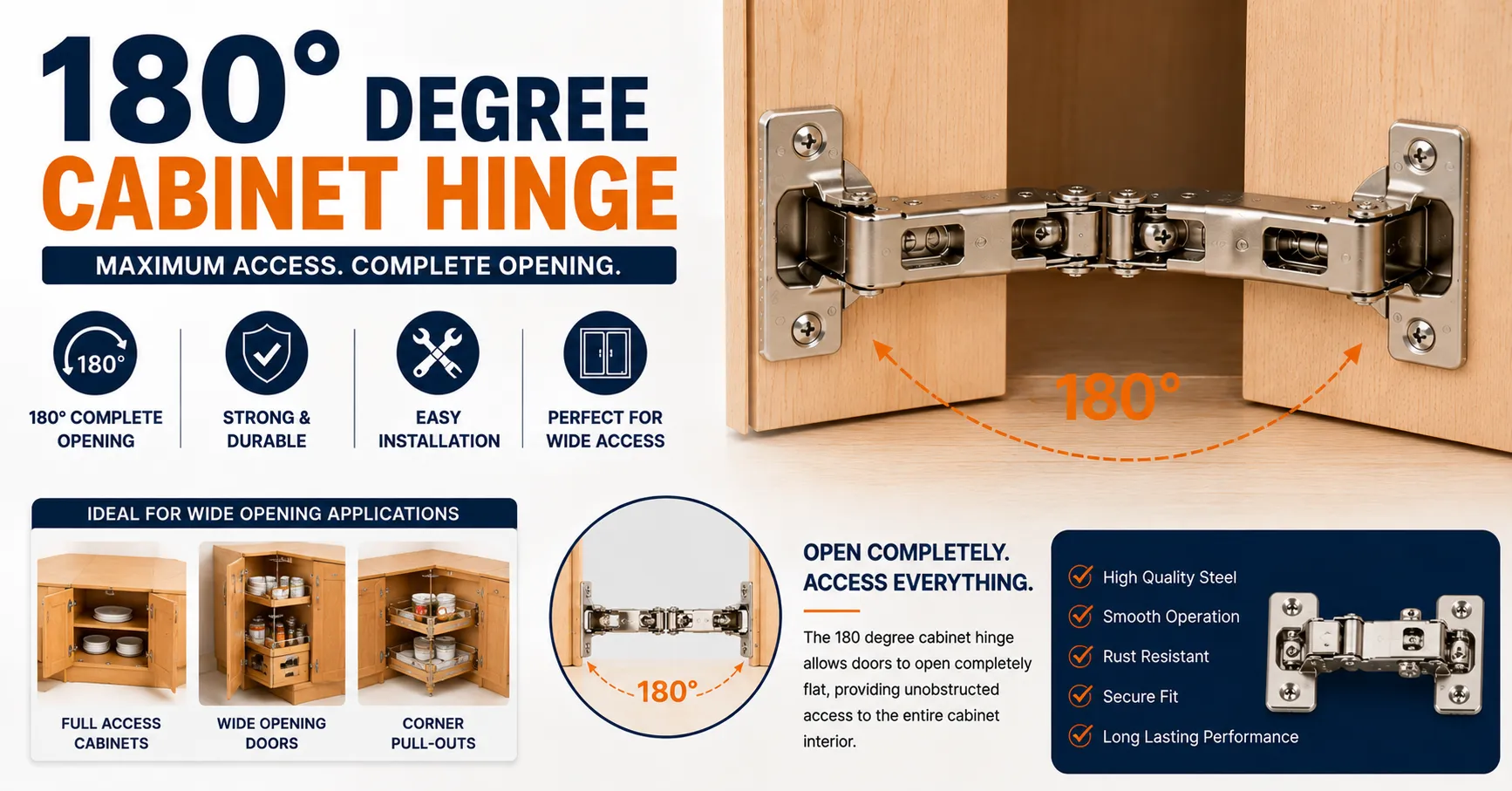
A 180 degree cabinet hinge is designed for cabinet doors that need a much wider opening range than conventional cabinet hinges. This type of hinge can be useful when you want the door to move farther out of the cabinet opening, improve access to stored items, or reduce interference with nearby cabinets. However, a hinge labeled “180 degree” does not automatically guarantee a full 180-degree opening in every cabinet. Door thickness, overlay, cabinet construction, mounting position, hinge design, and surrounding clearance all affect the final movement. If you are replacing an existing hinge, accurate measurements are essential before purchasing. You should also check whether the problem is actually caused by the hinge or simply by poor alignment, loose screws, or an incorrect installation. This guide explains the most common causes and practical solutions.
Quick Answer
A 180 degree cabinet hinge is a wide-opening cabinet hinge designed to allow a door to swing much farther than many standard hinges. It is useful for cabinets where maximum access and door clearance are important.
If your cabinet door will not open as expected, first determine whether the hinge is reaching its mechanical limit or whether something else is stopping the door. Check the hinge, overlay, mounting screws, alignment, and physical clearance before buying a replacement.
For accurate replacement measurements, see our guide on how to measure a cabinet hinge.
Reason #1 The Hinge May Not Actually Provide a Full 180-Degree Opening
The first possibility is that the hinge itself is limiting the movement.
Cabinet hinges are manufactured with different opening mechanisms and mechanical stops. Although a product may be marketed as a 180 degree cabinet hinge, the actual usable opening can depend on the installation and cabinet design.
A door may also appear to have a 180-degree hinge but still stop earlier because the hinge mounting position or cabinet frame interferes with its movement.
Simple Test for Reason #1
Open the cabinet door slowly.
Watch the hinge while moving the door:
- Does the hinge reach its mechanical stop?
- Does the hinge move smoothly?
- Does the door stop before the hinge reaches its limit?
- Is the mounting plate touching another component?
If the hinge itself reaches its stop, check the manufacturer’s specifications to confirm its actual opening range.
For comparison, you can read our guide to 90 degree cabinet hinges.
Reason #2 Incorrect Overlay Can Restrict Movement
Cabinet door overlay is another important factor.
Overlay describes how much the cabinet door covers the cabinet frame or cabinet box. If the overlay is incorrect for the hinge, the door may sit in the wrong position and fail to achieve the expected opening angle.
This is particularly important when replacing one hinge model with another.
A hinge can have the correct advertised opening angle but still be incompatible with your cabinet because the overlay or mounting configuration is different.
Simple Test for Reason #2
Close the cabinet door and look at how much it overlaps the cabinet frame.
Measure the overlay and compare it with the replacement hinge’s specifications.
If you are unsure how overlay works, read what is the overlay on a cabinet hinge.
You can also follow our detailed guide on how to measure cabinet hinge overlay.
Reason #3 Loose or Misaligned Hinge Hardware
Loose screws can cause a cabinet door to sag, shift, rub against the cabinet, or stop opening correctly.
This problem becomes more noticeable with larger or heavier doors because the additional weight places more stress on the hinge and mounting points.
A mounting plate that has shifted can also change the geometry of the hinge.
Simple Test for Reason #3
Open the door and gently check the hinge area.
Look for:
- Loose screws
- Movement around the mounting plate
- Cracked cabinet material
- A sagging door
- Uneven gaps
- A hinge that appears tilted
If the hinge is structurally sound, adjustment may solve the problem without requiring replacement.
Our guide on how to adjust cabinet door hinges explains the basic adjustment process.
For older hardware, see how to adjust old cabinet door hinges.
Reason #4 Something May Be Blocking the Door
Sometimes the hinge is working correctly, but the cabinet door cannot physically reach the desired opening angle.
Potential obstructions include:
- Cabinet side panels
- Face frames
- Adjacent cabinet doors
- Decorative trim
- Door handles
- Shelves
- Cabinet walls
- Incorrectly positioned mounting hardware
Even a high-quality 180 degree cabinet hinge cannot overcome physical interference between the door and cabinet.
Simple Test for Reason #4
Open the door slowly until it stops.
Look carefully for the first point where the door makes contact.
If the door touches the cabinet before the hinge reaches its mechanical limit, the issue is probably related to cabinet geometry, installation, or clearance rather than a defective hinge.
If new hinge holes are necessary, measure carefully before drilling. Our guide on how to drill cabinet hinge holes can help you understand the process.
Best Solution
The best solution depends on what your test reveals.
If the hinge is intact but the door is misaligned, adjustment should be your first option. Replacing a perfectly functional hinge may not solve an alignment or overlay problem.
If the hinge is bent, cracked, worn, or mechanically damaged, replacement is usually more appropriate.
When selecting a replacement 180 degree cabinet hinge, compare all of these specifications:
- Opening angle
- Hinge type
- Door thickness
- Overlay
- Hinge dimensions
- Mounting plate
- Screw-hole pattern
- Hinge cup diameter, if applicable
- Hinge cup depth, if applicable
- Door weight
- Cabinet construction
Do not purchase a replacement based only on the phrase “180 degree.”
For another useful comparison, see our guide to 170 degree cabinet hinges. If you need extremely wide movement, our 270 degree cabinet hinge guide may also be useful.
How to Choose the Right 180 Degree Cabinet Hinge
Before purchasing a replacement, measure the existing hinge.
Important measurements include:
- Door thickness
- Overlay
- Hinge dimensions
- Mounting-hole spacing
- Hinge cup diameter
- Hinge cup depth
- Cup-to-edge distance
- Opening angle
- Mounting plate type
Correct measurement reduces the risk of buying a hinge that looks similar but does not fit.
You can use our complete cabinet hinge measurement guide before ordering.
180 Degree Cabinet Hinge vs Other Hinge Angles
Not every cabinet requires a wide-opening hinge.
A standard hinge may work perfectly for an ordinary cabinet, while a wider-angle hinge is more useful when the door needs to move farther away from the opening.
For comparison, you can read about:
- 90 degree cabinet hinges
- 135 degree cabinet hinges
- 170 degree cabinet hinges
- 270 degree cabinet hinges
The correct hinge is determined by the cabinet’s construction and your required door movement—not simply by choosing the largest opening angle.
Amazon 180 Degree Cabinet Hinge
You can compare current 180 degree cabinet hinge listings on Amazon here:
Amazon — Search 180 Degree Cabinet Hinges
Before purchasing, compare the product’s opening angle, overlay, dimensions, mounting system, material, door-weight capacity, and customer reviews.
Amazon products, prices, sellers, and availability can change, so verify the specifications on the individual product page before ordering.
When Professional Repair/Replacement Makes Sense
DIY adjustment is usually reasonable when the hinge is intact and the cabinet itself is undamaged.
Professional repair or replacement makes more sense when:
- The cabinet material around the screws is damaged.
- The hinge mounting area is cracked.
- The cabinet door is unusually heavy.
- New hinge holes need to be drilled.
- The cabinet frame needs modification.
- Several hinges require precise alignment.
- The door continues to bind after adjustment.
- You cannot determine which hinge type is compatible.
A professional can also determine whether a 180-degree hinge is actually appropriate for the cabinet or whether another hinge design would provide better clearance.
Common Replacement Mistakes
Choosing Only by Opening Angle
A hinge advertised as 180 degrees may not fit your cabinet.
Ignoring Overlay
Incorrect overlay can cause poor positioning and restrict door movement.
Not Measuring the Existing Hinge
Similar-looking hinges can have completely different dimensions and mounting systems.
Ignoring Door Weight
Large or heavy doors may require hinges designed for the appropriate load.
Drilling Without Accurate Measurements
Incorrect hinge-hole placement can cause permanent alignment problems.
FAQ
Q: What is a 180 degree cabinet hinge?
A: A 180 degree cabinet hinge is designed for a very wide door-opening range, potentially allowing the door to swing approximately 180 degrees depending on the hinge and cabinet configuration.
Q: Is a 180 degree hinge better than a 90 degree hinge?
A: Not always. A 180-degree hinge is useful when you need wider access, while a standard hinge may be sufficient for ordinary cabinets.
Q: Can I replace a standard hinge with a 180 degree hinge?
A: Possibly. You must first compare overlay, mounting style, dimensions, door thickness, and available clearance.
Q: Why won’t my 180 degree hinge open fully?
A: The hinge may have a mechanical limit, or the door may be hitting the cabinet, frame, adjacent door, handle, or another obstruction.
Q: How do I choose a replacement?
A: Measure the existing hinge and compare its dimensions, overlay, mounting style, and opening specifications with the replacement hinge.
Final Takeaway
A 180 degree cabinet hinge can provide excellent access when a cabinet requires a very wide door opening. However, the advertised opening angle is only one part of hinge compatibility. Overlay, door thickness, mounting position, cabinet clearance, hinge dimensions, and door weight should all be considered before buying.
If the existing hinge is still functional, first check alignment, screws, overlay, and physical interference. If the hinge is damaged or incompatible with your cabinet’s requirements, replace it with a properly matched model.