
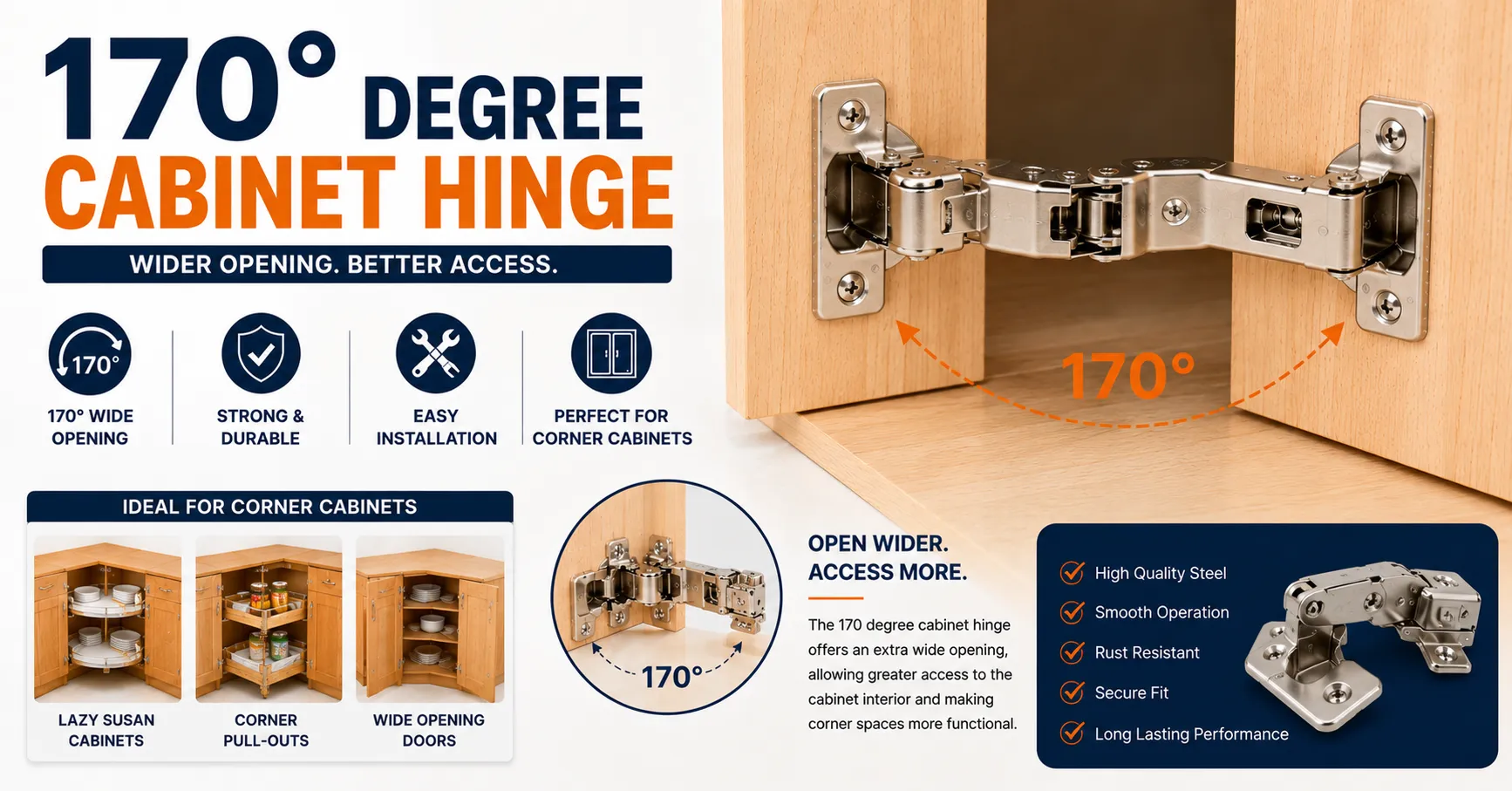
A 170 degree cabinet hinge is designed to let a cabinet door swing much farther than many standard hinges. This wide opening can make it easier to access the full cabinet interior, especially in kitchens, utility cabinets, corner storage areas, and furniture where maximum door clearance is important. However, choosing a hinge based only on its advertised opening angle can lead to compatibility problems. Door thickness, overlay, hinge cup dimensions, mounting plate, cabinet construction, and surrounding clearance all matter.
Whether you are replacing a damaged hinge or installing a new wide-opening system, accurate measurement is the first step. In this guide, you will learn what you need, how to remove and install a 170 degree cabinet hinge, how to adjust the door, what mistakes to avoid, and when replacing the hinge is a better option than repairing it.
What You Need
Before installing or replacing a 170 degree cabinet hinge, gather the following:
- Correct replacement hinge
- Screwdriver
- Drill/driver
- Measuring tape or ruler
- Pencil
- Appropriate screws
- Drill bit if new holes are required
- Cabinet hinge jig or template when necessary
- Soft cloth
- Safety glasses when drilling
If you are replacing an existing hinge, keep the old hardware nearby. Comparing the old and new hinge can help identify differences in mounting style, overlay, screw-hole position, and hinge dimensions.
For accurate replacement, learning how to measure a cabinet hinge before purchasing new hardware can prevent an expensive compatibility mistake.
Before You Start
Do not remove the existing hinge and immediately order a hinge labeled “170 degree.” The opening angle is only one part of the specification.
First, inspect the existing cabinet door and hinge. Check the following:
- Door thickness
- Overlay
- Hinge cup diameter, if applicable
- Cup depth
- Cup location
- Mounting-plate style
- Screw-hole pattern
- Hinge arm configuration
- Door and cabinet construction
- Available clearance around the door
- Required opening angle
Overlay is particularly important because the wrong overlay hinge can leave the door too far inside or outside the cabinet frame.
If you are unfamiliar with this measurement, read the guide on how to measure cabinet hinge overlay. You can also learn what the overlay on a cabinet hinge means before ordering replacement hardware.
A 170 degree hinge may physically have a wide range of movement, but the cabinet itself can prevent the door from reaching the full advertised angle. Adjacent doors, walls, handles, cabinet frames, and internal components can all affect the actual opening.
Step 1: Remove the Existing Cabinet Hinge
Start by opening the cabinet door and supporting its weight. Larger or heavier doors are easier and safer to handle with another person.
Locate the screws connecting the hinge to the cabinet and door.
- Support the door securely.
- Loosen the hinge screws gradually.
- Remove the screws from the cabinet side.
- Remove the hinge from the door.
- Keep the old screws and hinge for comparison.
- Inspect the cabinet and door for stripped or damaged mounting holes.
Do not force a screw that is difficult to remove. Excessive force can damage particleboard or MDF around the mounting hole.
If the old hinge is still usable, compare it directly with the new 170 degree cabinet hinge. Pay attention to the mounting plate and hinge arm because these components may look similar while having different dimensions.
Step 2: Check Measurements and Compatibility
This is the most important step when replacing a cabinet hinge.
Place the old hinge beside the replacement and compare the major dimensions. If your new hinge requires a different mounting pattern, determine whether the existing holes can be reused.
Check:
1. Overlay:
Measure how much the cabinet door overlaps the cabinet frame. The hinge must be designed for the correct overlay configuration.
2. Cup dimensions:
For concealed European-style hinges, verify the cup diameter, cup depth, and cup position.
3. Mounting plate:
Some hinges require a specific mounting plate. A visually similar plate may not provide the correct geometry.
4. Screw-hole spacing:
Check whether the replacement hinge uses the same mounting holes.
5. Door thickness:
Make sure the hinge is suitable for the thickness and weight of your cabinet door.
6. Opening clearance:
Check whether the cabinet layout actually allows the door to open to the desired angle.
For additional guidance, see how to measure a cabinet hinge before making your final purchase.
Step 3: Install the 170 Degree Cabinet Hinge
Once you have confirmed compatibility, position the hinge carefully.
For a concealed hinge installation, align the hinge cup with the existing cup hole and make sure the hinge is seated completely.
Then:
- Position the hinge correctly on the cabinet door.
- Align the screw holes.
- Start each screw by hand.
- Tighten the screws evenly.
- Attach the mounting plate to the cabinet.
- Connect the hinge arm to the mounting plate.
- Check that the hinge is properly seated.
- Do not overtighten the screws.
If new hinge holes must be drilled, measure twice before drilling. The position of the hinge cup has a direct effect on door alignment and opening behavior.
Before creating new holes, review this guide on how to drill cabinet hinge holes.
Proper vertical positioning is also important. If multiple hinges are being installed, consistent spacing can help distribute the door’s weight and improve alignment. See this guide on cabinet door hinge placement for additional positioning information.
Step 4: Adjust the Cabinet Door
After installation, the door may not be perfectly aligned immediately. Most adjustable concealed hinges provide several directions of adjustment.
Depending on the hinge design, you may be able to adjust:
- Side-to-side position
- Up-and-down position
- In-and-out depth
- Door gap
- Door alignment
Make small adjustments rather than turning the adjustment screws aggressively.
For example, if the door sits too close to a neighboring door, a small side-to-side adjustment may solve the problem. If the door sits too far forward or backward, the depth adjustment may be more appropriate.
For a detailed walkthrough, read how to adjust cabinet door hinges.
Older cabinet hardware can require a different approach, so how to adjust old cabinet door hinges may be useful if your cabinet uses older hinge hardware.
You can also use this cabinet door adjustment guide for fixing gaps and alignment if the finished installation leaves uneven gaps.
Testing
Once the hinge has been installed and adjusted, test the cabinet door carefully.
Open and close the door several times while watching the hinge movement.
Check the following:
- The door opens smoothly.
- The hinge does not bind.
- The door does not rub against the cabinet.
- The door does not hit an adjacent cabinet.
- Screws remain secure.
- The door stays aligned when opened and closed.
- The hinge reaches the intended range of movement.
- The cabinet door does not sag.
Do not assume that a hinge advertised as 170 degrees will always produce exactly 170 degrees of usable door movement in every cabinet. The physical cabinet layout determines the final range of motion.
A wall, adjacent door, cabinet frame, handle, or internal obstruction can limit the actual opening angle.
Common Mistakes
Several installation mistakes can cause problems even when the hinge itself is good.
Choosing Only by Opening Angle
A “170 degree” label does not tell you whether the hinge matches your cabinet door. Overlay, cup dimensions, mounting plate, door thickness, and mounting pattern must also match.
Ignoring Overlay
Incorrect overlay is one of the most common reasons a replacement cabinet door hinge does not align correctly.
Using the Wrong Mounting Plate
Some hinge systems require a compatible mounting plate. Mixing components without checking specifications can change the door position.
Drilling Without Measuring
New hinge holes should never be drilled based on visual estimation. A small positioning error can create a noticeable door-alignment problem.
Overtightening Screws
Overtightening can strip holes, particularly in particleboard and MDF cabinets.
Forgetting Door Clearance
A wide-opening hinge still needs physical space. Check nearby walls, cabinets, handles, and doors before installation.
Assuming All 170 Degree Hinges Are Universal
They are not. Two hinges with the same advertised opening angle can have completely different mounting requirements.
When to Replace the Part
Sometimes adjustment is enough, but a damaged hinge should usually be replaced.
Consider replacing the hinge when you notice:
- Bent hinge arms
- Cracked metal or plastic components
- Excessive looseness
- Broken spring or internal mechanism
- Severe corrosion
- Stripped mounting points
- Persistent door sag
- Door alignment repeatedly changing
- Hinge movement becoming rough or restricted
If the hinge is good but the cabinet mounting area has become damaged, a repair solution may be more appropriate than replacing the entire door or cabinet.
When replacing multiple hinges, consider whether you need a compatible complete hinge set rather than mixing unrelated hardware. For example, compare the available components with a 3-piece premier adjustable cabinet door set when appropriate for your cabinet application.
Recommended Tools
You do not need a large collection of professional tools for most cabinet hinge replacements.
Essential Tools
- Phillips screwdriver
- Measuring tape
- Pencil
- Appropriate replacement screws
Helpful Tools
- Cordless drill/driver
- Small level
- Ruler
- Hinge template
- Cabinet hinge jig
For New Hinge Holes
If you are installing concealed hinges where no suitable cup hole exists, a proper hinge boring jig and correctly sized drill bit can make the installation more accurate.
Always verify the manufacturer’s required dimensions before drilling.
Recommended 170 Degree Cabinet Hinge
When shopping for a 170 degree cabinet hinge, focus on compatibility instead of choosing the cheapest option.
Look for:
- Correct opening angle
- Correct overlay
- Compatible door thickness
- Suitable hinge cup dimensions
- Compatible mounting plate
- Appropriate screw-hole pattern
- Durable construction
- Suitable load capacity
- Soft-close functionality if desired
- Reliable manufacturer specifications
- Positive customer feedback
You can check current 170 degree cabinet hinge options on Amazon.
Affiliate disclosure: Some links on this page may be affiliate links. If you purchase through them, we may earn a commission at no additional cost to you.
Before buying from Amazon or another marketplace, compare the product dimensions with your existing hinge. The correct hinge is the one that fits your cabinet—not simply the one with the highest opening-angle number.
170 Degree vs. Other Cabinet Hinge Angles
Different cabinet applications require different opening angles.
A 90 degree cabinet hinge may be appropriate for standard applications where a relatively conventional door opening is sufficient. You can learn more in this 90 degree cabinet hinge guide.
A 135 degree cabinet hinge provides a wider opening and can be useful when additional access is required. See the 135 degree cabinet hinge guide for more information.
A 170 degree cabinet hinge provides an even wider range of movement and can be useful where broad access to the cabinet interior is important.
There are also 270 degree cabinet hinges, which are designed for applications requiring extremely wide door movement. Learn more in this 270 degree cabinet hinge guide.
The best choice depends on cabinet construction, door design, clearance, overlay, and the amount of movement you actually need.
FAQ
Q: What is a 170 degree cabinet hinge?
A: A 170 degree cabinet hinge is a wide-angle hinge designed to allow a cabinet door to open significantly farther than many standard hinges.
Q: Are 170 degree cabinet hinges universal?
A: No. Different hinges can have different cup sizes, mounting plates, overlays, screw patterns, and door-thickness requirements.
Q: How do I measure for one?
A: Measure the existing hinge, including overlay, cup dimensions, mounting-hole spacing, and door thickness. Compare those measurements with the replacement hinge specifications.
Q: Can I replace a regular hinge with a 170 degree hinge?
A: Sometimes, but not always. The cabinet door and cabinet structure must have enough clearance and the new hinge must be compatible with the existing mounting arrangement.
Q: Why doesn’t my hinge open to 170 degrees?
A: The cabinet frame, neighboring doors, wall, handle, hinge design, or installation position may restrict the actual opening angle.
Q: When should I replace a cabinet hinge?
A: Replace it when it is bent, cracked, excessively loose, corroded, damaged, or unable to keep the door properly aligned after adjustment.
Conclusion
A 170 degree cabinet hinge can be an excellent solution when you need wider cabinet-door access, but choosing the correct hinge requires more than checking the advertised opening angle. Measure the existing hardware, confirm the overlay and mounting configuration, check door thickness and clearance, and compare the replacement hinge carefully before installation.
After installing the hinge, make small alignment adjustments and test the door through its full movement. If the cabinet construction does not provide enough clearance, even a wide-angle hinge may not achieve its maximum advertised opening.
For the best result, treat the 170-degree rating as one specification among several. Correct measurements and compatibility are what determine whether the replacement hinge will actually work properly on your cabinet.