
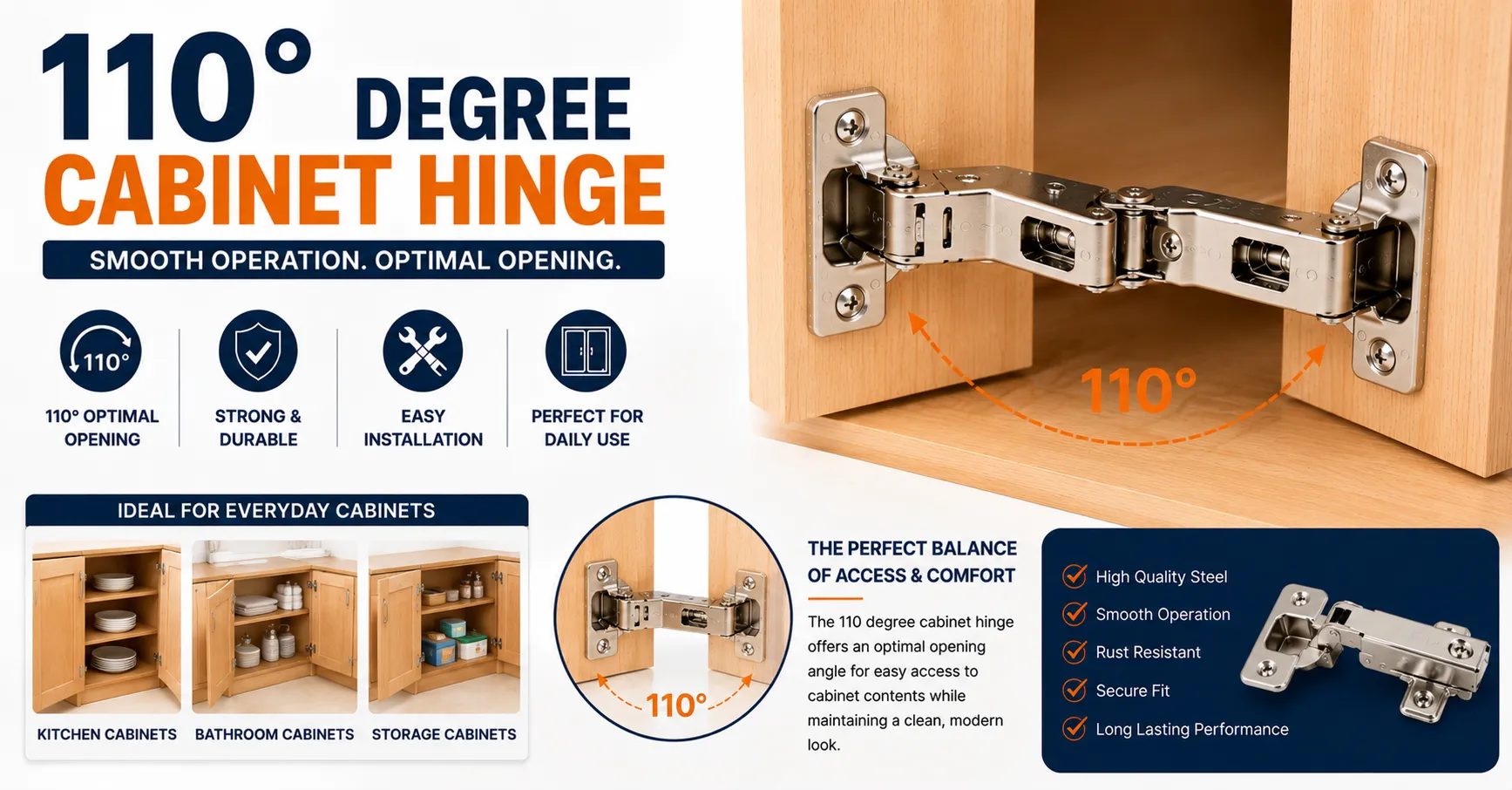
A 110 degree cabinet hinge is a popular choice for kitchen cabinets, wardrobes, cupboards, and furniture doors that need a wider opening than a standard 90-degree hinge. It provides a practical balance between accessibility and controlled door movement.
Many 110-degree concealed hinges use a 35 mm cup and are available with features such as soft-close operation, 3D adjustment, clip-on mounting, and different overlay configurations. However, the opening angle is only one part of choosing the right hinge. Door thickness, cup diameter, cup depth, overlay, mounting plate, and cabinet construction must also match.
If you are replacing an existing hinge, measuring the old hardware before ordering can prevent compatibility problems. You can learn more in our guide on how to measure a cabinet hinge.
Quick Verdict
A 110 degree cabinet hinge is an excellent all-purpose option when you want more door-opening clearance than a 90-degree hinge without moving to a specialized wide-angle hinge. For modern kitchens and wardrobes, a 110° soft-close concealed hinge with 3D adjustment is usually the most convenient choice.
Before buying, confirm the hinge cup size, overlay, mounting plate, door thickness, and installation style.
Product/Solution A: 110-Degree Soft-Close Cabinet Hinge
A soft-close 110-degree hinge is designed to provide a controlled closing action. Instead of allowing the cabinet door to slam against the frame, the integrated damper slows it during the final part of closing.
This makes it particularly useful for kitchen cabinets and frequently used storage doors.
Look for:
- 110° opening angle
- 35 mm cup
- Soft-close mechanism
- 3D adjustment
- Full-overlay compatibility when required
- Strong steel construction
- Suitable door-thickness range
Amazon: Shop 110-degree soft-close cabinet hinges
Product/Solution B: Standard 110-Degree Concealed Hinge
A standard 110-degree concealed hinge is a simpler alternative when soft-close functionality is not important. It can be a good choice for utility cabinets, garage storage, inexpensive furniture, or basic replacement projects.
Standard hinges generally cost less than soft-close versions, but they may produce more noise when the door closes.
Amazon: Shop standard 110-degree cabinet hinges
Key Differences
| Feature | Soft-Close 110° Hinge | Standard 110° Hinge |
|---|---|---|
| Opening angle | 110° | 110° |
| Closing action | Controlled | Standard |
| Noise | Lower | Usually higher |
| Price | Higher | Lower |
| Adjustment | Often 3D | Depends on model |
| Best for | Kitchens & premium cabinets | Budget & utility cabinets |
The most important point is that two hinges can both be rated at 110 degrees but still be incompatible because their cup depth, mounting pattern, overlay, or door-thickness requirements differ.
Installation
Installing a 110-degree concealed hinge normally requires fitting the hinge cup into the cabinet door and attaching the mounting plate to the cabinet.
Step 1: Check the Existing Hinge
Measure your existing hinge before removing it completely. Check the cup diameter, cup depth, screw positions, mounting plate, and overlay.
If you are unsure where to measure, follow our detailed cabinet hinge measurement guide.
Step 2: Measure the Overlay
Overlay is critical because it determines how much the door covers the cabinet when closed.
Read our guide on how to measure cabinet hinge overlay and our explanation of what the overlay on a cabinet hinge is.
Step 3: Install the Hinge
Position the hinge cup correctly inside the existing cup hole and secure it with the appropriate screws. Attach the mounting plate to the cabinet side and connect the hinge.
If the cabinet does not already have a suitable cup hole, see our guide on how to drill cabinet hinge holes.
Step 4: Adjust the Door
After installation, close the cabinet door and inspect the gaps. Use the hinge adjustment screws to move the door vertically, horizontally, or in depth when supported by the hinge design.
Our cabinet door adjustment guide provides additional guidance.
For older hardware, you can also read how to adjust old cabinet door hinges.
Strength/Durability
The durability of a 110-degree hinge depends on its material, construction, installation quality, door weight, and frequency of use.
Steel concealed hinges are common because they provide good strength for everyday cabinet applications. Stainless-steel versions can provide additional corrosion resistance.
Do not select a hinge based only on its advertised opening angle. A heavy cabinet door needs appropriate hinge support and, depending on its size and weight, may require additional hinges.
Always follow the manufacturer’s recommended door-weight and hinge-count specifications.
Ease of Use
A 110-degree hinge is easy to use in most standard cabinet applications. Compared with a 90-degree hinge, it provides additional access to the cabinet interior without requiring the much larger swing associated with wide-angle hinges.
Soft-close models are particularly convenient because they reduce slamming. 3D-adjustable models also make it easier to correct uneven gaps after installation.
If your cabinet door is already misaligned, adjusting the existing hinge may solve the problem without replacing it.
Best for…
A 110 degree cabinet hinge is best for:
- Kitchen cabinets
- Wardrobes
- Cupboards
- Bathroom cabinets
- Frameless furniture
- Standard cabinet doors
- Full-overlay applications
- DIY cabinet repairs
- Doors needing moderate additional opening clearance
Not ideal for…
A 110-degree hinge may not be the best solution if you need extremely wide cabinet-door movement.
For specialized applications, consider comparing:
- 135 degree cabinet hinges
- 165 degree cabinet hinges
- 170 degree cabinet hinges
- 180 degree cabinet hinges
- 270 degree cabinet hinges
These wider-angle hinges are designed for different cabinet layouts and access requirements.
Price/Value
Standard 110-degree hinges are generally more affordable, while soft-close and premium adjustable models cost more.
When comparing price, check what is included in the package. Some products include mounting plates and screws, while others may require these components to be purchased separately.
A slightly more expensive soft-close hinge can offer better long-term value if you use the cabinet frequently and want quieter operation.
Do not forget to compare the price per hinge, not just the package price.
Buying Mistakes to Avoid
1. Buying only by opening angle
A hinge being rated at 110° does not automatically mean it will fit your cabinet.
2. Ignoring overlay
Incorrect overlay selection can cause excessive gaps or prevent the door from sitting correctly.
3. Forgetting cup dimensions
Check the cup diameter and depth before purchasing a replacement.
4. Choosing the wrong mounting plate
The mounting plate must be compatible with the hinge and cabinet construction.
5. Ignoring door thickness
Make sure the hinge is designed for your cabinet-door thickness.
6. Choosing a cheap hinge for a heavy door
Low-cost hardware may not be appropriate for heavy or frequently used doors.
FAQ
Q: What is a 110 degree cabinet hinge?
A: A 110 degree cabinet hinge is a cabinet-door hinge designed to allow the door to open to approximately 110 degrees.
Q: Is a 110-degree hinge better than a 90-degree hinge?
A: It depends on the cabinet. A 110-degree hinge offers greater opening clearance, while a 90-degree hinge can be better where limited door movement is required.
Q: Are 110-degree hinges usually 35 mm?
A: Many European-style concealed cabinet hinges use a 35 mm cup, but you should verify the exact dimensions of the model before purchasing.
Q: Can I replace a 90-degree hinge with a 110-degree hinge?
A: Possibly. Check the cup dimensions, overlay, mounting plate, screw pattern, and door thickness before replacing it.
Q: Do all 110-degree hinges have soft close?
A: No. Both standard and soft-close 110-degree hinges are available.
Q: How do I measure a cabinet hinge?
A: Measure the cup diameter and depth, mounting position, overlay, door thickness, and other relevant dimensions. Our cabinet hinge measurement guide provides a step-by-step approach.
Q: How many hinges does a cabinet door need?
A: The number depends on the door’s size, weight, construction, and the hinge manufacturer’s recommendations. Larger or heavier doors generally require more support.
Final Thought
A 110 degree cabinet hinge is a practical choice for many kitchen, wardrobe, and cupboard applications. It offers more opening clearance than a conventional 90-degree hinge while remaining relatively simple to install and adjust.
For the best result, do not choose a replacement based solely on the 110-degree specification. Measure the existing hinge, confirm the overlay and cup dimensions, check door thickness, and decide whether you need standard or soft-close operation.
If appearance is also important, you can explore our guide to champagne gold cabinet hinges for decorative hardware ideas.
For multi-hinge replacement projects, our 3-piece premier adjustable cabinet door set guide may also be useful.