
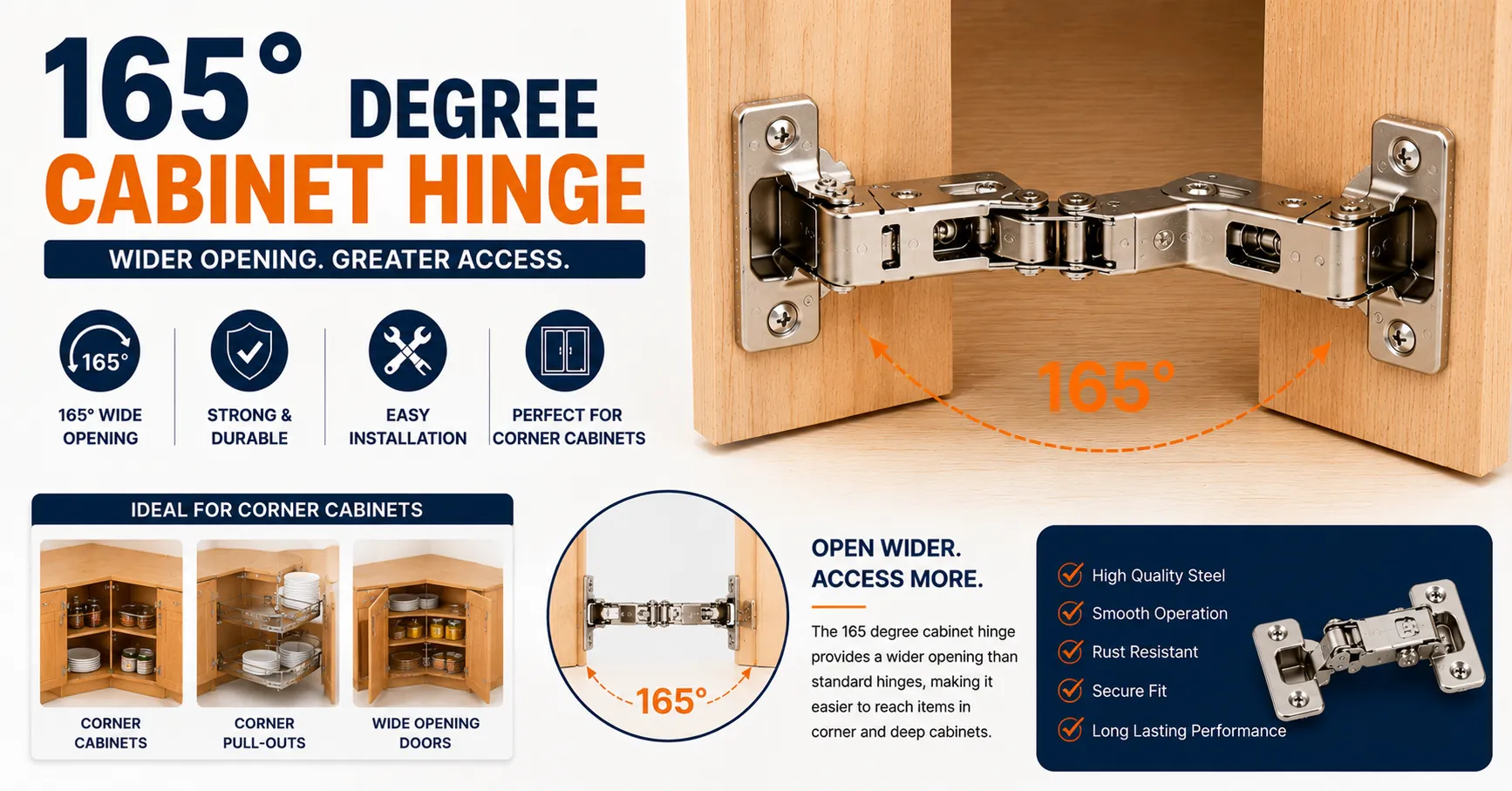
A 165 degree cabinet hinge is a wide-angle cabinet hinge designed to let a cabinet door open much farther than a standard hinge. This extra opening angle can make it easier to reach items stored inside corner cabinets, Lazy Susan units, pantry cabinets, wardrobes, and other storage furniture.
However, buying a 165-degree hinge is not simply about choosing the largest opening angle. The hinge must also match your cabinet’s construction, door thickness, overlay, cup diameter, cup depth, mounting plate, and installation pattern.
For example, many European-style concealed hinges use a 35 mm cup, while specific 165-degree models can have different drilling depths and door-thickness requirements. Therefore, measuring your existing hardware before purchasing a replacement is essential.
If you are replacing an existing hinge, start with our detailed guide on how to measure a cabinet hinge.
Who Needs a 165 Degree Cabinet Hinge?
A 165 degree cabinet hinge is ideal for anyone who needs extra-wide cabinet door access.
It can be particularly useful for:
- Corner kitchen cabinets
- Lazy Susan cabinets
- Pantry cabinets
- Tall storage cabinets
- Wardrobes
- Cabinets with adjacent doors
- Folding or bi-fold cabinet doors
- Modern frameless cabinets
- Storage areas where normal hinges restrict access
The wider opening allows the cabinet door to move farther away from the cabinet opening, making it easier to reach shelves and stored items.
If you only need a conventional cabinet opening, however, a standard hinge may be more practical and less expensive.
What to Check Before Buying
Before purchasing a 165 degree cabinet hinge, check these important specifications.
1. Opening Angle
Confirm that the product is actually designed for approximately 165 degrees of opening. Some manufacturers describe their products as wide-angle hinges, but the actual opening range can vary.
2. Cabinet Type
Determine whether your cabinet is frameless or face-frame. Many European concealed hinges are designed for frameless cabinets, while face-frame cabinets may require a different mounting arrangement.
3. Overlay
Overlay determines how much the cabinet door covers the cabinet frame or side panel.
If you are uncertain, read our guide on what is the overlay on a cabinet hinge.
4. Soft-Close Feature
If you want the door to close quietly and smoothly, choose a model with an integrated soft-close mechanism.
5. Mounting Style
Check whether the hinge uses a screw-on mounting plate, clip-on system, or another installation method.
6. Cup Configuration
Most European-style concealed hinges use a cup drilled into the back of the cabinet door. Make sure the replacement hinge matches your existing cup dimensions.
Important Measurements
Correct measurements are essential when choosing a replacement 165 degree cabinet hinge.
Hinge Cup Diameter
A 35 mm hinge cup is common for European concealed cabinet hinges. However, never assume your hinge uses 35 mm without checking.
Cup Depth
Measure how deep the hinge cup is drilled into the cabinet door. A mismatch can prevent the hinge from sitting correctly.
Door Thickness
Measure the thickness of your cabinet door. Different hinge models support different door thickness ranges.
Overlay
Measure how much the cabinet door overlaps the cabinet side or frame when closed.
Our guide on how to measure cabinet hinge overlay explains this measurement in more detail.
Mounting Plate
Check the mounting plate dimensions and screw-hole positions. A hinge cup can match perfectly while the mounting plate remains incompatible.
Hinge Position
If you are replacing multiple hinges, record the distance between hinges before removing them. Correct hinge placement helps distribute the door’s weight properly.
For more information, see our guide to cabinet door hinge placement.
Types of 165 Degree Cabinet Hinges
Not every 165-degree hinge is designed for exactly the same application.
1. 165 Degree Concealed Cabinet Hinge
A concealed hinge remains hidden when the cabinet door is closed. This is a popular option for modern kitchens and furniture because it provides a clean appearance.
2. 165 Degree Soft Close Hinge
This version incorporates a damping mechanism that slows the cabinet door before it closes completely.
Best for: Kitchens, bathrooms, bedrooms, and frequently used cabinets.
3. 165 Degree Lazy Susan Hinge
These hinges are designed for corner cabinet applications where wide opening is important.
Best for: Corner cabinets and Lazy Susan storage systems.
4. 165 Degree Full Overlay Hinge
A full-overlay version is designed for doors that cover most or all of the cabinet side when closed.
5. 165 Degree Bi-Fold Cabinet Hinge
Some specialized 165-degree systems are used with folding or bi-fold cabinet doors.
6. Adjustable 165 Degree Hinge
An adjustable hinge lets you fine-tune the cabinet door’s position after installation. This can help correct uneven gaps and alignment problems.
Which Type Fits Which Problem?
| Cabinet Problem | Best Hinge Type |
|---|---|
| Door needs to open wider | 165° wide-angle hinge |
| Corner cabinet is difficult to access | 165° Lazy Susan hinge |
| Door slams when closing | 165° soft-close hinge |
| Hardware should remain hidden | 165° concealed hinge |
| Door covers the cabinet side | Full-overlay hinge |
| Door uses a folding configuration | 165° bi-fold hinge |
| Door needs post-installation adjustment | Adjustable hinge |
| Existing European hinge needs replacement | Matching 165° concealed hinge |
If you are comparing opening angles, you can also explore our guides for 90 degree cabinet hinges, 135 degree cabinet hinges, 170 degree cabinet hinges, 180 degree cabinet hinges, and 270 degree cabinet hinges.
Top Recommended Options
1. 165 Degree Soft-Close Concealed Hinge
This is a strong choice for homeowners who want wide opening combined with smooth, quiet closing.
Best for: Modern kitchen and pantry cabinets.
Look for:
- 35 mm cup
- Adjustable mounting
- Integrated soft close
- Correct overlay
- Compatible door thickness
2. 165 Degree Lazy Susan Hinge
This option is particularly useful when the cabinet is positioned in a corner and normal door movement restricts access.
Best for: Corner cabinets and Lazy Susan configurations.
3. 165 Degree Full-Overlay Hinge
A full-overlay version is appropriate when the door covers the cabinet side or frame.
Best for: Frameless cabinets with full-overlay doors.
4. 165 Degree Adjustable Concealed Hinge
An adjustable version is useful when precise alignment is important.
Best for: DIY installations and replacement projects.
Comparison Table
| Feature | Standard 165° Hinge | 165° Soft-Close | 165° Lazy Susan | 165° Adjustable |
|---|---|---|---|---|
| Wide opening | Yes | Yes | Yes | Yes |
| Soft close | No/Model dependent | Yes | Model dependent | Model dependent |
| Corner cabinet | Good | Good | Excellent | Good |
| Door alignment | Basic | Adjustable on many models | Model dependent | Excellent |
| Installation | Moderate | Moderate | Specialized | Moderate |
| Best for | General wide access | Quiet closing | Corner storage | Precise alignment |
| Cost | Lower | Medium | Medium | Medium |
Always verify the manufacturer’s exact specifications because products with similar names can have different dimensions and mounting requirements.
Pros and Cons
Pros
- Provides a very wide cabinet-door opening
- Improves access to difficult storage areas
- Useful for corner and Lazy Susan cabinets
- Available with soft-close mechanisms
- Concealed designs create a clean appearance
- Adjustable versions make alignment easier
- Can be useful for kitchen, pantry, wardrobe, and storage cabinets
Cons
- More specialized than ordinary cabinet hinges
- May cost more than standard hinges
- Requires accurate measurements
- Not every 165° hinge fits every cabinet
- Incorrect overlay can cause installation problems
- Cup drilling must match the hinge
- Some models are designed for specific corner or folding applications
Buying Mistakes to Avoid
Mistake 1: Choosing Only by the 165° Rating
The opening angle is only one specification. Cup dimensions, overlay, mounting plate, and door thickness can be equally important.
Mistake 2: Ignoring Overlay
An incorrect overlay can leave the cabinet door too far inside or outside the cabinet opening.
Mistake 3: Not Measuring Door Thickness
A hinge designed for a different door thickness may not install correctly.
Mistake 4: Assuming All 165° Hinges Are the Same
Two 165-degree hinges can have completely different cup positions, mounting systems, and applications.
Mistake 5: Drilling Before Checking the Template
Do not drill new holes until you have confirmed the manufacturer’s required cup diameter, depth, and setback.
If drilling is necessary, read our guide on how to drill cabinet hinge holes.
Mistake 6: Forgetting Door Clearance
A 165° hinge allows a wide swing, but nearby walls, cabinets, handles, or appliances can still interfere with the door.
Mistake 7: Skipping Final Adjustment
After installation, adjust the hinge so the door sits level and the gaps are consistent.
Our cabinet door adjustment guide covers common alignment problems.
How to Install a 165 Degree Cabinet Hinge
If the new hinge matches the existing cup and mounting configuration, installation is relatively straightforward.
- Support the cabinet door.
- Remove the existing hinge.
- Measure and inspect the old hinge.
- Confirm the new hinge’s cup dimensions.
- Check overlay and mounting-plate compatibility.
- Position the hinge cup in the door.
- Attach the hinge to the mounting plate.
- Secure the mounting plate to the cabinet.
- Tighten the screws without overtightening.
- Open and close the door slowly.
- Adjust the hinge until the gaps are even.
- Test the complete 165-degree opening.
If your existing hardware is old, our guide on how to adjust old cabinet door hinges can also help.
Amazon Product Links
For your website, I recommend linking to Amazon search pages unless you have personally verified a specific product listing. This reduces the risk of publishing a dead or unavailable product URL.
165 Degree Cabinet Hinge
Shop 165 Degree Cabinet Hinges on Amazon
165 Degree Soft-Close Cabinet Hinge
Shop 165 Degree Soft-Close Cabinet Hinges on Amazon
165 Degree Lazy Susan Hinge
Shop 165 Degree Lazy Susan Cabinet Hinges on Amazon
165 Degree Concealed Hinge
Shop 165 Degree Concealed Hinges on Amazon
Affiliate-link tip: If you participate in Amazon Associates, replace these search links with your approved affiliate links and add the appropriate disclosure required by Amazon.
FAQ
Q: What is a 165 degree cabinet hinge?
A: A 165 degree cabinet hinge is a wide-angle hinge designed to allow a cabinet door to open approximately 165 degrees. It is useful when greater access to the cabinet interior is needed.
Q: Are 165 degree hinges good for corner cabinets?
A: Yes. They can be especially useful for corner and Lazy Susan cabinets because the wider opening can improve access to the storage area.
Q: Are all 165 degree hinges soft close?
A: No. Some 165-degree hinges have integrated soft-close mechanisms, while others do not.
Q: What size cup does a 165 degree concealed hinge use?
A: Many European concealed hinges use a 35 mm cup, but you should always verify the product’s specifications before drilling or ordering.
Q: Can I replace my existing hinge with a 165 degree hinge?
A: Potentially. The new hinge must match the cabinet’s door thickness, overlay, cup dimensions, mounting plate, and cabinet construction.
Q: Is a 165 degree hinge better than a 110 degree hinge?
A: Neither is universally better. A 165-degree hinge is preferable when you need a wider opening. A conventional hinge can be better when normal door movement provides sufficient access.
Q: How do I measure for a replacement hinge?
A: Measure the existing hinge cup, cup depth, door thickness, overlay, mounting plate, and screw-hole positions. Our cabinet hinge measurement guide provides a useful starting point.
Final Thought
A 165 degree cabinet hinge is a practical solution when standard cabinet hinges do not provide enough door clearance. The wider opening can significantly improve access to corner cabinets, Lazy Susan storage, pantry units, and other difficult-to-reach spaces.
However, do not purchase a hinge based solely on its 165-degree opening angle. Measure first, check the overlay, confirm the cup dimensions, verify door thickness, and make sure the mounting system matches your cabinet.
For homeowners who want quieter operation, a 165-degree soft-close hinge is usually worth considering. For corner storage, a specialized Lazy Susan hinge may be more appropriate.
The best hinge is ultimately the one that matches your cabinet’s exact construction and measurements—not simply the one with the highest opening angle.